

2 📋 What does the online menu show? Understand dish photos, prices and descriptions
From the appearance of dishes to set meal contents, help customers understand the menu before choosing
The photos, names, prices and descriptions in the online menu each help customers understand different information about a dish. This article explains the purpose of these details and how specifications, portion sizes and set meal contents should be expressed, helping merchants organize clear WeiCity dish displays so customers can compare and choose more easily.
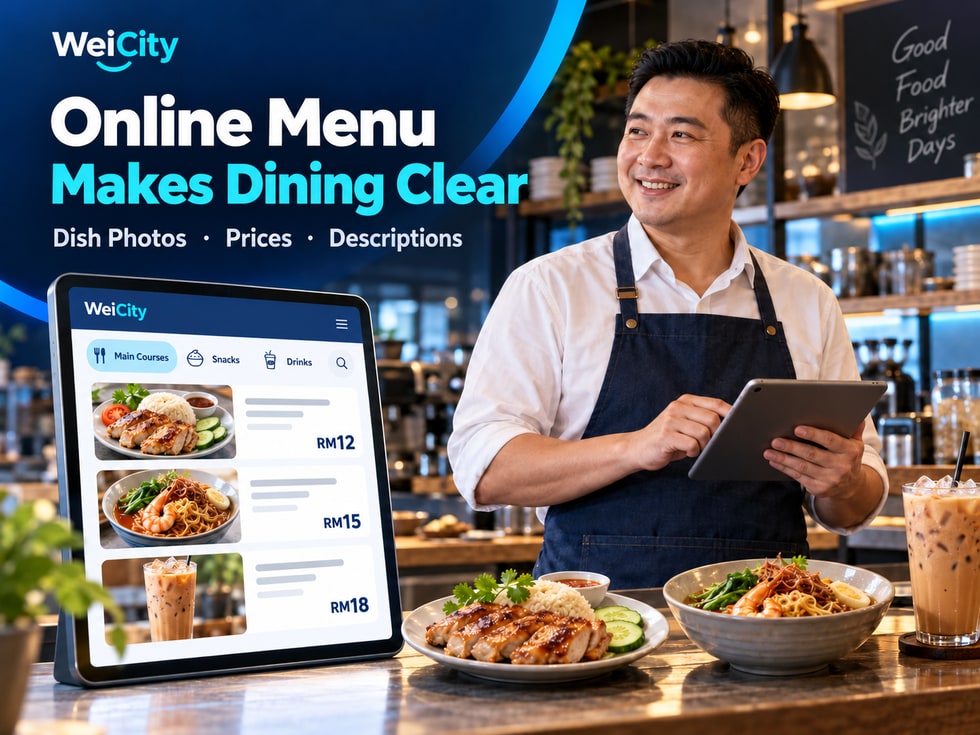
What do customers usually look at first when opening an online menu?
📷 Are the dish photos appealing?
🏷️ Are the dish names easy to understand?
💰 Are the prices clear?
📝 Is the dish description complete?
🍱 What foods are included in the set?
🌶️ Are there flavor or add-on options?
For restaurants, cafés, bakeries, and other food and beverage merchants, a clear online menu is more than just putting dish names and prices on a webpage.
A good online menu should let customers see what the food looks like through photos, recognize dishes by their names, compare options by price, and confirm the actual contents through descriptions.
When organizing an online menu on WeiCity, merchants can gradually improve the display information for each dish by focusing on the questions customers care about most.
This article introduces how to organize dish photos, names, prices, descriptions, portion sizes, sets, and optional items to help merchants build a clearer and more practical online menu.
Specific dish editing, specifications, add-ons, and Online Ordering features are subject to WeiCity's current pages and your actual merchant settings.
When ordering online, customers cannot see the actual dish directly.
Therefore, dish photos are an important way to help customers understand the product.
For example:
🍛 A plate of curry chicken rice.
🍜 A bowl of Penang Hokkien mee.
🍔 A chicken burger.
🥐 A croissant.
☕ A glass of iced latte.
Photos should show the food you actually serve as closely as possible, rather than making the food look noticeably different from what customers will receive.
The photo should let customers see at a glance what is being sold.
For example:
When photographing chicken chop rice, the chicken chop, white rice, and main side dishes should be clearly visible.
Avoid:
❌ The dish is too small.
❌ The background is too busy.
❌ The food is blocked by decorations.
Lighting affects food color and detail.
Recommendations:
☀️ Use natural light whenever possible.
📷 Avoid photos that are too dark.
🎨 Keep food colors natural.
🔍 Make the main ingredients clearly visible.
Heavy photo editing is not necessary.
For example:
Product name:
Pan-fried chicken chop rice
The photo shows:
🍗 Chicken chop.
🍚 Steamed rice.
🥗 Vegetables.
🥤 A drink.
If the drink is not included in the selling price, this must be stated clearly.
Otherwise, customers may assume that everything in the photo will be provided together.
You can choose an angle based on the type of dish.
🍛 Rice dishes: suitable for showing the overall combination.
🍔 Burgers: suitable for showing layers and fillings.
🥐 Bread: suitable for showing the exterior and interior texture.
🥤 Drinks: suitable for showing cup types and capacity.
Do not use exaggerated camera angles to make an ordinary meal look noticeably larger than the actual serving.
📌 The key purpose of meal photos is to let customers clearly see what the food looks like, not just to make the photo look attractive.
Meal names should be easy for customers to recognize.
Distinctive names may be kept, but it is best to also state the actual contents of the meal.
Signature No. 1.
Classic Set.
Special Recommendation.
Light Meal Choice.
🍗 Signature Roast Chicken Rice.
🍜 Curry Noodle Set.
🥪 Chicken Sandwich Set.
🥗 Pan-Seared Chicken Breast Salad.
Original name:
“Signature Rice”
Recommendations:
Signature Pan-Fried Chicken Leg Rice
Original name:
“Special Noodles”
Recommendations:
Penang Curry Chicken Noodles
Original name:
“Healthy Light Meal”
Recommendations:
Chicken and Vegetable Sandwich
Original name:
“Chocolate Cake”
If the product has a clear specification, you may write:
6-inch Chocolate Birthday Cake
No.
Names should, as far as possible:
🏷️ Be easy to recognize.
🍽️ Be clear about the contents.
📱 Display clearly on mobile phones.
🔎 Be easy for customers to find.
If the restaurant serves both Chinese- and English-speaking customers, bilingual names may be used as needed.
For example:
Pan-Fried Chicken Chop Rice | Grilled Chicken Chop Rice
Iced Latte | Iced Latte
Chicken Sandwich | Chicken Sandwich
Note that the Chinese and English names should refer to the same meal.
Do not write chicken in Chinese and beef in English.
📌 Meal names do not need to be complicated; the most important thing is that customers can quickly tell what they are choosing.
When customers view the online menu, price is usually an important basis for their choice.
However, a price is more than just a number.
Merchants also need to explain:
What meal, specification and contents this price corresponds to.
For example:
🍛 Pan-fried chicken chop rice: RM15.
Indicates the selling price of a specified meal.
For example:
🥤 Iced Lemon Tea Small: RM5.
🥤 Iced Lemon Tea Large: RM7.
For example:
🥚 Add egg: RM2.
🧀 Add cheese: RM3.
🍚 Extra rice: RM2.
For example:
🍔 Chicken Burger Set: RM18.
If it is called a set meal, further explain what it includes.
For example:
🍔 One chicken burger.
🍟 One portion of fries.
🥤 One cup of a specified drink.
For example:
Chicken Rice RM12
versus:
Chicken Rice Set RM12
May represent different contents.
If you use the name "Set", it is recommended to list the items actually included.
Assumed:
🍛 Chicken Chop Rice: RM15.
🥚 Add egg: RM2.
🧀 Add cheese: RM3.
Then:
Meal amount = RM15 + RM2 + RM3 = RM20.
The above is only an example of price explanation.
The actual amount should be calculated based on the selling price, options set by the merchant, and the current checkout page.
✅ Selling prices are accurate.
✅ Specifications correspond correctly.
✅ Add-on fees are clear.
✅ Set meal contents are clear.
✅ Prices are updated promptly after adjustment.
📌 The clearer the price information, the easier it is for customers to compare meals, and the fewer questions arise at checkout.
Images can show the appearance of the food.
However, some information cannot be explained by images alone.
For example:
🌶️ Is it spicy?
🍗 What are the main ingredients?
🔥 How is it cooked?
🍚 Does it come with white rice?
🥗 Does it come with side dishes?
Therefore, meal descriptions should include information that customers need to know when choosing.
For example:
Chicken leg meat.
Steamed rice.
Seasonal vegetables.
Black pepper sauce.
For example:
Mildly spicy.
Sweet and sour.
Rich and aromatic.
Light.
For example:
Pan-fried.
Baked.
Steamed.
Stewed.
Deep-fried.
For example:
Steamed rice.
Vegetables.
Sauces.
Soup.
“Delicious and worth a try.”
Pan-fried chicken leg served with white rice, seasonal vegetables and black pepper sauce, suitable for customers who enjoy rich, sauce-based flavors.
Penang Curry Chicken Noodles
Curry broth paired with noodles, chicken and specified toppings, with a rich flavor, suitable for customers who like curry flavors.
Actual ingredients and toppings should be filled in according to what the merchant supplies.
Chicken and Vegetable Sandwich
Bread with chicken, lettuce and specified sauce, suitable as breakfast or a light meal.
Iced Latte
Made with espresso, milk and ice, with coffee and milky aromas.
Not necessarily.
Usually you only need to answer:
🍽️ What is this?
🥘 What does it mainly include?
🌶️ What are the flavor characteristics?
📦 Does it include other accompaniments?
📌 A good meal description does not rely on many adjectives, but helps customers understand the actual contents served.
When ordering online, customers may not know how big a meal is.
Especially:
🍗 Fried chicken.
🍱 Sharing Sets.
🥐 Baked Goods.
🎂 Cakes.
🥤 Drinks.
Stating portion sizes appropriately helps customers judge how much to buy.
For example:
Pan-fried chicken chop rice
Includes:
🍗 One chicken chop.
🍚 One portion of white rice.
🥗 Designated side dish.
For example:
Family Sharing Set
Suitable for 3 to 4 people.
Also state what is actually included:
🍗 8 pieces of fried chicken.
🍟 2 portions of fries.
🥤 4 cups of a specified drink.
For example:
🍗 6 chicken wings.
🥪 2 sandwiches.
🥐 4 croissants.
🥧 6 egg tarts.
For example:
🥤 350ml.
🥤 500ml.
🥤 700ml.
For example:
🎂 6-inch.
🎂 8-inch.
If a suggested number of diners is provided, state that it is for reference only.
Different customers may have different appetites.
Therefore, you can use:
🔢 Piece counts.
📏 Dimensions.
🥤 Volume.
🍽️ Actual included contents.
For items described, it is recommended to be as specific as possible.
📌 The clearer the portion information, the easier it is for customers to judge how much to buy.
Set meals are a common way of selling in restaurant menus.
For example:
🍔 Burger set.
🍛 Lunch Set.
🍱 Family Set.
☕ Coffee Breakfast Set.
However, the name of a set meal itself does not necessarily explain all of its contents.
Chicken burger set meal | RM18
Includes:
🍔 1 chicken burger.
🍟 1 portion of fries.
🥤 1 cup of designated drink.
Pan-Fried Chicken Chop Lunch Set | RM20
Includes:
🍗 Pan-fried chicken chop.
🍚 Steamed rice.
🥗 Designated side dish.
🥤 Designated drink.
The above is a hypothetical set meal content and price.
🍽️ What the main meal is.
🥗 What the side dishes include.
🥤 Whether a drink is included.
🔢 The quantity of each item.
💰 Which replacements or upgrades require an extra charge.
For example:
The image shows:
🍔 Burger.
🍟 French fries.
🥤 Drinks.
But the actual selling price only includes the burger.
In such cases, this should be clearly explained in the image or product description to avoid customer misunderstanding.
For example:
The drink may be replaced with another specified option.
Should specify:
🥤 Which drinks can be selected.
💰 Whether an extra fee applies.
📋 Whether there are other restrictions.
📌 A set meal should let customers see at a glance what is included, rather than only seeing a set name and price.
Different dishes may offer different choices.
For example:
🌶️ Spice level.
🍚 Portion size.
🥚 Add egg.
🧀 Add cheese.
🥤 Drink size.
These options can help customers choose the dish they need.
However, merchants should make clear:
which items are already included in the original price, and which require an extra charge.
Base dish:
🍗 Chicken chop.
🍚 Steamed rice.
🥗 Side dish.
Optional add-ons:
🥚 Add egg: RM2.
🧀 Add cheese: RM3.
🍚 Extra rice: RM2.
Flavor options:
🌶️ Not spicy.
🌶️ Mildly spicy.
🌶️🌶️ Medium spicy.
Actual options should be set according to the preparation methods the merchant can provide.
Size options:
🥤 Small cup.
🥤 Large cup.
If different sizes have different prices, this should be clearly displayed.
For example:
The original set includes a designated drink.
If substitution is allowed, explain:
🥤 What can be substituted.
💰 Whether there is an extra charge.
For example:
A customer writes in the remarks:
"No peanuts."
but the merchant has not confirmed whether this can be met.
In this case, a special request should not be assumed to be guaranteed.
For food allergies, dietary restrictions or special preparation requirements, customers should contact the merchant before placing an order to confirm whether the ingredients and preparation process meet their needs.
Merchants should also avoid making inappropriate guarantees when the risk of cross-contact cannot be confirmed.
📌 Dish options should clearly state what can be chosen, whether there is a charge, and which requests need separate confirmation from the merchant.
After the dish information is ready, you also need to consider menu categories.
Sensible categories help customers find the food they want more quickly.
For example:
🍚 Chicken rice.
🍜 Noodles.
🍝 Pasta.
🍛 Curry rice.
For example:
🍗 Fried chicken.
🍟 French fries.
🥟 Dumplings.
For example:
☕ Coffee.
🍵 Tea drinks.
🥤 Fruit juice.
For example:
🍰 Cake.
🍮 Pudding.
🥐 Bread.
For example:
🍔 Burger set.
🍱 Lunch set.
👨👩👧👦 Family sets.
Not necessarily.
If a restaurant has only a dozen or so dishes, a simpler category structure can be used.
If it offers several dozen dishes, the categories can be organized further.
For example:
When the same dish appears in several similar categories, customers may mistake it for different products.
📌 The key purpose of menu categories is to help customers find dishes, not to add unnecessary levels.
When organizing an online menu, merchants also need to pay attention to how images are displayed.
For example:
4:3.
1:1.
The actual choice should be based on the current dish image display area on WeiCity.
If the page uses a uniform proportion, it is recommended to keep images as consistent as possible.
When cropping, avoid:
❌ Cutting off the food.
❌ Losing important side dishes.
❌ Showing an incomplete set meal.
Images should be clear enough for customers to recognize the details of the food.
Oversized images may affect page loading speed.
It is recommended to use a file size suitable for web display while retaining the necessary clarity.
Avoid over-adjusting:
🌈 Saturation.
☀️ Brightness.
🎨 Color.
so that the food looks very different from what is actually served.
Confirm:
🍽️ The main dish is complete.
📷 The image is not noticeably blurry.
📏 The cropping is reasonable.
📌 Images do not need to be especially complex; clear, realistic and consistent proportions matter more.
Different types of food and beverage businesses have different key points to present.
Recommended key information:
🍛 Main dishes.
🥗 Side dish.
🥤 Drinks.
🎁 Set meals.
Recommended key information:
☕ Coffee type.
🥤 Hot and cold options.
🥐 Desserts.
🥪 Light meals.
Recommended key information:
🥖 Types of bread.
🥐 Flavors.
🔢 Piece counts.
📅 Reservation requirements.
Recommended key information:
🎂 Cake sizes.
🍫 Flavor.
🎨 Design.
📅 Estimated preparation time.
Recommended key information:
🍚 Staple foods.
🍗 Main dish.
🥗 Side dish.
🔢 Ordering quantity.
📅 Pre-order and pickup arrangements.
Recommended key information:
🥤 Cup size.
🧊 Hot or iced.
🍯 Sweetness.
🧩 Optional add-ons.
Because customers may care about different things when choosing food.
For example:
When buying coffee, customers may pay more attention to volume and whether it is hot or cold.
When buying a cake, customers may pay more attention to size and pre-order time.
When buying bento, customers may pay more attention to side dishes and order quantity.
📌 Menu content should be organized according to the actual type of food or beverage business, so customers see the information they really need.
The following is a hypothetical example for explaining menu information.
Pan-Fried Chicken Chop Rice.
RM15 / portion.
Showcases:
🍗 Pan-fried chicken chop.
🍚 Steamed rice.
🥗 Side dish.
Pan-fried chicken leg served with white rice, seasonal vegetables and black pepper sauce, suitable for customers who enjoy rich, sauce-based flavors.
🍗 One chicken chop.
🍚 One portion of white rice.
🥗 Designated side dish.
🥚 Add egg: RM2.
🧀 Add cheese: RM3.
🍚 Extra rice: RM2.
Fill in according to the options the merchant actually offers.
Fill in according to the actual serving periods.
Explain according to the methods the merchant actually provides.
Because customers can clearly see:
🍽️ What they are buying.
📷 What the dish looks like.
💰 How much they need to pay.
🍚 What is included.
🧩 What else they can choose.
📅 When they can order.
📌 Complete dish information can reduce customer questions about contents, prices and pairings.
An online menu is not something that only needs to be published once and never changed.
Restaurants may adjust dishes due to ingredients, prices or business arrangements.
For example:
Grilled chicken rice changes from RM15 to RM16.
Check whether the related price information is consistent.
For example:
Originally included a specified vegetable.
Later changed to another side dish.
If it is a fixed pairing, update the description and any necessary images.
For example:
Originally included a drink.
Later no longer included.
Update the set meal information promptly.
If an item is temporarily unavailable, update its availability status or related notes according to the actual page functions.
For example:
Lunch serving hours are adjusted.
Update the related information in the menu.
If the dish's appearance or pairing has clearly changed, it is recommended to update the photo.
For example:
The price has been changed.
But the product description still shows the old price.
This may cause customer confusion.
📌 When adjusting the menu, check the images, names, prices, descriptions and actual served contents together.
Dish names and descriptions help customers understand the food, and can also help search engines more easily understand the page topic.
However, whether a page is indexed by Google and how it ranks also depends on platform technical settings, accessibility, content quality and other factors.
For example:
Penang Curry Chicken Noodles
Compare:
"Signature Noodles"
more clearly explains the type of dish.
For example:
Main ingredients.
Flavors.
Cooking method.
Served with meals.
Photos should match the food actually served.
For example:
🏪 Restaurant name.
📍 Address.
🕒 Opening hours.
📞 Contact information.
Avoid product information that does not match actual sales conditions.
Make sure customers can read the menu clearly.
For example:
"Best curry noodles in Penang, recommended curry noodles in Penang, number one curry noodles in Penang..."
Without a factual basis, this kind of wording may lower content quality.
Use natural, genuine dish descriptions instead.
📌 Clear menu information primarily helps customers, and also helps search engines understand dish content, but it does not guarantee search rankings.
It is recommended to provide clear, genuine dish photos to help customers understand how the food looks.
Use names that are easy to understand, and try to describe the main dish contents.
If rendered or illustrative images are used, this should be explained appropriately, so customers do not mistake them for a complete representation of what is actually served.
Not necessarily.
The key is to explain the main ingredients, flavors, pairings and other important information.
It is recommended to list the actual items included so that customers understand what the set price covers.
Whether different specifications and their corresponding prices are supported depends on the current dish setting features of WeiCity.
Whether add-on options and extra charges are supported depends on the current features.
You can provide the number of pieces, size, volume, or main contents based on the actual product.
You can prepare bilingual information as needed, but make sure the content is consistent.
Related information should be updated promptly to prevent customers from seeing outdated prices.
The product description should clearly state that the drink is not included in the selling price.
Arrange categories according to the actual number and types of dishes; do not add categories just for the sake of having more.
Update the availability status or related notes based on the features currently supported on the page.
Check the image ratio, cropping method, and text length, and adjust them according to the editing features actually available.
Clear dish names and descriptions help search engines understand page content, but indexing or ranking is not guaranteed.
📌 The key to menu information is to help customers accurately understand the dishes, rather than simply adding more images and text.
✅ Images are clear.
✅ The main subject is complete.
✅ The colors look natural.
✅ Pairings match actual supply.
✅ The name is easy to understand.
✅ The main contents are clear.
✅ Chinese and English information is consistent.
✅ The base selling price is accurate.
✅ Prices for different specifications are correct.
✅ Add-on fees are clear.
✅ The main ingredients are complete.
✅ Flavor descriptions are clear.
✅ The cooking method is accurate.
✅ Accompaniments included with the meal are clear.
✅ The number of pieces is correct.
✅ The size is clear.
✅ The volume is accurate.
✅ The suggested number of people is reasonable.
✅ The main dish is correct.
✅ Side dishes are clear.
✅ It is clearly stated whether a drink is included.
✅ The set meal image matches the actual contents.
✅ Flavor choices are correct.
✅ Add-on items are clear.
✅ Extra charges are accurate.
✅ Substitution conditions are clear.
✅ Categories are easy to understand.
✅ Dishes are placed in appropriate positions.
✅ There are no unnecessary duplicate items.
✅ Images are complete.
✅ Names are easy to read.
✅ Prices are easy to find.
✅ Descriptions are clearly laid out.
✅ Price changes are updated promptly.
✅ Changes to side dishes are reflected at the same time.
✅ Set meal contents remain accurate.
✅ Availability matches actual supply.
📌 Reviewing everything once before publishing can help merchants reduce menu errors and make it easier for customers to choose dishes.
A clear online menu requires images and text to work together.
📷 Dish Images: Help customers understand what the food looks like.
🏷️ Dish Names: Help customers identify products.
💰 Dish Prices: Help customers compare and choose.
📝 Dish Descriptions: Explain the main ingredients, flavors, and pairings.
📏 Portion Information: Helps customers judge how much to order.
🎁 Set Meal Contents: Explain which items are included in the selling price.
🧩 Optional Items: Let customers understand flavors, specifications, and add-ons.
📂 Menu Categories: Help customers find the dishes they want more quickly.
📱 Mobile Display: Make it easier for customers to read while browsing.
🔄 Information Updates: Keep the menu consistent with actual supply.
The value of a WeiCity online menu lies not only in putting dishes on a web page for merchants, but in helping customers understand the food they are about to order through clear images, names, prices, and descriptions.
For customers:
🍽️ Clear to see, easier to choose.
💰 Clear prices, easier to compare.
📝 Complete content, easier to judge whether it meets your needs.
For merchants:
📷 Accurate images can reduce customer misunderstandings.
🏷️ Clear names make order checking easier.
💰 Complete prices can reduce questions about charges.
📦 Clear portion information can reduce disputes over dish contents.
🔄 Timely information updates keep the menu better aligned with actual business conditions.
📷 Show dishes with images.
🏷️ Explain contents with names.
💰 Help comparison with prices.
📝 Add details with descriptions.
🍽️ Make the menu easier to understand and easier for customers to choose dishes that suit them.
Start with each dish: organize images, names, prices, descriptions, and portion information clearly, so the WeiCity online menu becomes a practical entry point for customers to learn about dishes and proceed to the ordering process.
Specific menu editing, image display, dish specifications, add-ons, set meals, and ordering features depend on the current WeiCity pages, merchant settings, and services activated.
👉 Open WeiCity: https://wei.city/