

72 How Corporate Uniform and Workwear Merchants Can Use WeiCity: From Style Showcase to Bulk Orders
Showcase garment styles, fabrics, sizing, and the customization process in one place, making it easier for corporate customers to compare options and request quotes.
How can uniform stores, workwear suppliers, and group apparel customization merchants use WeiCity? Build a channel that makes it easy for businesses to browse styles, submit requirements, and contact you through garment categories, fabric and sizing information, embroidery and printing examples, and bulk quotation guidance.
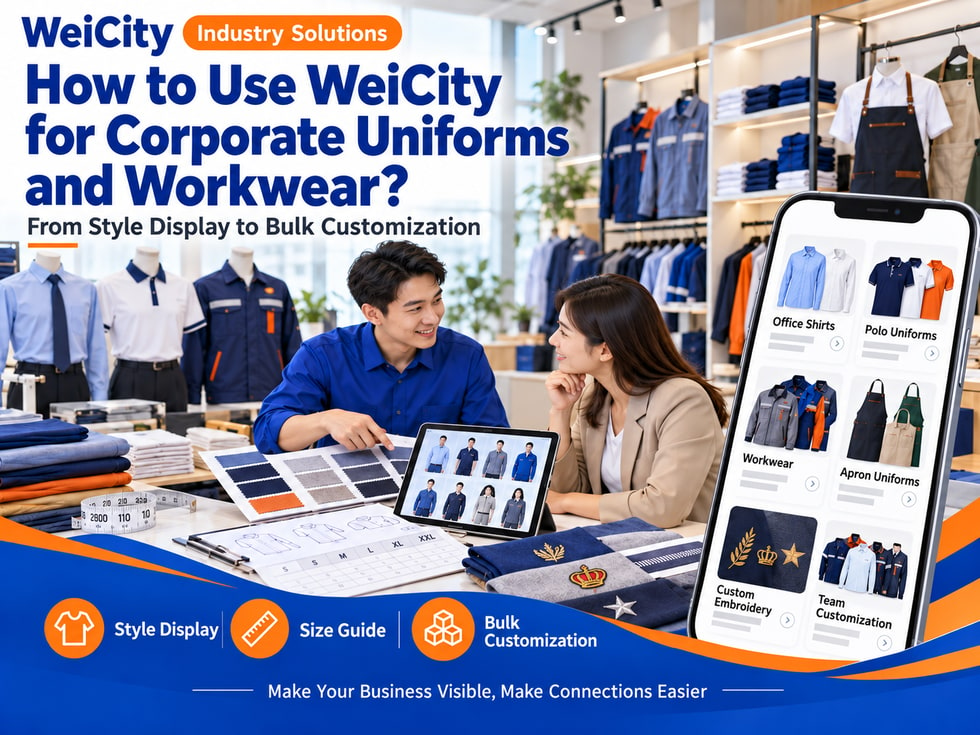
From Style Display to Bulk Custom Orders
“Can you make custom company uniforms?”
“Does this style come in different colors and sizes?”
“Can a company logo be embroidered on the chest?”
“How long does it take to make a batch?”
“Can I see sample garments and fabric first?”
When companies purchase uniforms, they need to confirm not only the style but also the fabric, sizes, colors, logo production method, order quantity and delivery time.
💡 With WeiCity, you can set up your own uniform customization channel, organizing garment styles, specifications and ordering steps so business customers can first understand their options and then contact you to confirm specific requirements.
✅ Corporate uniform suppliers
Display office, store and team uniform styles.
✅ Workwear merchants
Introduce the workwear and industry styles you actually supply.
✅ Group clothing custom merchants
Explain group wear, activity wear and bulk ordering methods.
✅ Embroidery and garment printing service providers
Display the logo production and garment processing services you actually provide.
✅ School uniform and institutional clothing suppliers
Introduce styles, sizes, ordering and restocking arrangements.
✅ Uniform design and styling teams
If provided, you may introduce style suggestions and your communication process with companies.
📌 Based on the products and processing services you actually offer, clearly distinguish between ready-made stock, custom orders and contract manufacturing projects.
You can organize by use:
🔹 Office uniforms
Display shirts, tops, trousers or other styles you actually offer.
🔹 Store and service industry uniforms
Categorize by job role or garment type.
🔹 Workwear and work clothing
Introduce suitable settings, styles and fabric information.
🔹 Group activity wear
Display group wear, activity T-shirts and related custom options.
🔹 School uniforms and institutional clothing
Explain the styles, sizes and purchasing methods you actually supply.
🔹 Outerwear and accessories
Organize aprons, jackets, hats or other matching garments.
💡 The same style in different colors or cuts can be placed in one series to make comparison easier for customers.
Recommended to specify:
✅ Style names and item numbers
✅ Available colors and sizes
✅ Fabric composition and care instructions
✅ Men's, women's or fit information (if applicable)
✅ Pockets, buttons and other style details
✅ Ready-made or custom status
✅ Whether logos can be printed or embroidered
✅ Minimum order quantity (if any)
✅ Sales unit for each garment
✅ How samples and fabrics can be viewed
🔶 Example: Custom company shirt instructions
Style: State the style number and available colors.
Size: Provide the actual size chart.
Fabric: List composition and care methods according to product information.
Logo: Explain the embroidery or print position and file requirements.
Ordering: Provide sizes, quantities and delivery location to request a quote.
Samples: Contact the merchant to confirm whether samples can be viewed or tried on.
📌 Sizes and fits may differ between styles, so customers should check against the corresponding size chart.
You may specify:
🔹 Chest, shoulder width, garment length or other measurement points in the size chart
🔹 Units used in the size chart
🔹 Product information on whether the fit is loose or slim
🔹 Whether sample garments or fitting arrangements are available
🔹 Group measurement and size collection methods
🔹 Whether special sizes can be custom made
🔹 How to verify the original style and size when reordering
💡 Companies can first collect employee sizes, then have the merchant confirm the size chart and ordering method.
📌 Size standards may differ between suppliers, so do not directly compare them with sizes from other brands.
If you actually provide embroidery or printing services, you can explain:
✅ Where the logo can be placed
✅ Accepted file formats
✅ Embroidery or printing methods
✅ How colors and sizes are confirmed
✅ Whether a design draft must be confirmed first
✅ How the processing fee per garment is calculated
✅ Whether there is a minimum quantity requirement
✅ How production time is estimated
🔶 For example:
“Please provide your company logo files, garment styles, quantities and preferred placement, and we will confirm the production method, mockup and quote.”
📌 Logo colors, details and final appearance may vary depending on the fabric and processing method, so check the mockup before production.
It is recommended to prepare:
🔹 Front and back photos of garments
Show the style, cut and overall appearance.
🔹 Close-up fabric photos
Help customers understand texture and thickness.
🔹 Size and detail photos
Show pockets, collars, cuffs and closures.
🔹 Logo processing examples
Show the actual results of embroidery or printing.
🔹 Photos from different work settings
Show how garments are worn in stores, offices or teams.
🔹 Packaging and delivery photos
Where applicable, show how bulk orders are packed and organized.
📌 Obtain authorization before publishing client logos, employee photos or uniform project examples.
1️⃣ Garment type and reference style
Explain whether they want custom shirts, T-shirts, jackets or other garments.
2️⃣ Order quantity
Estimate separately by style, color and size.
3️⃣ Color and fabric requirements
Provide preferred colors or an existing uniform for reference.
4️⃣ Logo and processing requirements
Provide the company logo and preferred placement.
5️⃣ Employee size information
Organize according to the size chart provided by the merchant.
6️⃣ Delivery location and preferred date
Helps confirm production and delivery arrangements.
📌 After quantities, sizes and logo content are confirmed, review the formal quote and delivery time.
Recommended to specify:
✅ Whether pricing is based on style, quantity or processing method
✅ Whether fabric or color changes affect the price
✅ Whether embroidery, printing and samples are charged separately
✅ Whether there is a minimum order quantity
✅ Deposit and balance payment arrangements
✅ How production begins after sample approval
✅ How the estimated production time is confirmed
✅ How additional orders, style changes or size replacements are handled
✅ Whether delivery fees are charged separately
🔶 For example:
“Custom fees will be confirmed based on style, fabric, quantity, size and logo processing method. Please provide your requirement list and desired delivery date, and we will reply with the quote and production arrangements.”
📌 Production time is affected by quantity, materials, design confirmation and supply conditions, and the merchant's final reply shall prevail.
You may specify:
🔹 How to look up the original style and color for future reorders
🔹 Whether style numbers or order records need to be kept
🔹 Conditions for size exchanges
🔹 How to contact the merchant if there is a quantity or processing issue
🔹 Alteration and return or exchange arrangements for custom garments
🔹 How to recheck fabric and logo files
💡 Businesses are advised to keep style numbers, color codes, size lists and logo files to make future reorder communication easier.
📌 Changes and return or exchange arrangements for custom garments should be explained according to the merchant's actual policies.
🔹 About Us
Introduce the merchant, service areas and business scope.
🔹 Uniform styles
Categorize by office, service industry and workwear.
🔹 Fabric and sizing
Organize material information, size charts and fitting arrangements.
🔹 Embroidery and printing
Display processing methods, positions and file requirements.
🔹 Corporate bulk custom orders
Explain the information needed for quote requests and the ordering process.
🔹 Case showcase
Publish authorized uniform and team clothing examples.
🔹 Reorders and after-sales service
Explain order records, alterations and future purchasing methods.
💡 When you are just getting started, you can first add your main styles, size chart, customization process and contact details, then gradually add production examples.
🔶 Customer asks: "Can you make custom uniforms for our company?"
You can reply:
"Hello, here you can find our uniform styles and customization details. Please share your preferred style, quantity, color and delivery date, and we will confirm the plan and quote for you."
🔶 Customer asks: "Can you embroider our company logo?"
You can reply:
"Please first provide the logo file, the garment style and your preferred placement. We will confirm the production method and design proof, then reply with the fees and production time."
🔶 Customer asks: "We have many employees with different sizes. How do we place an order?"
You can reply:
"We can help organize the orders according to the size chart provided by the merchant. Please first tell us the style, color and approximate quantity, and we will confirm how to collect sizes and place the order."
1️⃣ Basic merchant information
Name, address, business hours, and contact information.
2️⃣ Uniform and Workwear Categories
Organize common styles, uses and customization options.
3️⃣ Fabric and Size Information
Prepare the size chart, colors and care instructions.
4️⃣ Logo Production Examples
Showcase embroidery or printing results and obtain customer authorization.
5️⃣ Corporate Quotation Guide
Tell customers which information to provide so that a quotation can begin.
✅ Do the styles and product photos match?
✅ Are the fabric, color and size information accurate?
✅ Are ready-made items and custom orders clearly distinguished?
✅ Are logo production fees and methods explained?
✅ How are minimum quantities and lead times confirmed?
✅ Has authorization been obtained for client information in the examples?
✅ Are reorder and after-sales arrangements clear?
✅ Are the contact details correct?
After organizing uniform styles, size information and a bulk quotation guide in your channel, you can use it for everyday replies, corporate purchasing communication and new style displays.
Customers can browse the clothing collection first, then provide quantities, sizes and logo requirements; merchants can use this to continue confirming fabrics, quotes and delivery arrangements.
Want to learn how to set up a corporate uniform merchant channel?
Feel free to contact us through the official WeiCity channel contact methods, and we can work together to organize display content suited to your store or team.
WeiCity
Make your business visible and contact easier.