

6 🛒 From Viewing Products to Ordering, How Can You Make the Experience Smoother for Customers?
Connect product entry points, purchase details, and ordering instructions so interested customers can more easily find products, confirm their choices, and complete purchases.
After seeing a product they like, customers also need to know where to buy it, how to choose, and what to confirm before ordering. By presenting products centrally in the WeiCity Shop and pairing them with clear product links, purchase instructions, and pickup information, merchants can reduce the steps customers take to find information and give every product recommendation a clear next step.
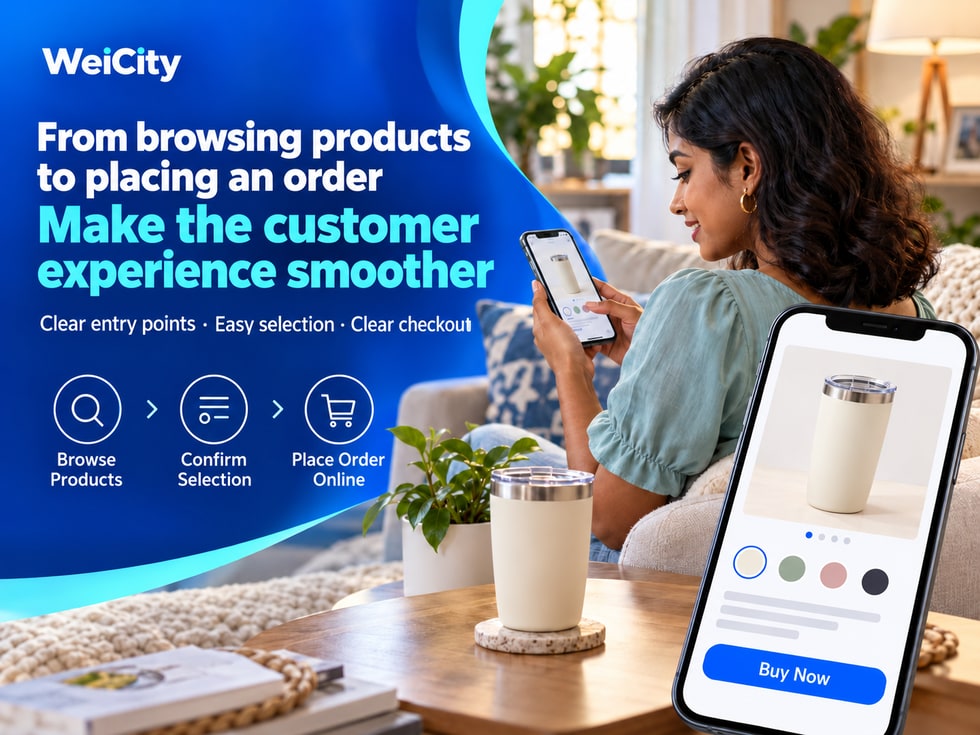
You posted a product photo, the customer likes it and is ready to learn more.
But if the price is hidden in another post, sizes must be asked about by private message, and the purchase entry is hard to find, the customer has to spend time piecing the information together one item at a time.
Each unclear point in the purchase process is one more chance for the customer to stop and ask questions or hesitate.
WeiCity Shop lets merchants list products and accept payments online so customers can order directly. To make the most of this entry point, the key is making every step from "seeing the product" to "confirming the purchase" easy to understand.
When a customer asks about a particular product, you can send them the link to that product's page.
For example, the customer asks:
"Can I buy the thermos in this photo?"
You can reply:
"Yes, here is the product page for this thermos. The colors, capacity and price are all listed there. If it suits you, you can place your order directly."
Once they open it, they can continue viewing the product that caught their interest.
If you are sharing a group of products, you can provide the relevant Shop entry and state the name of the product to look for.
💡 Merchant value:
Connecting product recommendations to a purchase action reduces the time customers spend searching for products again.
When customers open a page, they usually first check:
✅ Is this the product I just saw?
✅ How much does it cost?
✅ What colors, sizes or styles are available?
✅ Are the accessories shown in the image included?
✅ Is the product suitable for my needs?
This information should be placed where it is easy to find on the product page and use consistent names.
For example, if the photo is labeled "dark blue", do not suddenly change the product description to "navy", which may make customers think they are two different styles.
If items in the image are only props, also explain which items are actually included in the purchase.
💡 Merchant value:
This helps customers choose with more confidence and reduces the need for merchants to repeatedly explain the same information.
Some customers using your Shop for the first time may not know how to continue purchasing.
In your purchase instructions, you can use short text to explain:
"Please first confirm the product style, specifications and quantity, then complete your order by following the prompts on the page."
If a product needs requirements confirmed first, such as custom sizing, special packaging or bulk purchasing, state this clearly in the product description:
"For custom orders and bulk purchases, please contact the merchant first to confirm requirements and quotation."
Instructions should match the actual purchase process so that standard products and products that require consultation each have a clear way of being handled.
💡 Merchant value:
This reduces the chance of customers getting stuck on the page not knowing how to proceed, and makes it easier for merchants to handle different types of orders.
When customers decide to buy, they often also wonder:
"When can I get it?"
"Can I pick it up in store?"
"Can it be delivered to my area?"
Merchants should explain, in advance and according to their actual arrangements, the applicable pickup or delivery methods, related fees, and expected preparation time.
For example:
📍 In-store pickup: Please check the pickup location and business hours.
📦 Delivery: Please confirm the delivery area, fees and expected dispatch time.
🕒 Preparation time: Please state the time needed to prepare or make the item.
If arrangements differ between products, explain each one separately instead of covering all products with one general statement.
💡 Merchant value:
This helps customers judge whether a product fits their timing and location needs, and reduces back-and-forth coordination after ordering.
After products are listed, merchants can open the page from the entry they usually share and check it once from the customer's point of view:
✅ Does the link open the correct product?
✅ Are prices and specifications easy to read on a phone?
✅ Do the product images and names match?
✅ Is the purchase instruction easy to find?
✅ Is the pickup or delivery information clear?
✅ If there is a problem, does the customer know how to contact the merchant?
The key point of the check is whether, at each step, the customer knows what to do next.
If you need to test an actual order, check the order and payment results against the real process, and handle the test order properly.
💡 Merchant value:
Finding questions in the purchase process early avoids leaving issues for customers to discover.
When introducing new products, replying to inquiries or sharing how to use a product, you can attach the relevant product link.
For example:
"This storage box fits well on a desk. You can check the size and price on the product page."
"For the thermos I just introduced, you can confirm the color and capacity here and place your order by following the prompts on the page."
Content creates interest, the product page helps customers confirm their choice, and the Shop provides an entry point to keep purchasing.
✨ Make it easier for customers to buy, and easier for merchants to take orders
🛍️ Find a product you like
📋 Understand the product and price
🎨 Confirm the style and specifications
🚚 Understand the pickup or delivery arrangements
🛒 Complete the order by following the prompts on the page
Start with one featured product, organize this process, then gradually apply it to your other products.
Once customers see a product they like, they know where to learn more and how to buy it.