

26 🧭 Building Your Own Website, Opening an Online Store, and Creating a WeiCity Channel: What Is the Difference?
🔍 Compare investment, features, maintenance, transactions, and growth to choose the online entry point that suits your business at its current stage
Building your own website, using an independent online store, and creating a WeiCity merchant channel can all help merchants run an online business, but they do not solve exactly the same problems. A self-built website emphasizes design freedom and customization, an independent online store focuses on product and order transactions, and a WeiCity merchant channel brings brand introduction, content publishing, products or services, customer contact, and business features together in one entry point. This article compares these options in terms of investment, features, maintenance, transactions, and growth, helping merchants choose the plan that suits their current stage.
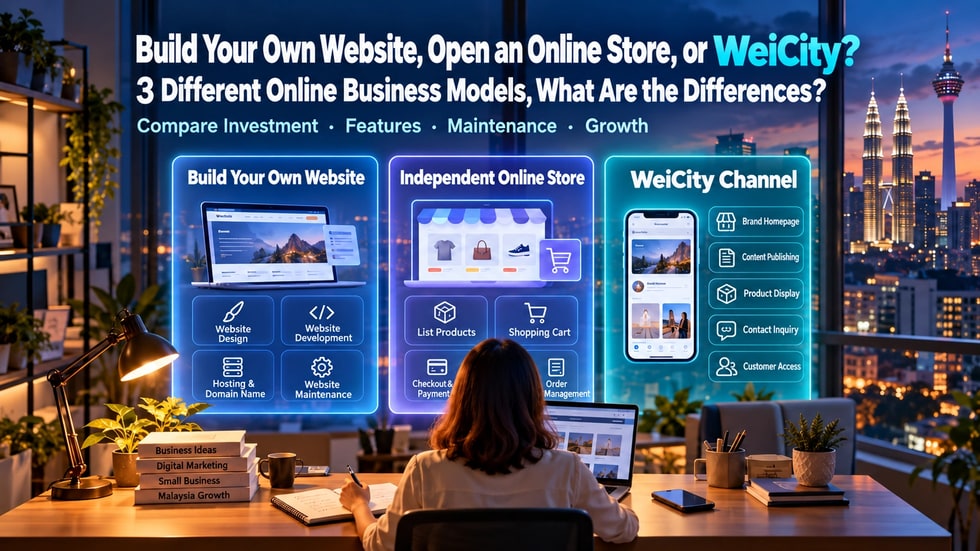
When a merchant prepares to build an online presence, they usually consider three options:
• Hire someone to design a dedicated official website
• Use an e-commerce platform or store system to build an independent online store
• Create a WeiCity Merchant Channel
All three can display business information, and may also include products, contact methods and payment features.
The real difference lies in how they are built, their main purpose, maintenance work, sources of customers and future expansion direction.
• What problem do I most need to solve right now?
• What is the most important action for customers once they reach the page?
• How much budget and time do I have for maintenance?
• Do I need brand presentation, sales transactions, or both?
A self-built website usually means the merchant buys a domain name, prepares a server or hosting service, and then completes the page design and feature development themselves, through a designer, or with a development team.
Its biggest characteristic is that the merchant has a high degree of control over the website's structure, design style and features.
The main advantages of a self-built website include:
• Pages can be designed around the brand image
• Website structure and content can be planned freely
• Special booking, membership or business processes can be developed
• Different third-party systems can be connected
• Suitable for businesses that need long-term brand building
• Buying and managing a domain name
• Choosing a hosting or server plan
• Designing desktop and mobile pages
• Installing and updating the website system
• Handling security, backups and technical issues
• Separately connecting products, shopping carts, orders and payment features
• Continuously carrying out search optimization and content updates
If a merchant has a clear brand plan, sufficient budget, and needs special features, a self-built website offers greater room for development.
If you only want to set up a basic entry point quickly, a self-built website may require relatively more preparation.
The core goal of an independent online store is to help merchants display and sell products.
Most online store systems place the product catalog, specifications, shopping cart, checkout, payment and order management at the center.
The advantages of an independent online store include:
• Product categories and price structures are usually clear
• Suitable for managing many products and specifications
• Customers can add items to a cart and check out together
• Makes it easier to handle orders, inventory and promotions
• Suitable for merchants whose main income comes from product sales
• Uploading and organizing product information
• Setting prices, specifications and inventory
• Handling payment, delivery and return or exchange rules
• Updating promotions
• Arranging advertising or other traffic-driving methods
• Installing additional features as needed
An independent online store is usually good at handling the stage when a customer is already ready to buy.
If the merchant also needs to tell a brand story, publish a large amount of content, showcase works, offer courses, or connect with local customers, it may also need to be combined with other pages, social accounts or promotion tools.
The focus of a WeiCity Merchant Channel is to bring together the merchant's brand introduction, content, products or services, customer contact and related business features in one channel.
Depending on the type of business, merchants can choose the functional modules that suit them, such as:
• Website features, for introducing the brand, services and contact information
• Shop features, for displaying products and accepting orders
• Online Ordering features, for displaying menus and handling food and beverage orders
• Video course features, for publishing teaching content
• Gallery features, for showcasing works, cases or service results
A WeiCity Merchant Channel is well suited to the following needs:
• Wanting to build an online presence with a low barrier to entry
• Not wanting to manage several separate systems
• You also need a brand introduction, content publishing, and product display
• You want customers to learn about, contact, or buy from you through one link
• You prefer to start with basic features and expand according to actual needs
• You value local customer discovery and ongoing content management
WeiCity's official materials currently offer an RM0 trial option, so merchants can first set up and test a channel, then consider next steps based on real business needs.
Self-built website:
• Usually requires a budget for domain, hosting, design, or development
• Preparation time depends on how complex the pages and features are
• Suitable for merchants with clear requirements and a set budget
Standalone online store:
• Can generally use ready-made templates and sales systems
• Still requires complete product, payment, and delivery information
• Costs vary depending on the plan, transactions, and add-on features
WeiCity Merchant Channel:
• You can start with the RM0 trial option
• No need to complete complex website development first
• You can start testing with one main module and a small amount of content
A self-built website requires confirming the structure, design, and features. If custom development is involved, launch usually takes longer.
A standalone online store already has product and transaction frameworks, but merchants still need to organize product categories, specifications, inventory, payment, and logistics.
A WeiCity Merchant Channel can be set up by first completing the merchant name, introduction, contact details, and one main feature, then gradually adding products and content. It is well suited to merchants who want to quickly establish a basic entry point.
If a merchant needs to design every page strictly according to brand guidelines, a self-built website usually offers the highest degree of freedom.
The design of a standalone online store is shaped by its template and e-commerce system structure, but product and transaction pages are usually more standardized.
WeiCity Merchant Channel provides a unified channel structure that lets merchants manage information, content, and business features in one place. Its focus is not on developing every page from scratch, but on helping merchants quickly set up a usable online entry point.
If a merchant runs a large number of products, complex categories, and a full e-commerce process, a dedicated online store system may better fit their needs.
If a merchant needs fully customized products, memberships, payments, or enterprise systems, they can consider a self-built website and connect the relevant features.
If a merchant wants to bring brand introduction, product display, content publishing, customer contact, and online transactions together in one channel, the WeiCity Merchant Channel is more convenient.
Creating an online page does not mean customers will automatically find it.
A self-built website usually relies on search engines, advertising, social media, digital business cards, or offline promotion to bring in visits.
A standalone online store also requires merchants to attract customers through advertising, social content, livestreams, memberships, or other channels.
Beyond letting merchants share their channel link, WeiCity also emphasizes local merchant discovery and the connection between content and channels, giving merchants another entry point that customers can get to know.
Whichever option you choose, merchants still need to keep updating content and actively share their entry point with target customers.
Maintenance for a self-built website may include:
• Updating the system and plugins
• Security checks and backups
• Page edits
• Managing servers and domains
• Handling feature malfunctions
Maintenance for a standalone online store may include:
• Updating products, prices, and inventory
• Handling orders, payments, and delivery
• Setting up discounts and promotions
• Managing apps and add-on features
The main maintenance focus for a WeiCity Merchant Channel includes:
• Updating merchant information
• Publishing content
• Managing products, menus, courses, or works
• Viewing and handling customer-related actions
• Adjusting the features used according to business changes
The more complex the system, the more maintenance time it usually requires. Merchants should choose an approach that their team can manage consistently.
Merchants do not have to use only one approach permanently.
Different tools can take on different roles:
• A corporate official website handles the complete brand image and company information
• A standalone online store handles large product catalogs and e-commerce transactions
• A WeiCity Merchant Channel handles local discovery, content publishing, and a centralized customer entry point
Merchants who already have an official website can also create a WeiCity channel to add a local entry point that is easy to share and update.
Merchants who already have a standalone online store can also use WeiCity to publish brand content, introduce featured products, and guide customers to the appropriate purchasing process.
The key is not how many tools you have, but whether each entry point has a clear purpose.
If you need full control over design and features, and have budget for development and maintenance:
• Consider a self-built website first
If your core business is managing large numbers of products, inventory, and orders:
• Consider a standalone online store first
If you want a low-barrier start and want to bring your brand, content, products, and customer contact together:
• Consider creating a WeiCity Merchant Channel first
If your business has grown to multiple stages:
• You can combine them so that different entry points handle branding, transactions, and promotion separately
• Is my main goal to showcase my brand, sell products, or connect with local customers?
• What is the most important action for customers once they reach the page?
• Do I need special design or custom features?
• How much budget do I have for setup and long-term maintenance?
• Who will be responsible for updating content, products, and orders?
• Do I need to publish articles, images, products, courses, or works at the same time?
• Do I want to test the market first, or am I ready for a full investment?
What features are missing from my existing social profile, website, or online store?
The clearer these answers are, the easier the choice will be.
The value of a self-built website lies in freedom and customization.
The value of a standalone online store lies in product and transaction management.
The value of a WeiCity Merchant Channel lies in helping merchants bring brand introduction, content, products or services, and customer entry points together with a lower barrier to entry.
Merchants who are just starting out can first complete one channel that customers can open and use.
Merchants who have grown steadily can decide, based on orders, team, brand, and system needs, whether to add a standalone online store, a self-built website, or other tools.
There is no need to add complexity just to have more features. An entry point that helps customers get to know you, contact you, and take action is what truly matters.
📌 Friendly Reminder
This article is compiled from WeiCity's official channel information currently available to the public. Platform features, trial options, plan details, and prices may change. Please refer to the information shown on WeiCity's live pages before use.