

57 How Farms and Agricultural Product Merchants Can Use WeiCity: From Product Showcase to Customer Orders
Showcase agricultural product types, specifications, supply times, and ordering methods in one place, helping customers learn more about products and contact you more easily.
How can farms, direct agricultural product sellers, fruit and vegetable suppliers, and agricultural processing merchants use WeiCity? Build a channel that makes it easy for customers to browse products, understand supply arrangements, and contact you through product categories, origin and packaging information, supply schedules, and bulk quotation guidance.
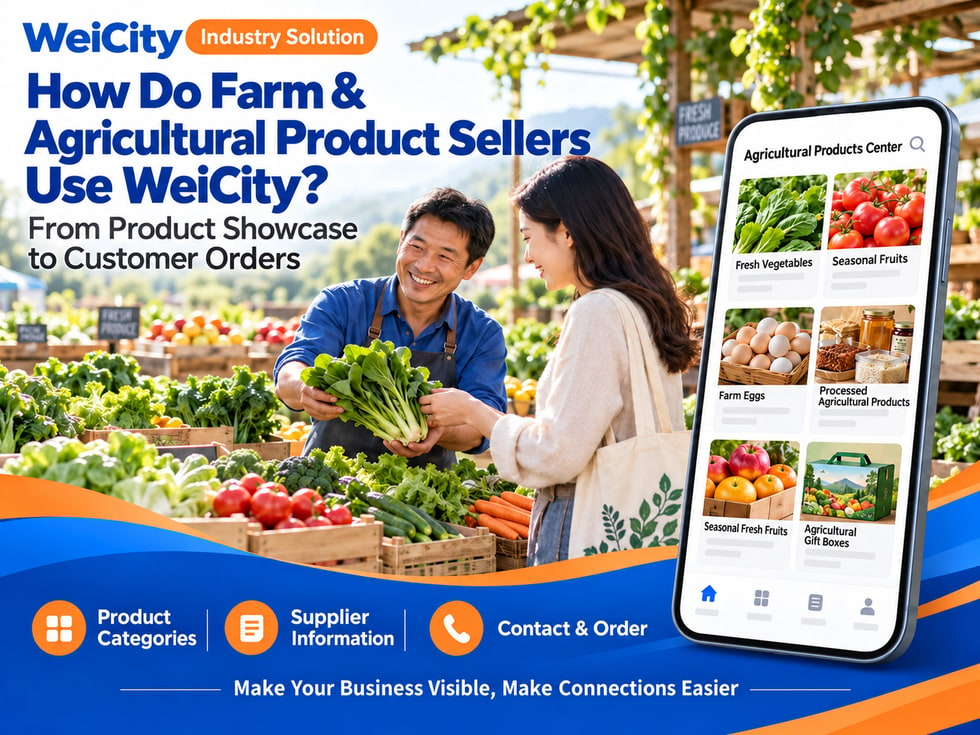
From Product Display to Customer Orders
“What vegetables are available this week?”
“Are the fruits sold by the kilogram or by the box?”
“Can you deliver to my home?”
“Our restaurant would like to order regularly. Can you quote a price?”
“When will these products be harvested or restocked?”
When buying farm produce, customers usually care about variety, specifications, supply timing, packaging and pickup arrangements. Clear information makes it easier for customers to choose and for merchants to confirm orders.
💡 With WeiCity, you can create your own farm produce channel and organize your product categories, supply methods and ordering guide, so customers can first see what you supply and then contact you to confirm quantities and arrangements.
✅ Farms and Growers
Introduce the farm produce you actually grow or supply.
✅ Fruit and Vegetable Direct Sellers
Display vegetables, fruits and seasonal products.
✅ Meat, Egg and Other Agricultural Suppliers
Explain products, specifications and delivery methods according to your actual range of business.
✅ Agricultural Product Processors
Introduce jams, dried goods, pickled products or other products you actually sell.
✅ Agricultural Product Wholesalers
Organize case packs, bulk quantities and long-term supply information.
✅ Farmers' Markets and Community Produce Merchants
Publish current products, pickup locations and selling times.
📌 Describe product types, places of origin and production methods accurately. Do not use unverified quality or certification claims.
You can organize information by category and supply method:
🔹 Seasonal Vegetables
List the varieties and packaging methods you have actually supplied recently.
🔹 Fruits and Farm-Harvested Produce
Describe varieties, specifications and supply times.
🔹 Root Vegetables and Grains
Introduce selling units, package weights and storage recommendations.
🔹 Eggs and Other Farm Products
Categorize by product type, package quantity and pickup method.
🔹 Processed Farm Products
Display ingredients, net content and storage instructions.
🔹 Gift Baskets and Combination Products
Describe what is included, suitable occasions and ordering times.
🔹 Wholesale and Long-Term Supply
Provide a way for restaurants, retailers or group customers to request quotes.
💡 Customers usually look at product categories first, then confirm current supply and quantities.
Recommended to specify:
✅ Product Names and Varieties
✅ Place of Origin or Supply Source
✅ Selling Units and Specifications
✅ Packaging Method and Quantity per Pack
✅ Supply Times or Seasons
✅ Storage and Handling Recommendations
✅ Whether pre-ordering is required
✅ Pickup or Delivery Arrangements
✅ How to Request Quotes for Bulk Purchases
✅ Relevant Certifications or Production Notes (if supported)
🔶 Example: Introduction to Seasonal Vegetables
Product name: Enter the actual variety.
Package specifications: State the quantity or weight per bag, box or case.
Supply time: State the expected supply date or that it needs to be confirmed in advance.
Pickup method: List farm pickup, market pickup or delivery arrangements.
How to inquire: Contact the merchant to confirm current supply, prices and quantities.
📌 The size, appearance and available quantity of farm produce may change with the season and harvest conditions, so describe them according to the actual situation.
It is recommended to prepare:
🔹 Overall product photo
Show the actual appearance and packaging of your products.
🔹 Photos of Harvesting or Production Environments
Introduce your farm or processing setting, and make sure the images truly correspond to it.
🔹 Photos of Packaging and Labels
Help customers check specifications, net content and product information.
🔹 Comparison of Different Grades or Sizes
If you actually offer different specifications, you can display them side by side.
🔹 Photos of Pickup Points or Markets
Help customers understand where products are handed over and the selling environment.
🔹 Detail Photos of Processed Products
Show the actual contents of bottled, bagged or gift-box products.
📌 Images should correspond to the products you actually supply. If an image is illustrative or shows a past product, label it clearly.
1️⃣ Products they want to buy
List the product name or the product number in the channel.
2️⃣ Required quantity
State the unit, such as bags, boxes, cases, kilograms or other units.
3️⃣ Preferred pickup or delivery date
Helps the merchant confirm harvesting and stock preparation.
4️⃣ Pickup or delivery location
State the pickup point or the area of the delivery address.
5️⃣ Whether substitutes are acceptable
When certain varieties are temporarily out of stock, this helps the merchant ask about alternative options.
6️⃣ Contact information
This helps the merchant confirm order and delivery details.
📌 An order should be established only after the merchant confirms the products, quantities, prices and delivery time.
You can use simple status labels:
🔹 Currently Available: List the products that can be ordered now.
🔹 Pre-Order Products: Explain which varieties need to be reserved in advance.
🔹 Seasonal Products: Indicate the approximate supply season and remind customers to reconfirm.
🔹 Temporarily Out of Stock: Update promptly or tell customers to contact you for confirmation.
🔹 Harvest Dates: If relevant information is available, state the expected harvest schedule.
💡 If product supply changes frequently, you can state in the channel: “Please contact the merchant to check current supply and prices.”
📌 Product listings do not necessarily reflect real-time stock. Confirm products and quantities before payment or pickup.
Recommended to specify:
✅ Whether pricing is per kilogram, bag, box, case or individual item
✅ Weight or quantity in each package
✅ Whether prices differ for different specifications
✅ Minimum quantity for wholesale orders
✅ Whether reservations or deposits are required
✅ Whether delivery fees are charged separately
✅ Whether gift boxes or special packaging incur extra charges
✅ The date or method for confirming prices
🔶 For example:
“Products are sold by the box. For specifications of each box, see the product description. Please contact the merchant to confirm supply quantities, current prices and delivery arrangements.”
📌 Farm produce prices may change with the season, yield and purchasing conditions. Update them promptly or let customers confirm before ordering.
Suggested items to organise:
🔹 Farm, store, or market pickup address
🔹 Pickup date and opening hours
🔹 Whether advance appointments are required
🔹 Actual delivery areas
🔹 Delivery fees and minimum order requirements
🔹 Refrigeration or special packaging arrangements (if applicable)
🔹 How to check quantity and packaging on receipt
🔹 How to notify customers of order delays or supply changes
💡 If delivery only happens on fixed days, you can list the weekly schedule and remind customers to confirm the current service first.
📌 Different products may have different transport and storage requirements; arrange them according to the actual order.
If you sell processed foods, you can indicate:
✅ Product name and net content
✅ Ingredient or composition information
✅ Storage method and recommendations after opening
✅ Packing date or shelf life (as shown on the product label)
✅ Producer and contact information
✅ Whether there are applicable product certifications or licence documents
📌 Product labels and related requirements should follow the actual packaging and applicable regulations. Do not add unverified health benefits or certification claims to your channel.
You can ask customers to provide:
🔹 List of products to purchase
🔹 Specifications and expected quantity for each item
🔹 Purchase frequency and supply cycle
🔹 Preferred delivery date and location
🔹 Packaging or repacking requirements
🔹 Whether seasonal substitutes are acceptable
🔹 Payment and reconciliation method
🔹 Product information or label details required
🔶 For example:
“We welcome restaurant and retail customers to provide product lists, specifications, quantities, delivery locations, and supply frequency. We will confirm quotes and arrangements based on current supply.”
💡 Before arranging long-term supply, you can first confirm samples, specifications, delivery times, and how changes in quantity will be communicated.
🔹 About Us
Introduce the farm, supply sources, and scope of operations.
🔹 Current products
Display recently supplied vegetables, fruits, and farm produce.
🔹 Processed products
Organize specifications, packaging, and storage instructions according to actual products.
🔹 Supply and harvest information
Update seasons, pre-orders, and supply arrangements.
🔹 Wholesale and long-term purchasing
Explain the information business customers need to provide when requesting prices.
🔹 Pickup and delivery
Introduce locations, times, service areas, and how fees are confirmed.
🔹 FAQ
Organize price units, pre-orders, out-of-stock items, and storage questions.
💡 When you start, you can first add main products, packaging specifications, and ordering methods, then gradually add supply updates and bulk purchasing information.
🔶 Customer asks: “What vegetables are available this week?”
You can reply:
“Hello, here is our list of farm products. Supply changes every week. Please tell us the varieties and quantities you want, and we will confirm the current products and prices for you.”
🔶 Customer asks: “Can you deliver to my home?”
You can reply:
“Please tell us your area, the products you want, and the quantities. We will confirm whether it is within our delivery range and reply with delivery times and fees.”
🔶 Customer asks: “Our restaurant would like to purchase long-term. Can you give a quote?”
You can reply:
“Yes. Please provide your product list, specifications, weekly usage, and delivery location. We will confirm long-term purchasing arrangements based on supply.”
1️⃣ Basic merchant information
Name, farm or store location, contact details, and business hours.
2️⃣ Main product categories
First organize the products you regularly supply and the products customers ask about most often.
3️⃣ Product Images and Specifications
Prepare product samples, packaging, units, and storage information.
4️⃣ Supply and ordering instructions
List current enquiry, pre-order, pickup, and delivery methods.
5️⃣ Bulk enquiry guide
Tell restaurant, retail, or group customers what information to provide.
✅ Are product names and specifications accurate?
✅ Are origin and production descriptions supported by evidence?
✅ Are price units and packaging quantities clear?
✅ How are supply times and stock confirmed?
✅ Do the photos match the actual products?
✅ Are delivery areas and pickup times correct?
✅ Is the label information for processed products complete?
✅ Are the contact details valid?
Once you organize product categories, packaging specifications, and ordering methods in your channel, you can use it for everyday replies, farm promotion, and bulk purchasing communication.
Customers can browse products first, then provide the varieties, quantities, and delivery location they need. Merchants can then continue to confirm current supply, prices, and delivery arrangements.
Want to learn how to set up a farm and agricultural product merchant channel?
Please contact us through the official WeiCity channel, and we can organize display content suitable for your farm or team.
WeiCityMake your business visible and your contact easier.