

22 🎟️ What problems can pre-orders, coupons, and discounted products solve for merchants?
🚀 Use pre-orders to confirm demand, use coupons to attract new customers, and use clear discounted prices to help customers complete their purchase
💡 Pre-orders, coupons, and discounted products all appear to offer savings, but they actually solve different problems. Pre-orders help merchants confirm demand and plan inventory in advance; coupons suit attracting new customers, driving store visits, or locking in future spending; discounted products use a clear checkout price to encourage customers to buy immediately. This article introduces the differences among the three tools, suitable scenarios, setup methods, and common mistakes.
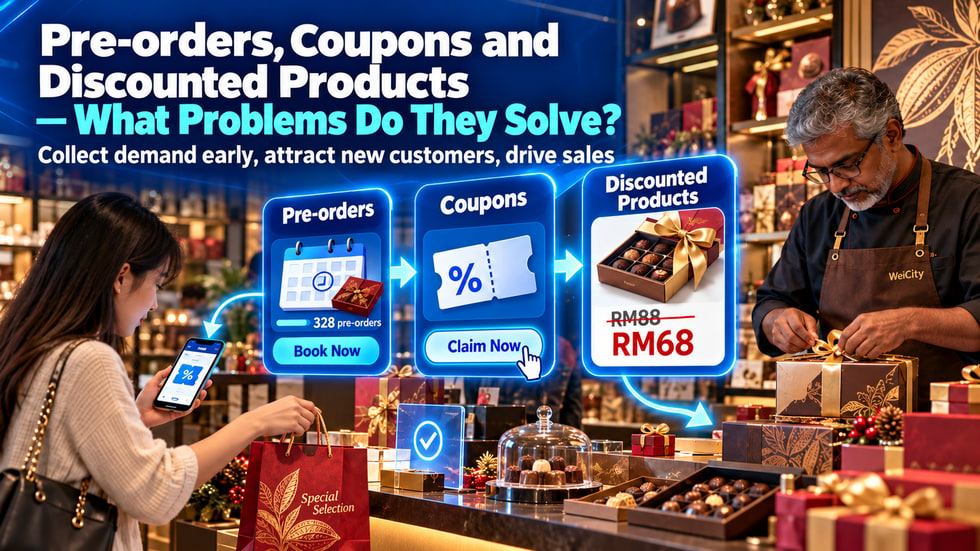
When merchants want to attract customers, discounts often come to mind.
However, not every problem encountered in business needs to be solved by directly cutting prices.
Sometimes, merchants need to confirm market demand before preparing products.
Sometimes, merchants hope new customers will visit the store to try things out first.
Sometimes, merchants simply want certain products to sell within a limited time.
These three situations are each suited to the following:
• Pre-order
• Coupon
• Discounted Product
They are not the same promotional method, and they should not be mixed together.
📦 Pre-order
Customers place a reservation before the product is officially available, finished being made, or open for pickup.
Mainly solves:
• Unsure how much stock to prepare
• Products need to be made in advance
• Festive orders are concentrated
• New products need demand testing
• Custom products need quantities confirmed in advance
🎟️ Coupons
Customers claim or purchase a voucher that can be used under specified conditions.
Mainly solves:
• New customers lack a reason to try something for the first time
• Merchants want to increase the number of visitors to the store
• Returning customers need a reason to buy again
• Customers want to give a service as a gift
• Merchants want to lock in future spending in advance
🏷️ Discounted Product
Merchants directly lower the actual checkout price of specified products.
Mainly solves:
• Customers are still hesitating about buying immediately
• Seasonal products need to sell before a deadline
• Some stock needs to turn over faster
• New products need to quickly receive their first orders
Before choosing a tool, first determine the problem the merchant really wants to solve.
A pre-order means the product has not yet entered general sale, but the merchant has started accepting customer reservations.
WeiCity official materials show that products can be pre-sold through the "Order Now" method.
Products suitable for pre-orders include:
• Festive gift boxes
• Cakes and desserts
• Limited-edition products
• Handmade products
• Custom products
• First batch orders for new products
• Products that require materials to be purchased in advance
• Products that require production quantities to be arranged
The key of a pre-order is not to make customers wait, but to let them clearly know when the product will be ready and how to collect it.
If a merchant prepares a large amount of product directly, two situations may occur:
• Preparing too little, missing orders
• Preparing too much, creating stock and waste
Through pre-orders, merchants can know in advance:
• How many customers are interested
• Which style is the most popular
• How many materials need to be prepared
• Which pickup date has the most orders
• Whether more staff need to be added
• Whether demand for the product has reached production conditions
Pre-orders are especially suitable for products with a short shelf life, long production times, or high costs.
They can help merchants arrange work according to actual orders instead of relying entirely on guesswork.
Before paying or reserving, customers should be able to see:
• What the product is
• Pre-order start date
• Pre-order end date
• Expected completion date
• Delivery or pickup arrangements
• Whether quantities are limited
• The amount the customer needs to pay
• Whether changes or cancellations are accepted
• How the merchant will notify customers of delays
• Reasonable differences that may exist between the product and the display images
Do not just write "Pre-order now open" without explaining when customers can receive the product.
The clearer the delivery date, the easier it is for customers to decide.
Pre-orders give merchants demand information in advance, but they also bring delivery responsibility.
Common risks include:
• Accepting orders beyond production capacity
• Materials failing to arrive on time
• Customers mistakenly thinking they can collect immediately
• Expected completion dates keep changing
• Merchants failing to update order status promptly
• Continuing to accept reservations after the campaign has ended
Merchants should set quantities and deadlines based on their actual capacity.
If a delay occurs, the new arrangement should be explained to customers as soon as possible.
A coupon does not directly change the price of all products.
It represents a benefit that customers obtain and can use under specific conditions.
WeiCity official materials show that coupons can be given away for free or sold for a fee.
Free coupons allow customers to claim them with one click and receive a code, which is redeemed by showing it when visiting the store; customers can also directly purchase paid coupons.
Coupons are suitable for:
• First-time store visits
• Redeeming specified services
• Festive gifts
• Repeat purchase rewards
• Thank-you gifts for returning customers
• Promotion for new store openings
• Attracting traffic during off-peak hours
• Introducing friends to the experience
Free coupons are suitable for lowering the barrier for customers' first experience.
For example:
• Free drink upgrade coupon
• Free basic inspection coupon
• Free small-portion tasting coupon
• Free trial course coupon
• Additional service coupon given after a purchase
• Gift voucher for new customers visiting the store
The goal of free coupons is not to give away large amounts of high-cost products for free, but to encourage target customers to take a first step.
Through free coupons, merchants can:
• Attract customers to claim them
• Encourage customers to visit the store
• Let customers experience a basic service
• Introduce other related products
• Increase the chances of being discovered
The content of free coupons should be cost-controlled and related to the merchant's main products or services.
A paid coupon is one that customers buy first and then use later under the stated conditions.
For example:
• RM50 dining voucher
• One care service voucher
• Two-person experience voucher
• Festive gift voucher
• Course trial voucher
Paid coupons are suitable for:
• Customers giving products or services as gifts
• Merchants locking in future spending in advance
• Customers who have not yet decided on a specific date of use
• Services that have no physical product to take away immediately
Before selling paid coupons, merchants should clearly explain:
• The value of the coupon
• What it can be redeemed for
• The validity period
• Whether a booking is required
• Whether it is limited to specific dates or time slots
• Whether it can be used together with other offers
• Whether a price difference must be paid
• How it is redeemed after use
The clearer the rules, the less likely disputes will arise during redemption.
Redemption means the customer has used the coupon, and the merchant marks it as redeemed.
Redemption prevents the same coupon from being used more than once.
When a customer visits the store, the merchant should check:
• Whether the code is valid
• Whether it is within the validity period
• Whether the conditions of use are met
• Whether it applies to the current product or service
• Whether it has already been used
Only complete the redemption after confirming.
Staff should understand the redemption process, rather than only the owner knowing how to handle it.
A discounted product means the merchant directly adjusts the actual checkout price of specified products.
WeiCity official materials state that a product discount directly changes the checkout price.
For example:
Original price RM88
Discounted price RM68
After adding a product to the shopping cart, customers should be able to see the actual amount they need to pay.
Discounted products are suitable for:
• Encouraging customers to buy immediately
• Promoting new products
• Clearing seasonal stock
• Supporting limited-time campaigns
• Increasing orders for specified products
• Creating new attention for existing products
Discounts should have a clear reason, rather than keeping all products at low prices for a long time.
A bigger discount does not mean a more successful campaign.
Before starting, calculate:
• Product cost
• Packaging cost
• Delivery cost
• Payment cost
• Labor time
• After-sales cost
• Actual revenue after the discount
You can use a simple method:
Expected profit after discount = discounted checkout price − product cost − packaging and delivery − payment cost − additional labor
If orders increase but each order brings almost no reasonable profit, the merchant may just be increasing their workload.
Customers should be able to quickly see:
• Original price
• Discounted price
• Campaign start date
• Campaign end date
• Applicable products
• Quantity limits
• Stock availability
• Delivery or pickup method
• Whether it can be combined with other offers
After the promotion ends, restore or update product information promptly.
Do not leave expired prices visible in your channel.
Problem 1: You are not sure how many products to prepare
Recommended: Pre-sale
Reason: Collect order demand first, then arrange materials, production and inventory.
Problem 2: You want new customers to visit the store for the first time
Recommended: Free coupon
Reason: Lowers the barrier to a first experience and gives a clear reason to visit.
Problem 3: You want to lock in future spending
Recommended: Paid coupon
Reason: Customers can buy first and then redeem products or services within the validity period.
Problem 4: You want specific products to sell quickly
Recommended: Discounted products
Reason: The actual checkout price is clear and can directly drive purchase decisions.
Problem 5: Festive gift boxes need to be produced in advance
Recommended: Pre-sale
Reason: Confirm quantities and pickup dates in advance.
Problem 6: You want to attract more customers during slow periods
Recommended: Time-limited coupon
Reason: Concentrates offers during the times when you want to increase foot traffic.
If one product has pre-sale, coupons and a large discount all at once, customers may not understand the actual price and conditions.
It may also be hard for you to tell why the promotion worked.
For each promotion, choose one main tool.
For example:
• Use pre-sale for festive gift boxes
• Use free coupons for new-customer trials
• Use discounted prices for end-of-season products
If you need to combine tools, keep the conditions simple and clearly explain the order in which they apply.
When publishing a promotion, you can use the following structure:
1️⃣ Explain what customers can get
2️⃣ Explain which customers it suits
3️⃣ State the price or the value of the offer
4️⃣ State the start and end dates
5️⃣ Explain how to use or claim it
6️⃣ List the important conditions
7️⃣ Provide a booking, coupon claim or purchase entry point
Do not publish only one image that says "Limited-time offer."
The text should let customers understand the main conditions without having to ask separately.
For pre-sales, you can record:
• Number of pre-orders
• Most popular styles
• Actual quantity completed
• Delays or cancellations
For coupon promotions, you can record:
• Number of coupons claimed
• Number of purchases
• Actual number redeemed
• Share of new customers
For discount promotions, you can record:
• Product views
• Number of items added to cart
• Actual number of orders
• Actual earnings after discounts
Do not look only at how many people saw the promotion.
In the end, you need to judge whether the promotion solved the original problem.
• No clear promotion goal
• Pre-sale without a stated delivery date
• Accepting pre-orders beyond production capacity
• Coupons without an expiry date
• Staff do not know how to redeem coupons
• Coupon conditions that are too complicated
• Discount price differs from checkout price
• Earnings after discounts not calculated
• Pages not updated after the promotion ends
• Too many offers on the same product
The more complex the rules, the more likely customers are to give up, and the harder they are for you to run.
• Have you confirmed the main goal of the promotion?
• Have you chosen the right tool?
• Is the pre-sale delivery date clear?
• Are pre-sale quantities within your capacity?
• Is the value of the coupon clear?
• Are the validity period and conditions complete?
• Do staff understand how to redeem?
• Is the discounted checkout price correct?
• Is there enough promotional stock?
• Are the relevant purchase or claim entry points working?
• Have you scheduled an update after the promotion ends?
Complete the check before officially sharing the promotion.
Pre-sales, coupons and discounted products are not three identical price-cutting tools.
Pre-sales help you confirm demand and arrange supply.
Coupons help you attract new customers, drive store visits or lock in future spending.
Discounted products help customers see a clear actual price and make purchase decisions faster.
Define the business problem first, then choose the suitable tool, so promotions do not end up as nothing more than repeated price cuts.
👉 Use the WeiCity Merchant Channel to plan pre-sales, coupons and discounted products, so every promotion has a clear goal and customers clearly know how to take part.