

12 How to Run Online Video Courses Sustainably? From Course Updates to Building a Sustainable Knowledge Business
It is not just about producing and selling video courses. You also need to focus on maintaining teaching content, learner support, operating costs and long-term planning, helping education centres, training institutions and independent instructors build a stable online teaching business.
After an online video course is completed, how should it be run over the long term? This article introduces course content updates, teaching quality management, learner feedback, course maintenance, video storage costs, knowledge product planning and long-term business development strategies. It also explores how education centres, training institutions and independent instructors can use the WeiCity merchant channel to continuously showcase teaching content and build professional knowledge resources, so that their online course business grows in a more systematic way.
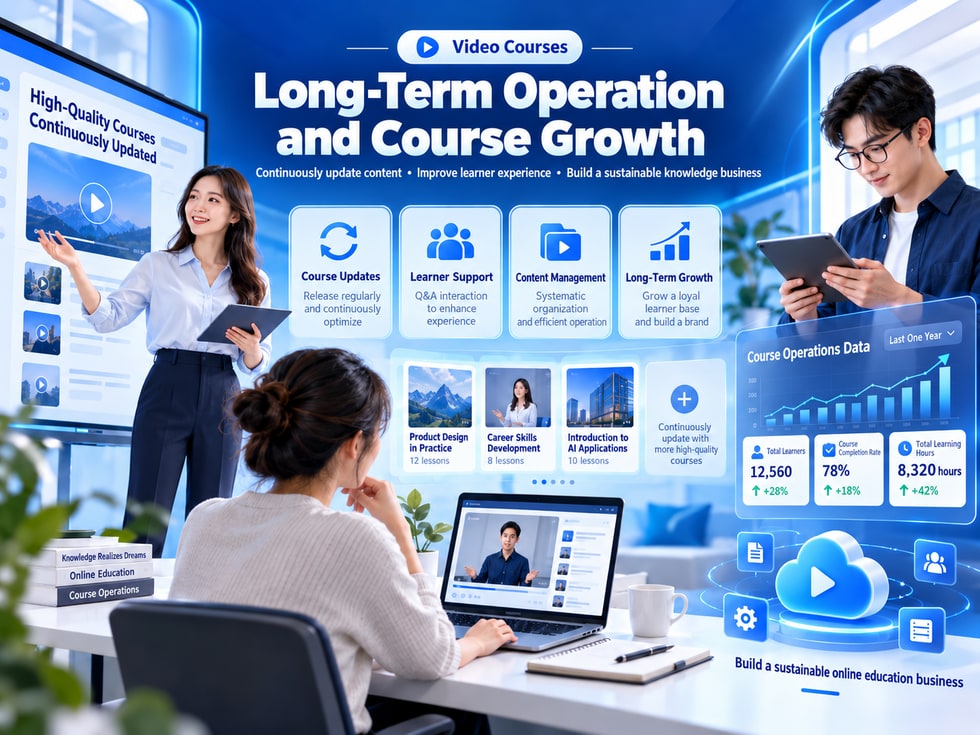
Producing an online video course may take several days, several weeks, or even several months.
From teaching plans and video recording to course editing, content organization, and formal promotion, every step requires time and effort.
However, once the course is officially launched, operations do not end there.
Many education centers, training institutions, and independent instructors may face new challenges.
🔸 Some people buy the course when it first launches, but enquiries gradually decline afterward.
🔸 Some teaching content becomes outdated over time.
🔸 Students buy the course but do not complete their studies.
🔸 Merchants keep producing new videos but have no time to maintain older courses.
🔸 The number of video files keeps growing, and storage and management costs continue to rise.
🔸 Several courses have been created, but there is no clear long-term development direction.
🔸 Course sales bring in revenue, but the actual profit is unknown.
These issues show that running an online video course is more than completing production and sales.
More importantly, it means continuously providing valuable teaching content, maintaining a good learning experience, and building an operating model that can work over the long term.
For merchants who want to develop an online teaching business, planning can begin with the following directions.
Traditional classroom courses are usually taught at fixed times.
Pre-recorded video courses, however, allow different students to learn at different times, provided this complies with the terms of service and technical requirements.
For example:
📘 A mathematics teacher creates a basic problem-solving course.
🗣️ An English instructor creates a daily spoken English course.
💻 A computer trainer creates an Excel operation course.
🍰 A baking mentor creates a basic baking course.
Once these courses are completed, they are not necessarily used only once.
If the content remains accurate and meets learning needs, merchants can continue introducing it to new potential students.
However, over time, some knowledge, software operations, or teaching materials may need to be updated.
Therefore, long-term course operation usually involves:
✅ Maintaining teaching content.
✅ Checking course quality.
✅ Supporting student learning.
✅ Managing videos and materials.
✅ Updating course descriptions.
✅ Controlling operating costs.
✅ Long-term business planning.
When this work is carried out systematically, courses are more likely to continue delivering teaching and business value.
Not every video course needs to be re-recorded every month.
Knowledge in different subjects does not change at the same speed.
For example:
📚 Basic mathematics knowledge: some content may remain applicable for a long time.
🗣️ Basic language learning: some grammar and pronunciation lessons may remain usable for a long time, but examples and textbooks may need adjustment.
💻 Computer software training: as software interfaces and features are updated, courses may need to be revised.
📱 Social media marketing: platform rules and operating methods may change quickly.
⚖️ Legal, tax or compliance training: pay special attention to policies, regulations and their effective dates.
Therefore, merchants can decide how often to review a course based on its subject.
It is recommended to check regularly:
✅ Whether the teaching materials are still accurate.
✅ Whether the operating steps shown in the videos are still valid.
✅ Whether the software screens have changed.
✅ Whether the relevant laws or rules have been updated.
✅ Whether the textbooks or demonstrations need improvement.
✅ Whether any learners have reported that the content is outdated.
If only one chapter needs changes, it is not necessary to re-produce the entire course.
Relevant content can be updated as needed, with the course version and update date clearly stated.
When a merchant has only one course, management may be relatively simple.
However, as the number of courses grows, files and teaching materials may increase rapidly.
For example, a training institute gradually developed:
📘 Excel Basics course.
📗 Excel Advanced course.
📙 PowerPoint presentation course.
📕 Business data analysis course.
📚 Comprehensive office software course.
Each course may include teaching videos, cover images, original files, handouts and practice materials.
If all files are mixed together in one folder, they may be difficult to identify when updates are needed.
It is recommended to set up a clear management structure for each course.
📁 Course name.
📂 Original recording files.
🎬 Completed edited videos.
📄 Teaching handouts.
📝 Exercises and quiz materials.
🖼️ Course cover and promotional images.
📋 Course description and version records.
🔐 Course authorization and related documents.
Also, set appropriate backups and access permissions for important teaching materials.
This can reduce the risks of losing files, using outdated versions by mistake, or producing duplicate content.
For merchants who teach online, selling a course is only part of the service process.
After purchasing, learners still need to actually study.
For example, a learner bought a 10-lesson Excel course but only watched the first two lessons.
There can be many reasons for this.
🔸 The course is more difficult than expected.
🔸 The video length does not suit the learner's schedule.
🔸 Learners lack practical exercises.
🔸 The content differs from what was understood before purchase.
🔸 Learners are busy with work and temporarily stop studying.
🔸 The way to use the course is not explained clearly enough.
Merchants can consider ways to improve the course experience.
✅ Clearly explain the learning objectives.
✅ Arrange chapters according to difficulty.
✅ Provide suitable practice suggestions.
✅ Avoid spreading the content of a single lesson too thinly.
✅ Let learners know what they should study next.
✅ Provide necessary learning support based on the actual service arrangements.
Completion rates of different courses may be affected by the target learners, course length and teaching format.
Therefore, course quality should not be judged by completion rate alone, and not all learners should be required to study at exactly the same pace.
Learner feedback is an important reference for the long-term operation of a course.
This is because merchants may think the teaching content is already clear enough, while actual learners may still encounter difficulties.
For example:
💬 "This lesson goes too fast."
💬 "Could you add more practical demonstrations?"
💬 "Some teaching screens are hard to see."
💬 "The course suits beginners, but the later chapters are a bit difficult."
💬 "I would like more practice questions."
This feedback can help instructors identify areas of the course that need improvement.
It is recommended to regularly check:
📚 Which chapters are harder to understand.
🎬 Whether the video and audio are clear.
📝 Whether the practice content is useful.
🎯 Whether the course still meets its original learning objectives.
👨🏫 Whether the teaching method suits the target learners.
📱 Whether learners have encountered technical problems.
Merchants can adjust the teaching content based on feedback.
However, it is also necessary to weigh the opinions of different learners together.
A need raised by one learner does not necessarily represent the needs of everyone.
Course improvements should combine real feedback, teaching objectives and practical teaching experience, rather than decisions based on a single review.
Some merchants think that once a video course is completed, it can be sold continuously without any other expenses.
In fact, long-term operation may still involve various costs.
For example:
🎬 Video recording and editing fees.
💻 Computer, software and equipment costs.
☁️ Video storage and hosting fees.
📡 Video transmission and data traffic costs.
💳 Payment processing fees.
📱 Advertising and promotion costs.
👨🏫 Instructor and content maintenance time.
💬 Customer service costs.
🔐 System management and security costs.
📚 Course update and teaching material production costs.
For example, if one course sells 100 copies at RM99 each.
📊 Total sales: RM9,900.
However, this does not mean the merchant earns RM9,900 in profit.
The merchant still needs to deduct related costs, refunds and applicable taxes, among other items.
Therefore, it is recommended to record separately:
✅ Total course sales.
✅ Amount actually received.
✅ Refunds and related adjustments.
✅ Platform and payment fees.
✅ Advertising and promotion expenses.
✅ Course production and maintenance costs.
✅ Other operating expenses.
This makes it possible to understand the actual performance of a course more accurately.
Whether a course is worth long-term operation should not be judged only by cumulative views.
Merchants can observe it from multiple angles.
👀 Market demand
Are there still potential learners looking for related courses?
💬 Inquiry situation
Do you continue to receive inquiries from customers with genuine learning needs?
💳 Sales performance
Can course income reasonably support production and maintenance costs?
⭐ Learner feedback
Has the course received valuable genuine reviews?
📚 Content quality
Are the teaching materials accurate, complete and aligned with the learning objectives?
🔄 Maintenance difficulty
Does the course need to be re-recorded frequently?
🎯 Business positioning
Does the course fit the merchant's main areas of expertise?
For example, a software training course that was once very popular may require considerable maintenance if the software version has changed significantly.
Conversely, a basic skills course may not have grown in sales quickly, but if its content is stable and its target learners are clear, it may still be worth offering continuously.
Merchants should comprehensively assess actual returns, maintenance costs and long-term teaching value.
When starting to operate an online video course, it is not necessary to launch many different topics at the same time.
You can start with one clearly defined teaching area.
For example, an Excel trainer can expand step by step according to learners' proficiency levels.
📘 Stage 1: Excel basic operations.
📗 Stage 2: Common formulas and functions.
📙 Stage 3: Data organization and charts.
📕 Stage 4: Advanced data analysis.
📚 Stage 5: Practical office case studies.
Through this kind of arrangement, merchants can build a clearer course system.
However, not every learner needs to purchase all the courses.
Each course should have clear learning objectives and state the suitable target audience.
For educational institutions, related courses can also be added gradually based on the professional capabilities of the teaching team.
For example:
🗣️ Language schools add spoken language courses at different levels.
💻 Computer training institutes add new office software courses.
🎨 Art education centers add painting courses on different techniques.
🍰 Baking centers add dessert-making courses on different themes.
The key is to develop according to actual needs, rather than continuously producing repetitive content just to increase the number of courses.
For education centers that already have physical classrooms, video courses do not necessarily have to become a completely separate business.
They can also be considered as a supplement to existing teaching services.
For example:
📘 Pre-class preparation: Helps students understand the basics in advance.
🏫 In-person teaching: The teacher gives explanations and guidance.
🎬 After-class review: Lets students watch the relevant teaching demonstrations again.
📝 Home practice: Practice that supports the course content.
💬 Learning feedback: Communicate with the teacher according to actual arrangements.
This approach can help education centres make use of teaching resources that have already been produced.
However, different learners need different levels of support.
In particular, for young children, learners who need individualised support, or professional courses involving hands-on assessment, pre-recorded videos should not be simply assumed to replace face-to-face teaching, assessment or professional guidance.
Merchants should choose appropriate teaching methods according to the nature of the course and the needs of learners.
Running a course over the long term also means that merchants need to continuously manage learner data and teaching resources.
Consider the following:
🔒 Protect learner accounts and personal data.
📄 Clearly explain purchase conditions and viewing periods.
©️ Confirm the copyright ownership of course videos and materials.
🎵 Properly handle licences for third-party music, images and videos.
📂 Maintain appropriate backups of original teaching materials.
🔑 Regularly review access permissions for the course system.
📝 Keep necessary course version and update records.
📱 Provide effective customer support channels.
If a course involves children or other personal data requiring additional protection, pay special attention to consent, purpose and retention period.
Merchants operating in Malaysia should also consider applicable requirements on personal data protection, consumer rights and intellectual property.
Course security is not a one-time task; it needs to be maintained continuously according to actual business conditions.
For education centres, training institutions and independent teachers who run online teaching over the long term, in addition to maintaining course content, it is also necessary to keep potential learners continuously informed about their teaching services.
The WeiCity Merchant Channel can serve as an entry point for displaying materials and introducing content related to teaching businesses.
🏪 Continuously showcase the teaching institution
Introduce the professional background of education centres, training institutions and teachers.
📚 Organise course introductions
Through content display methods actually supported by the platform, make information about different courses clearer.
📝 Share teaching knowledge
Publish practical articles related to courses to help potential learners understand professional knowledge.
🎬 Introduce new courses and update news
Based on the features available on the platform, display course topics, teaching highlights and related news.
👨🏫 Showcase professional experience
Build a more complete merchant image through authentic teacher profiles and teaching introductions.
📱 Provide enquiry methods
Make it easier for people who need to learn to contact the merchant further.
🔗 Share a unified channel URL
Use the same merchant profile entry on social media and other promotional channels.
For example, a computer training institution can continuously introduce:
💻 Excel Basics Course.
📊 Business data analysis courses.
📽️ PowerPoint presentation design courses.
📝 Practical office software tips articles.
🎬 New course launch news.
📞 Training enquiry and course registration information.
Merchants do not need to rebuild a complete business introduction every time a new course is released.
However, note that the content display in the Merchant Channel does not mean that WeiCity already provides full course management, automatic subscriptions, learner progress tracking, paid video protection or learning data statistics.
Relevant features should be based on what the platform actually offers at the time.
Search engines generally aim to provide users with useful, relevant and reliable information.
For merchants who run courses over the long term, keeping course introductions accurate is work worth taking seriously.
For example:
💻 Update instructions for software courses.
📚 Add new examples to teaching articles.
📅 Update actual course start information on course pages.
👨🏫 Update teacher profiles with genuine professional experience.
🎬 Describe newly added teaching chapters in course introductions.
However, updating content does not necessarily improve Google rankings.
It is also not recommended to change only the date to create the appearance of "fresh content" without improving the actual information.
Merchants should prioritise ensuring that:
✅ Course names are accurate.
✅ Course content matches the actual service.
✅ Fees and service conditions are not outdated.
✅ Course links can be accessed normally.
✅ Contact details remain valid.
✅ Public pages allow appropriate search engine indexing.
✅ Teaching articles answer the real questions of users.
For example:
🔍 Online Excel Training Malaysia.
🔍 Beginner English Video Course.
🔍 Malaysia online courses.
🔍 Online Baking Classes.
🔍 Video Course for Beginners.
Keywords should appear naturally in relevant course introductions.
Truly valuable long-term SEO work means consistently providing accurate, clear content that is helpful to readers.
If a merchant already runs multiple video courses, they can consider setting up a simple annual review schedule.
The following is for reference only; not all courses must follow the same frequency.
📅 Monthly: Check course services
✅ Record common learner questions.
✅ Confirm that course enquiry channels are working.
✅ Check whether important videos play normally.
✅ Address any technical issues identified.
📅 Every three months: Check course materials
✅ Check whether course introductions are accurate.
✅ Organise learner feedback.
✅ Check whether any teaching content needs improvement.
✅ Evaluate course enquiry and sales performance.
📅 Every six months: Check content quality
✅ Evaluate course chapters and learning objectives.
✅ Update outdated demonstrations.
✅ Check important teaching materials and their licences.
✅ Evaluate course maintenance costs.
📅 Annually: Set business development direction
✅ Assess whether existing courses should continue to be offered.
✅ Analyse the actual operating performance of different courses.
✅ Decide whether to develop new teaching topics.
✅ Plan teachers, equipment and production resources.
✅ Review long-term material management and security arrangements.
✅ Set course development goals suited to the next stage.
If a course involves software versions, regulations or fast-changing specialist knowledge, more frequent checks may be needed.
For merchants who are just starting to run video courses, long-term planning can be divided into four stages.
🌱 Stage 1: Build foundational courses
Choose a clear teaching topic.
Complete a course with practical learning value.
Organise clear course introductions and related materials.
📚 Stage 2: Improve teaching quality
Collect genuine learner feedback.
Optimise course chapters and teaching demonstrations.
Resolve common learning and technical issues.
📈 Stage 3: Expand related content
Add advanced courses based on actual needs.
Consider appropriate series course combinations.
Improve teaching materials and course maintenance processes.
🏆 Stage 4: Establish a sustainable operating model
Continuously evaluate course quality.
Control costs reasonably.
Manage teaching materials and copyright.
Maintain responsible learner services.
Plan long-term business development based on genuine needs.
Each stage should be based on actual operating capacity and learner needs.
Increasing the number of courses does not necessarily mean the business is developing in a healthier way.
What really matters is whether courses can keep providing value and whether the merchant has the ability to maintain service quality.
If you already have multiple teaching videos or courses, you can use the following checklist to review your operations.
✅ Is the course content still accurate?
✅ Are the course chapters clear?
✅ Can learners understand the learning objectives?
✅ Is there a suitable feedback channel?
✅ Are teaching materials properly stored?
✅ Are necessary file backups in place?
✅ Are the video viewing conditions clear?
✅ Are course fees and service descriptions accurate?
✅ Are operating costs being controlled reasonably?
✅ Do you understand actual sales and maintenance costs?
✅ Are public course materials reviewed regularly?
✅ Is there a plan for updating course content?
✅ Is importance given to learner personal data and copyright protection?
✅ Is the next stage of courses clearly introduced?
✅ Is there a long-term development direction that matches actual resources?
These checks do not need to be completed all at once.
Based on the current scale of the business, merchants can prioritise the most important issues first and improve gradually.
Online video courses help education centers, training institutions and professional instructors organize their teaching knowledge into content that is easier to share and review repeatedly.
However, finishing production does not mean that business work is over.
For a course to keep delivering value over time, merchants still need to pay attention to the following:
📚 Keep teaching content up to date.
🎬 Maintain course quality.
👨🎓 Understand the learning needs of students.
💬 Provide clear consultation and service.
📂 Manage teaching materials properly.
💰 Keep operating costs under reasonable control.
🔐 Protect course content and related materials.
📈 Grow gradually according to market demand.
For merchants who hope to build a knowledge business over the long term, success is not just about how many courses are sold.
What matters more is whether they can continuously provide learning content that is authentic, reliable and meets the needs of students.
🌐 WeiCity | Let professional knowledge keep being seen, and make it easier for students who need it to find your teaching services.
🎓 From your first teaching video, to a complete course, to a long-term knowledge business, let every piece of teaching experience keep creating value.