

4 🍽️ How is online food ordering different from Shop purchases?
From choosing dishes to arranging pickup, understand the key points of both purchase scenarios
Both online food ordering and Shop purchases involve choosing items and submitting orders, but the information customers need to confirm differs. Food ordering usually focuses more on dish combinations, service times and pickup arrangements; Shop purchases often involve product specifications, uses and delivery methods. Using examples from restaurants, bakeries and cafés, this article helps merchants understand both scenarios and organize suitable WeiCity display content.
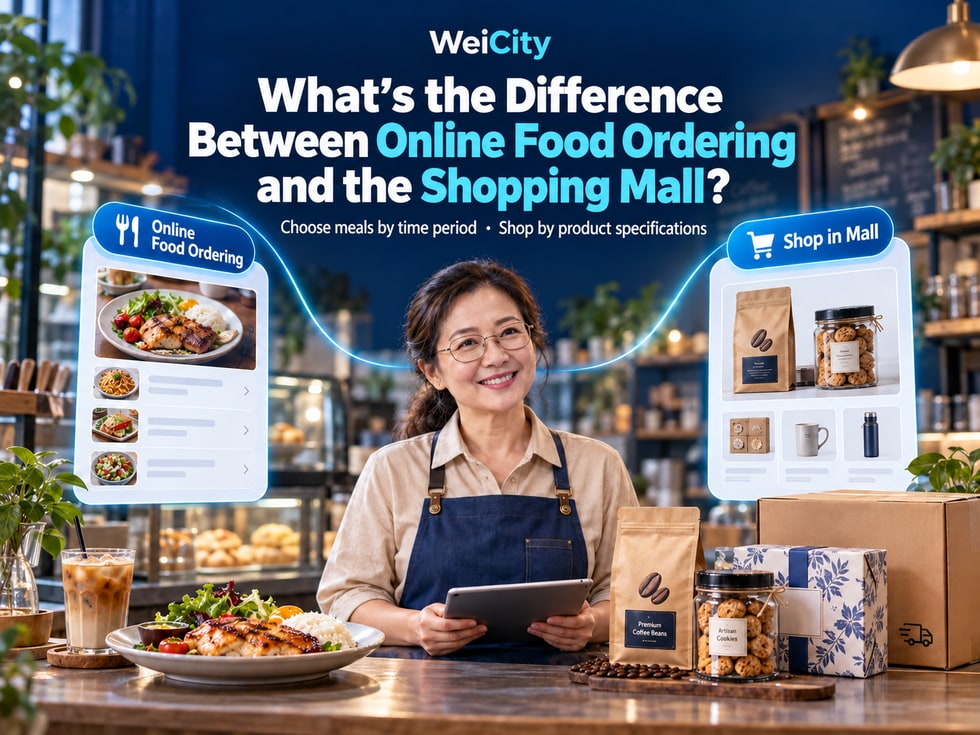
Both let you display products online, select specifications, submit orders and pay. So why distinguish between "Menu & Online Ordering" and "Shop purchases"?
For example:
🍛 When ordering a lunch, customers usually care about whether it is available today, which side dishes they can choose, and when they can pick it up.
☕ When buying a bag of coffee beans, customers may care more about weight, roast level, packaging, and how the product will be delivered to them.
🎂 When reserving a birthday cake, customers may need to choose the size, flavor, production date and pickup time all at once.
🎁 When buying a festive gift box, customers may focus more on the contents of the package, shelf life, quantity and delivery arrangements.
These products can all be displayed and sold online, but customers' purchase goals, the information they need to confirm, and the way merchants process orders are not entirely the same.
The main difference between WeiCity Menu & Online Ordering and Shop is not just what is sold, but how customers choose and how merchants prepare and deliver.
This article starts from real business scenarios to help restaurants, cafés, bakeries, cake shops and other food and beverage merchants understand the characteristics of the two sales methods.
Specific product specifications, meal options, pickup reservations, delivery, payment and order management features depend on WeiCity's current pages and each merchant's actual settings.
Online Food Ordering usually revolves around meal selection, serving times, preparation arrangements and pickup methods.
Customers are not just buying a product; they may also need to get prepared food at a specified time.
For example:
🍚 Chicken rice.
🍜 Curry noodles.
🍝 Pasta.
🍔 Burger.
🍱 Bento.
For example:
🌶️ Not spicy.
🌶️ Mildly spicy.
🥚 Add egg.
🍗 Add meat.
🍚 Add rice.
For example:
🍳 Breakfast serving times.
🍛 Lunch serving times.
🍜 Dinner serving times.
For example:
🏪 In-store pickup.
🚚 Delivery methods offered by the merchant.
📅 Reserve pickup in advance.
Customers review the meal, quantity, fees and delivery details according to the prompts on the actual page, then submit the order.
A customer wants to reserve chicken rice for lunch tomorrow.
Check the following:
🍛 What set meal is the chicken rice?
🌶️ Which flavor should I choose?
🔢 How many portions do I need?
📅 Is it available tomorrow?
🕒 What time can I pick it up at noon?
🏪 Where should I collect it?
📌 The key to Online Ordering is letting customers clearly choose their meal and understand the serving and pickup arrangements.
Online Shop is usually suited to displaying products that can be selected by product information, specifications, packaging and intended use.
For example:
☕ Packaged coffee beans.
🍪 Cookie gift boxes.
🎁 Festive gifts.
🥤 Packaged beverages.
🍯 Honey.
🛍️ Restaurant merchandise.
Customers usually need to understand the product itself first, then confirm the purchase quantity and delivery method.
For example:
Product name.
Packaging contents.
Main ingredients.
For example:
☕ 250g coffee beans.
☕ 500g coffee beans.
☕ 1kg coffee beans.
For example:
🌱 Origin.
🔥 Roast level.
☕ Flavor profile.
📦 Packaging method.
Explain the selling prices corresponding to different specifications or packages.
For example:
🏪 Self-pickup.
🚚 Local delivery.
📦 Mail delivery.
The methods actually offered depend on the merchant's settings.
A customer wants to buy a bag of coffee beans.
Check the following:
☕ Type of coffee beans.
📏 Weight.
🔥 Roast level.
⚙️ Whether grinding options are available.
💰 Product selling price.
📦 Packaging method.
🚚 Delivery arrangements.
📌 The key to the Shop is letting customers understand product specifications, prices and delivery conditions before deciding to buy.
Both sales methods may offer product images, names, prices, specifications and order entry points.
However, the focus of customers' purchases is different.
| Comparison Item | 🍽️ Menu and Online Ordering | 🛍️ Product Shop |
|---|---|---|
| Main Purpose | Choosing Meals and Arranging Dining | Browsing Products and Buying Items |
| Typical Products | Rice dishes, noodles, beverages, set meals | Packaged foods, coffee beans, gift boxes |
| Key Specifications | Portion, flavor, set meal | Weight, size, packaging |
| Additional Options | Add egg, add meat, add toppings | Packaging combinations, product versions |
| Timing Requirements | Often involves serving and pickup time slots | Based on product availability and delivery arrangements |
| Delivery Focus | Meal preparation, pickup, delivery | Packaging, self-pickup, delivery or mail |
| Order Processing | May require the kitchen to prepare each order | May require picking, packing and shipping |
| Typical Scenario | Ordering today's lunch | Buying a bag of coffee beans |
The above is a comparison of common business scenarios and is not a complete technical specification of WeiCity's two features.
Actual available options, restrictions, and automated features should be based on the current page.
🍽️ Online Ordering: Customers want to know how to choose this meal and when they can eat it.
🛍️ Shop: Customers want to know what specifications this product has and how to buy it and receive delivery.
However, this is not an absolute classification.
For example, a cake can be either a pre-ordered meal or a product for sale; the decision should be based on the actual purchase process.
Food and beverage items are often related to meal times.
For example:
🍳 Breakfast is only served in the morning.
🍛 Lunch sets are only served at noon.
🍜 Some dishes are only available in the evening.
🥐 Fresh bread is available in limited quantities each day.
🎂 Birthday cakes need to be prepared in advance.
Therefore, in addition to choosing dishes, customers also need to confirm the timing.
For example:
Available Monday to Friday.
Or:
Only available on specified dates.
For example:
11:00 a.m. to 2:00 p.m.
The above times are examples.
For example:
Orders must be placed at least one day in advance.
Or:
Confirmation is required three business days in advance.
For example:
Designated outlet.
Specified pickup time slots.
For example:
How customers should contact the merchant if they need to change their pickup time.
For example:
The restaurant is open until 10 PM.
However, a certain lunch set is only served until 3 PM.
Therefore, merchants should clearly explain the actual supply times for their dishes.
That is not the case.
For example:
🎁 Festive gift boxes must be ordered in advance.
🎂 Custom cakes require production time.
📦 Pre-sale products require waiting for arrival.
Whenever production or delivery time is involved, whether under Online Ordering or Shop, it should be explained in advance.
📌 Timing is an important feature of Online Ordering, but any product that requires waiting for production or arrival also needs a clearly stated delivery time.
Both Online Ordering and Shop may include items such as "specification," "flavor," and "quantity."
However, what these options represent may be different.
For example:
🍚 Regular portion.
🍚 Large portion.
🍕 9-inch pizza.
🍕 12-inch pizza.
For example:
☕ 250g coffee beans.
☕ 500g coffee beans.
🍪 12-piece cookie pack.
🍪 24-piece cookie pack.
For example:
🥚 Add egg.
🧀 Add cheese.
🍗 Add meat.
🍚 Add rice.
For example:
🎁 Single gift box.
🎁 Double gift box set.
🎁 Gift packaging combination.
Because customers need to know what each option actually represents.
For example:
❌ Style A.
❌ Style B.
Instead, write:
Style A | 250g coffee beans.
Style B | 500g coffee beans.
Similarly, dishes should also be clearly described:
Regular portion.
Large portion.
📌 Whether using Online Ordering or Shop, specification names should correspond to clear product contents.
A food and beverage merchant may sell both freshly made dishes and packaged products.
For example:
A café that sells:
☕ Freshly made coffee.
🥪 Sandwiches.
🥐 Croissants.
☕ Packaged coffee beans.
🎁 Coffee gift boxes.
These products may be purchased in different ways.
Customers usually care about:
☕ Types of coffee.
🧊 Hot or iced.
🥤 Cup size.
🕒 Pickup time.
Customers usually care about:
🥪 Flavors.
🥗 Main ingredients.
🔢 Quantity.
🏪 Pickup arrangements.
Customers usually care about:
🥐 Types of bread.
📦 Quantity available that day.
🕒 Service hours.
Customers usually care about:
🌱 Bean variety.
📏 Weight.
🔥 Roast level.
📦 Packaging method.
🚚 Delivery method.
Customers usually care about:
🎁 What the gift box contains.
📦 Package quantity.
💰 Selling price.
🚚 Delivery Arrangements.
Product information and purchase entry points can be organized separately based on the customer's actual purchase purpose.
For example:
Freshly made dishes: Prioritize dish selection, supply, and pickup processes.
Packaged products: Prioritize product specifications, packaging, and delivery processes.
Whether to use WeiCity Online Ordering and Shop separately should be decided based on current features and the merchant's actual business process.
📌 The same store can have different sales scenarios; the key is to make it easy for customers to find the right purchase entry point.
Birthday cakes are a special example.
This is because they are both food and may involve the purchasing method for custom products.
For example:
The store already has finished cakes.
Customers can choose based on actual availability.
Please state:
🎂 Cake flavors.
📏 Dimensions.
💰 Prices.
🏪 Pickup arrangements.
For example:
Customers need to order three days in advance.
Please state:
📅 Booking date.
🎂 Cake sizes.
🍫 Flavor.
🏪 Pickup location.
For example:
Customers want to add a name or specify decorations.
Please state:
🎨 Available designs.
📏 Dimensions.
✍️ Custom text.
📅 Production time.
💬 How special requests will be confirmed.
Please state:
📍 Delivery areas.
📦 Packaging arrangements.
🕒 Delivery time.
⚠️ Storage and transportation notes.
If the purchase process mainly revolves around dish selection, production dates, and pickup time slots, a suitable Online Ordering process may be considered.
If the purchase process mainly revolves around product specifications, packaging, and custom information, a suitable Shop process may be considered.
However, the final judgment should be based on whether WeiCity's currently available features can fully express the purchase requirements.
Festive gift boxes are also a common mixed sales scenario.
For example:
🧧 Chinese New Year cookie gift boxes.
🎄 Christmas dessert gift boxes.
🥮 Mid-Autumn mooncake gift boxes.
🎁 Corporate food gift boxes.
For example:
🍪 Types of cookies.
🔢 Quantity per box.
🎁 The packaging contents.
For example:
Small gift box.
Large gift box.
Double gift box set.
For example:
Price per single box.
Combined price.
For example:
When bookings start being accepted.
When bookings close.
For example:
🏪 In-store pickup.
🚚 Local delivery.
📦 Mail delivery.
For example:
🌡️ Storage conditions.
📅 Applicable shelf life information.
If customers mainly choose by package, quantity, and specification, a shop-style product display may be easier to understand.
If products need to be made, prepared, and picked up on specified dates, focus on whether the related booking and delivery features meet the need.
📌 Gift boxes are food products, but that does not mean they must use Online Ordering; what matters is the actual purchase and delivery process.
Some foods are not made or eaten immediately after purchase.
For example:
☕ Coffee beans.
🍯 Honey.
🍪 Packaged cookies.
🥜 Nuts.
🥫 Packaged foods.
When buying, customers usually pay more attention to product information.
For example:
Medium-roast coffee beans
For example:
250g.
500g.
1kg.
For example:
🌱 Origin.
🔥 Roast level.
☕ Flavor profile.
For example:
Actual weight of each package.
Number of packages.
For example:
Storage conditions should follow the actual product label instructions.
For example:
Self-pickup.
Local delivery.
Mail delivery.
For example:
📅 Shelf life.
🌡️ Storage conditions.
📦 Package integrity.
🚚 Suitability for shipping.
This information should be provided accurately based on the actual product and applicable requirements.
📌 Packaged foods generally require more complete product specifications, storage, and delivery information.
Although purchase processes differ, the basic principles for checking orders are similar.
Confirm that the correct dish or product has been selected.
For example:
🍚 Chicken rice, large portion.
☕ 500g coffee beans.
For example:
🍱 Bento, 3 portions.
☕ Coffee beans, 2 packs.
For example:
🥚 Add egg.
🎁 Gift box packaging.
Confirm:
💰 Product selling price.
➕ Additional charges.
🚚 Delivery charges.
🎟️ Applicable discounts.
For example:
🏪 Pickup location.
📅 Pickup date.
🏠 Delivery address.
Confirm the actual payment result.
Distinguish between:
🧾 Order submitted.
💳 Payment confirmed.
📦 Merchant is preparing.
🚚 Product has been shipped.
The actual status names follow the current system.
📌 Whether the customer buys meals or packaged products, the content, quantity, amount, and delivery arrangements should be confirmed before submitting an order.
Merchants can start by answering a few practical business questions.
For example:
Chicken rice.
Curry mee.
Freshly made coffee.
If the main considerations are meal preparation and pickup, Online Ordering may be worth evaluating first.
For example:
250g coffee beans.
500g coffee beans.
12-piece biscuit pack.
If the main considerations are specifications, packaging, and delivery, Shop may be worth evaluating first.
For example:
Birthday cakes.
Festive gift boxes.
Group lunch boxes.
Confirm whether the current purchase process can clearly capture date requirements.
For example:
Text on birthday cakes.
Gift box packaging.
Special combinations.
Confirm whether the page can record the necessary details, and which requirements need to be confirmed separately.
For example:
🏪 In-store pickup.
🚚 Local delivery.
📦 Mail delivery.
Confirm the actual payment methods available for the current product type and whether they meet the merchant's business needs.
🍽️ Buying by meal, flavor, and meal time: evaluate Online Ordering first.
🛍️ Buying by product specification, packaging, and use: evaluate Shop first.
📅 Bookings or customization needed: focus on checking dates, options, confirmation, and delivery processes.
This is only a guide to direction, not a fixed rule.
Some merchants may want the same product to appear in more than one purchase entry.
For example:
🥐 Croissants.
🍪 Packaged cookies.
☕ Coffee beans.
Before arranging this, consider how the information will be managed.
For example:
The Online Ordering page shows RM12.
The Shop page shows RM15.
If the reason for different prices is not explained, customers may be confused.
If the two entries accept orders separately, confirm how the actual stock is managed.
For example:
Do both pages include the same quantity or packaging?
For example:
The Online Ordering page is only available on the same day.
The Shop page accepts advance purchases.
For example:
One entry offers self-pickup.
Another entry offers postage.
Whether WeiCity shares stock, syncs quantities, or merges orders across different product types should be confirmed against the current actual features.
If there is no automatic sync mechanism, merchants need to use suitable management methods to avoid duplicate acceptance of orders or overselling.
📌 When the same product appears in multiple entries, the most important thing is to keep the price, content, stock, and delivery information accurate.
After publishing products, it is recommended to check each one from the customer's perspective.
📷 Are the meal photos clear?
🏷️ Is the meal name accurate?
🌶️ Are flavor options clear?
🥚 Are add-on prices correct?
🔢 Is the quantity easy to verify?
🕒 Is the availability period clear?
🏪 Are the pickup arrangements clear?
📦 Are the product photos accurate?
📏 Is the specification complete?
💰 Whether the price is correct.
📝 Is the product description clear?
🔢 Is the purchase quantity correct?
🚚 Are the delivery instructions complete?
🧾 Order content.
💰 Final amount.
👤 Contact details.
💳 Payment instructions.
🔔 Submission result.
If the platform provides a testing method, it can be used first.
If an order needs to be submitted for real, arrange payment, stock, and subsequent order handling in advance.
📌 For both Online Ordering and Shop, check the actual purchase process, not only whether the product has been published successfully.
Whichever entry is used, clear product names and descriptions are important.
We recommend providing:
🏷️ Item name.
🥘 Main ingredients.
🌶️ Flavor characteristics.
💰 Prices.
📍 Merchant information.
We recommend providing:
🏷️ Product name.
📏 Product specifications.
📦 Package contents.
📝 Product introduction.
🚚 Delivery instructions.
Because customers' search needs may differ.
For example:
"Penang chicken rice online ordering"
versus:
"500g medium roast coffee beans"
represent different purchase intentions.
Whether a page is crawled, indexed, and displayed by Google still depends on platform technical settings, page quality, accessibility, and other factors.
📌 Whether for Online Ordering or Shop, content should first answer the customer's purchase questions accurately.
The main difference lies in the usage scenario.
Online Ordering usually centers on meal selection, availability periods, and pickup arrangements.
Shop usually centers on product specifications, packaging, and delivery arrangements.
Not necessarily.
Choose based on the actual products sold and the purchase process.
Depending on the current features and actual business needs, merchants can evaluate using Shop to display and sell related products.
If the main considerations are weight, roast level, and packaging, Shop may be worth evaluating first.
If the main considerations are cup size, hot or cold, and pickup time, Online Ordering may be worth evaluating first.
It depends on whether a booking date, size, flavor, and customization requirements are needed, and whether the current features support them.
If the main considerations are packaging, quantity, and specifications, Shop may be worth evaluating first.
If the considerations involve meal quantity, preparation time, and pickup arrangements, Online Ordering may be worth evaluating first.
For specific specification features, refer to the current page.
The actual payment methods and processing workflow depend on the current features and merchant settings.
Whether stock is shared or synced depends on the current actual features.
Confirm based on current features and business arrangements, and pay attention to information and stock management.
Not necessarily.
It depends on the merchant's supply method and the actual features.
Pre-sale may be evaluated based on actual supply arrangements, but related settings and payment features must follow the current system.
First confirm how customers choose products, whether a booking is needed, and how the merchant prepares, stocks, and delivers, then evaluate the suitable entry.
📌 Choosing Online Ordering or Shop should be based on the actual purchase process, not simply on whether the product is food.
✅ Is it a freshly made meal or a packaged product?
✅ Does it need to be prepared?
✅ Does it need to be booked in advance?
✅ Are flavor choices needed?
✅ Are add-ons needed?
✅ Are product specifications needed?
✅ Is customization involved?
✅ Are there availability periods?
✅ Is a booking date needed?
✅ Is preparation time needed?
✅ The actual available quantity is clear.
✅ The stock management method is clear.
✅ There is a checking arrangement when selling through multiple entries.
✅ The base selling price is accurate.
✅ Specification prices are correct.
✅ Add-on or packaging charges are clear.
✅ Self-pickup conditions are clear.
✅ Delivery arrangements are clear.
✅ Postage conditions match the actual product.
✅ Payment methods meet actual needs.
✅ Payment instructions are clear.
✅ Product name is correct.
✅ Quantities are accurate.
✅ Options are complete.
✅ Delivery details are clear.
✅ Browsing on mobile works properly.
✅ Images are clear.
✅ The text is easy to understand.
✅ The purchase entry point is clear.
📌 Confirm how customers want to buy before deciding how to display products, so that Online Ordering and the Shop better match your actual business needs.
For food and beverage merchants, online sales do not have to follow just one approach.
🍛 Freshly made lunch: Customers care about dishes, flavors, quantities and pickup time.
☕ Freshly brewed coffee: Customers care about hot or iced options, cup sizes and pickup arrangements.
🥐 Baked the same day: Customers care about available quantities and collection time.
🎂 Birthday cakes: Customers care about size, flavor, production date and custom requirements.
🎁 Festive gift boxes: Customers care about packaging, number of pieces, pre-order deadlines and delivery methods.
📦 Packaged coffee beans: Customers care about weight, roast level, storage and delivery.
These products may all come from the same shop, but the information customers need to confirm when buying them is different.
WeiCity menus, Online Ordering and the Shop can each handle different types of product display and purchase processes, depending on your actual business needs.
When choosing, you can first ask yourself:
🍽️ Does the customer want to arrange a meal?
📦 Does the customer want to buy a packaged product?
📅 Does it need to be made for a specific date?
🎨 Does it need different specifications to be selected?
💬 Are there custom requirements that need to be confirmed separately?
🚚 How should the product be delivered?
💳 Do the current payment and order functions meet your needs?
🍽️ If the choice centers on dishes and dining times, evaluate Online Ordering first.
🛍️ If the purchase centers on product specifications and packaging, evaluate the Shop first.
📅 For pre-orders, appointments or custom items, focus on confirming the timing, order and delivery functions.
Whichever entry point you ultimately use, customers should clearly know:
🏷️ What they are buying.
🎨 How they can make a selection.
💰 How much they need to pay.
📅 When they can get it.
📍 How they should receive it.
🔔 How they will be confirmed after submitting an order.
Making sure customers can understand, choose correctly and know how to get the product is the key to arranging online ordering and Shop purchase processes.
Specific menu, Shop, specification, add-on, appointment, inventory, delivery, payment and order management features depend on WeiCity's current pages, your merchant settings and the services you have activated.
👉 Open WeiCity: https://wei.city/