

7 How to Choose the Right Online Video Course? 10 Key Points to Check Before Signing Up
From course content and learning level to instructor background, pricing and viewing methods, help students and parents compare online courses, and help education institutions understand the selection criteria that prospective learners care about most.
As online video courses become more common, how should learners choose the right course? This article sets out 10 key points to check before signing up, including learning goals, course difficulty, teaching content, instructor qualifications, trial lesson arrangements, course fees, viewing periods and after-sales service. It also explains how education centres and trainers can use the WeiCity merchant channel to present course information clearly, helping prospective learners understand and compare their options.
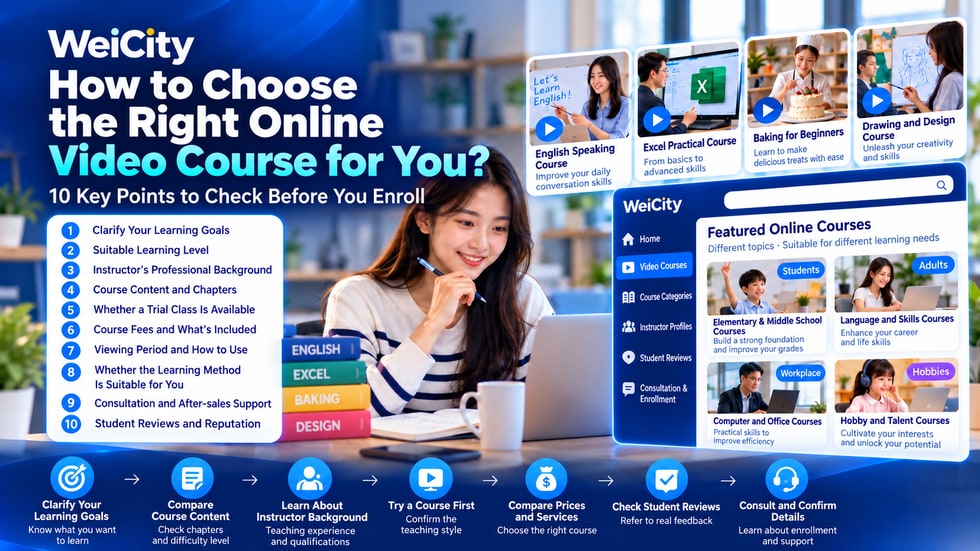
More and more students, parents and working professionals are searching online for learning courses that suit them.
Whether it is English, mathematics, computer skills, design, baking or professional training, you can find online video courses in many different formats.
However, as course choices multiply, many learners also face new problems.
🔸 Why do courses on the same topic have such different prices?
🔸 How can you tell whether a course suits beginners?
🔸 How should you assess an instructor's teaching experience?
🔸 How long can you watch after purchase?
🔸 Can you get a refund if the course content is not suitable?
🔸 Should you choose a free course or a paid course?
In fact, when choosing an online video course, you should not only look at advertisements, prices or the number of videos.
What matters more is confirming whether the course content matches your learning goals and whether the services it offers are clear and reliable.
Below are 10 key points worth checking before you enroll.
Before choosing a course, you should first understand why you want to learn.
Different learning goals may call for completely different courses.
For example:
📚 A student wants to strengthen mathematics fundamentals.
🗣️ An adult wants to improve English speaking ability.
💻 An office worker wants to learn Excel operations.
🎨 A beginner wants to master graphic design techniques.
🍰 A hobby learner wants to learn how to make cakes.
💼 An entrepreneur wants to understand digital marketing methods.
If your learning goal is unclear, you may not know where to start even with a course that has rich content.
It is recommended to first ask yourself:
✅ What do I want to learn?
✅ What foundation do I currently have?
✅ How much study time am I prepared to invest?
✅ Do I want to learn through video, or do I need live instruction from a teacher?
Only after clarifying your learning goals can you further compare different courses.
Not all courses are suitable for learners with no background.
Some courses are designed specifically for beginners.
Others require a certain level of foundational knowledge.
For example, computer courses can be divided into:
📘 Beginner: Understanding the Excel interface and basic operations.
📗 Intermediate: Commonly used formulas, charts and data organization.
📙 Advanced: Complex data analysis and advanced applications.
If you have no Excel experience but buy an advanced course directly, the learning process may be quite difficult.
Therefore, before enrolling, you should check the course's intended audience and prerequisites.
For education centers and instructors, clearly labeling the course level can also reduce misunderstandings after students enroll.
Whether a course suits you depends not only on its content but also on the instructor's expertise and teaching methods.
It is worth checking:
🎓 Whether the instructor has relevant academic qualifications or professional certifications.
💼 Whether the instructor has relevant industry experience.
📚 Whether the instructor has teaching experience related to the course.
🗣️ Which language is used for instruction.
🎬 Whether teaching demonstrations or trial content are provided.
💬 Whether complex knowledge is explained clearly.
For example, an office worker who wants to learn business Excel can first check whether the instructor has practical experience handling office data.
If a parent is looking for a course for a child, they can consider whether the teacher is familiar with the appropriate age group and learning level.
Professional qualifications, teaching experience and course performance should be assessed together, rather than relying only on promotional titles.
Similar course names do not mean the actual teaching content is the same.
For example, two courses may both be called “Basic English Speaking Course.”
The first may mainly introduce everyday vocabulary.
The second may include pronunciation, dialogues, situational practice and review.
Therefore, it is recommended to review the full course outline before purchasing.
📘 Chapter 1: Basic knowledge.
📗 Chapter 2: Main teaching content.
📙 Chapter 3: Practical application.
📕 Chapter 4: Practice and review.
A course does not necessarily need many chapters.
What matters more is a reasonable content arrangement that helps learners progress step by step.
For learners encountering an instructor for the first time, trial content can help determine whether the teaching style suits them.
Trial lessons do not need to be very long.
For example:
🎬 A 5-minute explanation demonstration.
💻 A simple software operation lesson.
🗣️ A short English speaking practice.
🎨 A demonstration of a basic painting technique.
Through a trial lesson, learners can observe:
✅ Whether the explanations are clear.
✅ Whether the video and audio are easy to understand.
✅ Whether the teaching pace is suitable.
✅ Whether the course content meets your personal needs.
✅ Whether they are willing to continue with the full course.
If there is no free trial, you can also review the public course outline, teaching samples, or other reliable materials.
Online video courses may use different pricing methods.
For example:
💳 One-time purchase.
📦 Series course bundle.
🔄 Monthly or yearly subscription.
🏫 Online courses combined with in-person lessons.
🎁 Free basic course plus paid advanced course.
When comparing prices, you should also understand what is actually included.
For example, two Excel courses may be priced at RM49 and RM99 respectively.
The more expensive one is not necessarily better, and the cheaper one is not necessarily more worthwhile.
You should further compare:
📚 Whether the teaching content is complete.
⏱️ The actual course duration.
📝 Whether exercises and learning materials are included.
👨🏫 Whether instructor guidance is provided.
🔐 How long you can watch after purchase.
💬 Whether course consultation or learning support is included.
Whether a course is worth buying should be judged based on its actual content and your personal needs, not just its selling price.
This is a part that many learners easily overlook.
Some video courses allow long-term viewing.
Some courses only provide access for a fixed period.
Some membership courses require an active subscription to continue viewing the specified content.
Before enrolling, you should confirm:
🔹 How long can you watch after purchase?
🔹 Can you replay the content?
🔹 Is a continuous membership fee required?
🔹 Is viewing allowed on both mobile phones and computers?
🔹 Can course materials be downloaded?
🔹 Can you still use the course after it is updated?
🔹 What happens to viewing access when a subscription ends?
Merchants should also clearly explain these conditions in course introductions, so learners do not discover restrictions only after paying.
Different online video courses may use different teaching formats.
🎬 Pre-recorded video course
Learners watch recorded content according to their own schedule.
💻 Live online classroom
Learners take part in the teacher's online lessons at scheduled times.
🏫 Blended learning
Combines in-person classes, online lessons, or pre-recorded videos.
📝 Self-paced course
Learning is mainly completed through videos, textbooks, and exercises.
👨🏫 Guided course
Instructor feedback or learning guidance is provided according to the actual service arrangement.
For example, office workers who need flexible scheduling may prefer pre-recorded videos.
Children or beginners who need more real-time interaction may be better suited to courses with a teacher's guidance.
In particular, learners who need individualized teaching support should confirm whether the course can meet those learning needs.
Before buying a course, you should also understand how to contact the merchant if a problem occurs.
For example:
❓ What if payment succeeds but you cannot access the course?
❓ Who should you contact if a video cannot play properly?
❓ Can you ask the teacher questions about the course content?
❓ Can you exchange a course if you bought the wrong one?
❓ Do you meet the refund conditions?
❓ Who is responsible for the course service?
These questions are worth confirming in advance.
For education providers, offering clear contact details and service explanations also helps build customer trust.
However, providing contact details should not lead you to assume that one-on-one teaching or unlimited consultation is included.
All services should be subject to the actual course description.
When choosing a course, learners may look at other people's learning reviews.
Genuine, specific reviews can help you understand the actual experience of a course.
For example:
💬 Whether the course explanations are easy to understand.
💬 Whether the teaching content matches the description.
💬 Whether the course materials are practical.
💬 Whether the learning process is easy to keep up with.
💬 Whether the merchant delivers the service as promised.
However, reviews also need to be judged sensibly.
It is recommended to give priority to content that is specific, genuine, and relevant to your own learning needs.
Do not decide whether to buy based only on star ratings, the number of learners, or exaggerated success stories.
For merchants, when using learner reviews, they should also obtain appropriate authorization and ensure the content is genuine.
For learners looking for courses, one of the most frustrating situations is when important information is scattered across different places.
For example:
📱 Facebook only has course promotional images.
🎬 YouTube only has teaching demonstrations.
💬 WhatsApp requires asking about course materials one by one.
📋 Prices, target learners, and course content are not explained in one place.
Education providers and instructors may consider using the WeiCity merchant channel to centrally introduce their courses and teaching services.
🏪 Merchant and institution introduction
Helps prospective learners understand the background of the teaching institution or professional instructor.
📚 Course content introduction
Explains the course topics, teaching scope, and learning objectives.
👨🎓 Target learner description
Helps learners judge whether the course suits their age, level, and learning needs.
👨🏫 Instructor profile display
Introduces genuine relevant experience and professional background.
💰 Course fee explanation
Introduces fees and payment methods based on what the merchant actually provides.
📱 Contact and consultation information
Lets customers know how to ask further questions about the course or enroll.
🔗 Share the merchant channel in one place
Merchants can use the channel link for social media and everyday course promotion.
In this way, customers can learn about teaching services from one more centralized entry point, instead of having to start from scratch each time to look for basic information.
However, features such as course comparison, instant purchase, learning progress tracking, and paid viewing still need to be judged according to what WeiCity actually supports.
For education providers hoping to attract prospective learners, clear course descriptions are equally important.
When searching, many learners type their learning needs directly.
For example:
🔍 Online English Classes Malaysia.
🔍 Beginner Excel Course Malaysia.
🔍 Online Malaysian math tuition.
🔍 Children's English speaking course.
🔍 Penang Baking Course.
🔍 Photoshop Online Course for Beginners.
For this reason, merchants should avoid course names that are too general.
❌ English course.
✅ Beginner English Speaking Online Video Course | Suitable for Adult Beginners.
❌ Computer lessons.
✅ Basic Excel Online Course | Practical Lessons for Office Beginners.
❌ Math videos.
✅ Primary School Math Video Course | Basic Operations and Word Problem Practice.
Public course pages should reasonably include:
✅ A clear course title.
✅ Detailed course content.
✅ Suitable target learners.
✅ Teaching language and format.
✅ Introduction to the instructor and institution.
✅ Course fees or consultation methods.
✅ Genuine and relevant teaching materials.
This information not only helps learners understand the course, but also helps search engines judge the topic of the page.
Of course, actual Google search rankings also depend on factors such as page indexing status, technical settings, content quality, and search competition.
Learners and parents can use the following checklist to help them make a choice.
✅ Does the course match your learning goals?
✅ Is the course difficulty suitable for you?
✅ Is the instructor's background genuine and clear?
✅ Is the course catalogue complete?
✅ Can you first review the teaching demonstrations?
✅ Are the course price and what is included clear?
✅ Is the viewing access after purchase clear?
✅ Does the learning format fit your schedule?
✅ Is the learning support you need provided?
✅ Are the course service and refund conditions clear?
Not every course needs to have the same features.
The key is to choose a teaching service that suits your personal needs and provides transparent information.
Online video courses offer flexible learning options.
However, different learners have different foundations, goals, and schedules.
Therefore, whether a course suits you matters more than simply comparing the number of videos, prices, or promotional effects.
For education centres, training institutions, and professional instructors, it is also important to think from the learner's perspective and provide genuine, clear, and easy-to-understand course introductions.
When prospective students can quickly find the information they need, it is easier for them to decide whether to seek further consultation or sign up.
🌐 WeiCity | Making course information easier to understand, so learners in need can more conveniently find teaching services that suit them.
🎓 Choosing a suitable course starts with understanding the course content.