

7 🔍 Social profile, traditional website, or merchant channel? How should small merchants choose?
🧭 Understand the different roles of three online business tools and choose the development approach that best fits your business
💡 Social profiles suit attracting followers and everyday interaction, traditional websites suit highly customized brand and system needs, and WeiCity merchant channels bring together brand introductions, content, products, services, and customer actions in one entry point. This article compares costs, management, features, and customer experience to help small merchants choose the online business approach that fits their current stage.
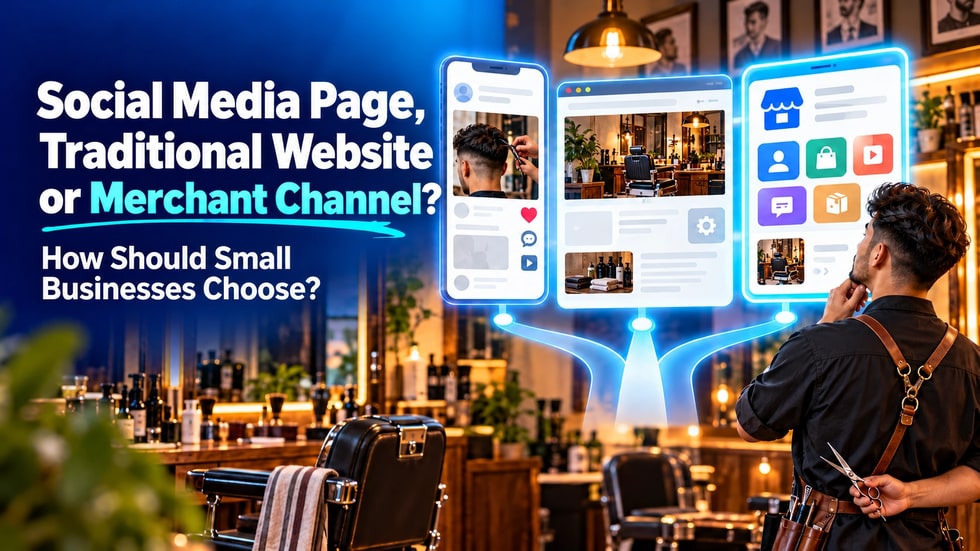
When a merchant prepares to develop an online business, they often face three choices: running a social profile, building a traditional website, or creating a merchant channel.
These three tools are not exactly the same, and you do not necessarily have to choose just one. They solve different problems and suit different stages of business.
Merchants first need to understand their goals before deciding where to start.
Social platforms such as Facebook, Instagram and TikTok can help merchants publish content, reach new customers and build everyday interaction.
For merchants just starting an online brand, a social profile is usually an easy promotional channel to begin with.
• Publish photos, short videos and brand stories
• Share new products, offers and daily updates
• Interact with fans' comments
• Reach more users through platform recommendations
• Increase brand exposure with popular content
However, the main role of a social profile is to spread content. It does not fully organize merchant information or handle transactions.
Customers may need to scroll through many posts to find the address, opening hours, menu, products and contact details. Content a merchant posts may also be quickly replaced by new information.
Social platforms are good for letting customers see you, but they may not fully answer every question customers want to know.
A traditional website allows merchants to plan their own page structure, visual design and system features.
If a business needs a complex membership system, multilingual content, special booking processes, connections to internal systems or a highly customized brand experience, a traditional website offers greater room for design and development.
• Every page can be designed according to brand requirements
• Special features and business processes can be developed
• Suitable for displaying large amounts of company information
• Can connect with different external systems
• Suitable for businesses with long-term technical and maintenance budgets
Traditional websites offer a high degree of freedom, but they usually also require more time, cost and management resources.
Merchants may need to handle domain names, servers, design, development, security, maintenance and content updates. If business needs change, the system may also need to be adjusted again.
For smaller merchants or those just starting digital operations, building a complex website from the outset may not be the easiest choice.
The WeiCity merchant channel sits between a social profile and a complex website.
It allows merchants to create a clear brand entry point while adding products, menus, content, Gallery, contact and transaction features as needed.
• Centrally display brand introduction and merchant information
• Clearly list address, opening hours and contact details
• Publish articles, announcements, events and offers
• Display products, services, menus or works
• Connect inquiries, bookings, orders and payment processes
• Add features step by step as business needs grow
Merchants do not need to plan a complex website structure first, nor do they need to enable all features at once.
You can first set up a basic channel so customers can find and learn about your business, then gradually improve online business features based on actual needs.
From a business perspective, a social profile is more like a promotional window, a traditional website is more like a custom project, and a merchant channel is more like an online business space that can be used right away.
• If you want to increase exposure and interaction: a social profile is more suitable
• If you want to develop a highly customized system: a traditional website is more suitable
• If you want to centrally display information and drive customer action: a merchant channel is more suitable
• If you want to start quickly and add features gradually: a merchant channel is more lightweight
• If you want full control over complex design and technical architecture: a traditional website offers more room
• If you want to keep publishing short videos and daily updates: social platforms have a stronger reach advantage
When choosing a tool, do not only compare which one has the most features. Consider which one better suits your current business needs and management capacity.
Online tools involve not only upfront building costs but also long-term update and maintenance costs.
Social profiles are usually easy to register and use, but merchants need to keep creating content to maintain exposure.
Traditional websites may involve design, development, servers, security and later modification fees, and also require regular maintenance by staff.
Merchant channels provide an already organized business structure, so merchants can first set up essential information and then expand features as needed.
• The main investment in a social profile is content and operating time
• The main investment in a traditional website is design, development and technical maintenance
• The main investment in a merchant channel is organizing information and continuously updating business content
For small merchants, a tool that they can manage themselves, update easily and that fits current budgets is usually more practical than a feature-heavy platform that no one maintains over the long term.
A social profile, a traditional website and a merchant channel can work together rather than replace one another.
A simple and practical combination is:
• Use social platforms to publish content and attract customer follows
• Place a merchant channel link in your profile bio, posts and ads
• Let customers enter the channel to view complete information, products, menus or services
• Complete inquiries, bookings, orders or payments through the channel
• When the business grows to need high customization, consider building or connecting a traditional website
This lets different tools handle different tasks, reduces duplicate management, and gives customers a clearer path to action.
Before deciding, you can first answer the following questions:
• What do you need most right now: exposure, brand display, or completing transactions?
• What information do customers ask about most often?
• Do you need to display products, menus, services or works?
• Do you have time to continuously manage multiple platforms?
• How much building and maintenance budget can you invest right now?
• Do you need complex and special customized features?
If the merchant most needs a professional entry point where customers can quickly understand the business and take action, a merchant channel will be the easier choice to start with.
If the main goal is to increase content exposure, you can continue to focus on running a social profile.
If the business already has clear complex requirements, a technical team and a long-term budget, you can further plan a traditional website.
Every online tool has its own value.
What matters is not following what other merchants do, but choosing a way you can keep managing and that truly helps customers take action.
For many small merchants, you can start with a lightweight merchant channel and bring together important information, content, products and customer entry points.
As the business gradually grows, you can add more features or connect other platforms, so your online business space develops alongside the business.
👉 Start with the RM0 Trial Edition to create a WeiCity merchant channel and give customers a clearer, more complete online entry point.