

28 👥 How Can Multiple Staff Members Jointly Manage One Merchant Channel?
🧭 From staff division and content review to order handover and account security, build a channel management process that does not become chaotic
Once a merchant channel begins generating content, products, orders, and customer inquiries, multiple staff members usually need to take part. Effective team management does not mean everyone edits the channel at the same time. Instead, first confirm the channel owner, then divide responsibilities for content, products, orders, and customer contact, and establish review, update, and handover processes. This article explains how small merchants can arrange multi-person collaboration while avoiding duplicate edits, information errors, missed orders, and account security problems.
When a merchant is run by one person, products, content, orders and customer contact are all handled by the same person.
As the business becomes more stable, work may start to be divided among different employees:
• Someone is responsible for filming and publishing content
• Someone is responsible for updating products and prices
• Someone is responsible for checking orders
• Someone is responsible for replying to customers
• The store manager is responsible for checking overall materials
Without clear division of work, employees may edit the same content at the same time, or assume someone else has handled it, resulting in omissions.
Therefore, the first step in multi-person management is not assigning login credentials, but first assigning responsibilities.
According to WeiCity's currently public information, one account corresponds to one merchant channel. Once a channel is set up, you can publish articles, images, videos and products.
However, the current public pages do not clearly state whether different plans offer multiple administrators, staff sub-accounts or role-based permissions.
If a merchant needs several employees to access the management backend directly, it should first confirm with WeiCity the number of administrators, login methods and permission scope supported by the current plan.
Until this is confirmed, do not assume that each employee can have an independent backend account, and it is not recommended to casually share the main account password with the whole team.
Every merchant channel should have one ultimate owner.
The channel owner does not necessarily complete all tasks personally, but is responsible for the channel's overall materials.
Main responsibilities include:
• Keeping the main account credentials
• Confirming the merchant name and brand materials
• Deciding which employees may take part in management
• Reviewing important products, prices and promotions
• Checking that orders are being handled
• Handling major customer issues
• Completing account and material handover when an employee leaves
• Regularly checking that the channel still matches the business situation
The channel owner should have the final decision-making authority to prevent different employees from publishing conflicting information.
The content lead is responsible for turning the merchant's business strengths into content that customers can read and watch.
Main tasks may include:
• Preparing article topics
• Photographing products, environments and service processes
• Organising images and videos
• Writing titles, summaries and body text
• Checking that brand names and tone are consistent
• Scheduling publication dates
• Updating business notices and promotional content
The content lead does not necessarily need to change product prices or process orders.
Separating responsibilities reduces the risk of accidentally changing important business information.
The product lead makes sure that the products, menus, courses, or service materials that customers see are accurate.
Main tasks include:
• Adding new products or service items
• Updating names, images, and descriptions
• Checking prices and specifications
• Update inventory or availability
• Stopping the display of items that have ended
• Checking whether promotional content has expired
• Informing the content lead about important product changes
If prices are decided by the store manager, the product lead should obtain confirmation first before making updates.
Do not let different employees fill in prices from memory.
The order lead should check orders generated through the relevant features on a regular schedule and make sure customers receive a response.
Main tasks include:
• Checking new orders
• Confirming whether products or meals are available
• Verifying information submitted by customers
• Confirming payments according to the merchant's process
• Arranging preparation, packing, pickup, or delivery
• Informing the next shift about unfinished orders
• Recording cancellations, refunds, or special situations
• Organizing questions that customers frequently ask
The most important task for the order lead is to ensure that every item requiring follow-up has a clear status.
Do not just say "already handled" in a chat message without leaving handover information the team can check.
Small teams do not necessarily need a dedicated reviewer.
The channel lead, store manager, or a senior employee can be responsible for the final check.
The following content should be reviewed before publishing:
• Product price
• Discounts and promotional conditions
• Changes to business hours
• Payment instructions
• Delivery or pickup arrangements
• Public phone numbers and addresses
• Content involving customer information
• Articles and videos that may affect the brand image
Routine everyday images can follow a simple review process, while content involving prices, payments, or customer commitments should be handled more carefully.
Merchants can first divide channel work into several parts, then specify who is responsible for each.
For example:
• Merchant information: managed by the store manager, reviewed by the lead
• Article content: prepared by the content employee, published by the store manager
• Product images: prepared by photography or content staff
• Product prices: updated by the product lead, confirmed by the store manager
• New orders: handled by the employee on duty
• Customer questions: followed up by customer service or the store manager
• Promotions: published after approval from the lead
• Account security: managed by the channel lead
One person can take on multiple roles, but each task can have only one primary person responsible.
Others may assist, but there should not be a situation where "everyone is responsible, so no one is really responsible."
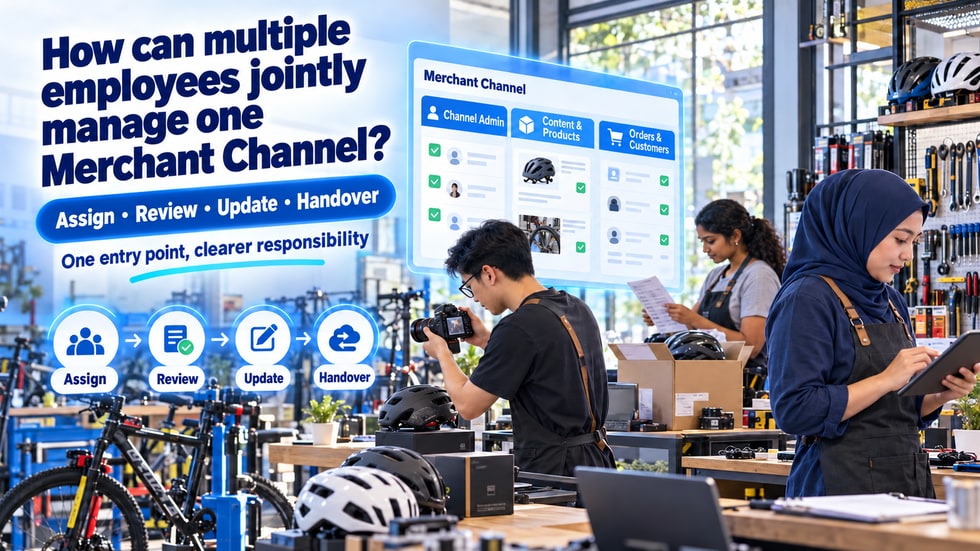
Whether publishing an article, updating a product, or launching a promotion, the same process can be used:
• Step 1: Assign
Decide who prepares the materials, who checks them, and who is responsible for the final publishing.
• Step 2: Review
Check text, images, prices, dates, contact methods, and promotional conditions.
• Step 3: Update
Authorized staff enter the channel to complete the publishing or editing.
• Step 4: Hand over
Record in the team log what was changed, when it was changed, and whether any follow-up work remains.
A fixed process reduces differences caused by employees operating based on personal habits.
We suggest dividing content into three stages:
• Draft: the article, image, or video is still being prepared
• Pending review: the content is complete and waiting for the responsible person to check it
• Published: the content has appeared on the merchant channel
Before publishing, you can check:
• Is the title clear?
• Are the dates and event times correct?
• Do the images belong to the merchant or have usage permission?
• Do the product names and prices match?
• Are the contact details correct?
• After reading, will customers know what to do next?
• Does it include any internal or customer information that should not be made public?
Content review does not need to be complicated, but someone must complete the final confirmation.
When many people manage products, the most common problem is that each employee saves different versions of prices and images.
We suggest establishing a unified rule:
• Use a fixed name for each product
• Store product images in one shared folder
• Refer to only one primary record for current prices
• Use the same format for specifications and inventory
• Clearly record the start and end dates of promotions
• Record the date and person responsible when changing a price
• Do not keep delisted products in promotional content
When employees need to update a product, they should first check the primary record rather than edit based on old chat messages or memory.
If the merchant has morning and evening shifts, it should specify when orders are checked in each shift.
For example:
• Check unfinished orders from the previous day when opening
• Check new orders at fixed intervals during business hours
• Before the shift ends, organize items that still need to be handled
• Before closing, confirm the status of the day's orders
Handover content may include:
• Orders not yet confirmed
• Orders awaiting payment
• Orders awaiting customer replies
• Out-of-stock products or items that need replacement
• Orders for which pickup or delivery has been arranged
• Issues that need a decision from the store manager
A handover must allow the next employee to continue the work without having to ask about every situation again.
Different employees should not differ too much in tone or commitments when replying to customers.
Merchants can first prepare standard materials for common questions:
• Business hours
• Address and service area
• Product price
• Payment methods
• Delivery and pickup arrangements
• Appointment process
• Return, exchange, or cancellation rules
• Typical reply time
Standard materials are not meant to make employees reply like robots, but to ensure that important information remains consistent.
Employees should not promise additional discounts, free delivery, or special refunds without approval.
If the current plan supports separate staff accounts or role permissions, each authorized employee should use an individual login and be granted only the permissions needed for their work.
If the current plan does not support individual staff logins, it is recommended that a small number of designated people handle back-end operations, while other employees provide content and materials through internal processes.
Account security should take note of the following:
• Do not send passwords in public groups
• Do not let multiple people share the same simple password for a long time
• Do not use the same password as a personal account
• Do not store passwords in public files on shared computers
• Regularly check who still needs management permissions
• Complete account handover immediately when an employee leaves
• If unusual changes are found, change the password promptly and check the content
• Important operations should be confirmed by the channel lead
Many people participating in the work does not mean that everyone must log in to the back end directly.
Sometimes it is actually safer for employees to prepare materials and then have designated people review and publish them.
When an employee leaves the team, a verbal handover alone is not enough.
We suggest checking the following items:
• Are account passwords still saved anywhere?
• Can they still access relevant work email or devices?
• Where are unpublished materials stored?
• Which orders have not been completed?
• Which customers are still waiting for a reply?
• Have product prices and inventory been updated?
• Are any promotions about to start or end?
• Which employee will take over the existing work?
After the handover is complete, change passwords, adjust permissions, or stop related access as appropriate.
Employee A: Channel lead
• Manages account security
• Reviews prices and important content
• Handles special orders and customer questions
Employee B: Content and products
• Shoots images and videos
• Prepares articles
• Updates product descriptions and images
Employee C: Orders and customers
• Checks orders
• Replies to general questions
• Arranges pickup, preparation, or delivery
Before the end of each day, the three people only need to complete one brief handover:
• What was changed today?
• Which orders have been completed?
• Which items are still waiting to be handled?
• What content or promotions need to be published tomorrow?
This process is clearer than having all employees freely edit the channel at the same time.
Day 1: List all routine work in the channel.
Day 2: Assign a primary person responsible for each task.
Day 3: Decide which content must go through review.
Day 4: Establish unified storage rules for products, images, and copy.
Day 5: Establish order duty and handover records.
Day 6: Check account security and confirm who truly needs back-end access.
Day 7: Simulate a content publishing, product update, and order handover process.
After one simulation, the team can spot unclear responsibilities or steps that are easy to miss.
• Is there a clearly designated channel owner?
• Does each task have a primary person responsible?
• Who decides and reviews product prices?
• Which employees can publish content?
• Which employees are responsible for checking orders?
• Who handles customer questions?
• Is an order handover completed at the end of each shift?
• Are images, copy, and prices kept in just one primary version?
• Do employees know which materials must not be made public?
• Are primary account passwords kept out of group chats?
• Is there a complete handover process when an employee leaves?
• Has the current plan's management options been confirmed with WeiCity?
The key to managing a merchant channel with multiple people is not having more people operate at once, but making sure everyone knows what they are responsible for.
The channel owner ensures direction and security.
Content staff keep updates going.
Product staff ensure information is accurate.
Order staff ensure customers receive follow-up.
The review process helps the team reduce mistakes.
When division of duties, review, updates, and handovers become settled habits, a merchant channel can keep its information clear, its responses timely, and its brand consistent as the team grows.
📌 Friendly Reminder
WeiCity's current public materials clearly state that one account corresponds to one merchant channel, but the public pages do not specify detailed rules for multiple administrators, staff sub-accounts, or role-based permissions. Merchants who need several people to manage the back end directly should first confirm the current plan, number of accounts, permissions, and security requirements with WeiCity before having staff log in.