

3 📋 Hard to explain a service? Make it clear in one article
Organize service content, target audience, process, and preparation requirements in the WeiCity merchant channel, so customers understand more clearly before choosing and can quickly get to the key points when inquiring.
Simply listing a service name and price often leaves customers unsure what is included or whether it suits them. This article explains how to use the WeiCity article feature to write a complete service description, and uses a custom curtain example to help merchants clearly explain the service scope, handling process, fee details, and materials needed for inquiries, reducing back-and-forth communication.
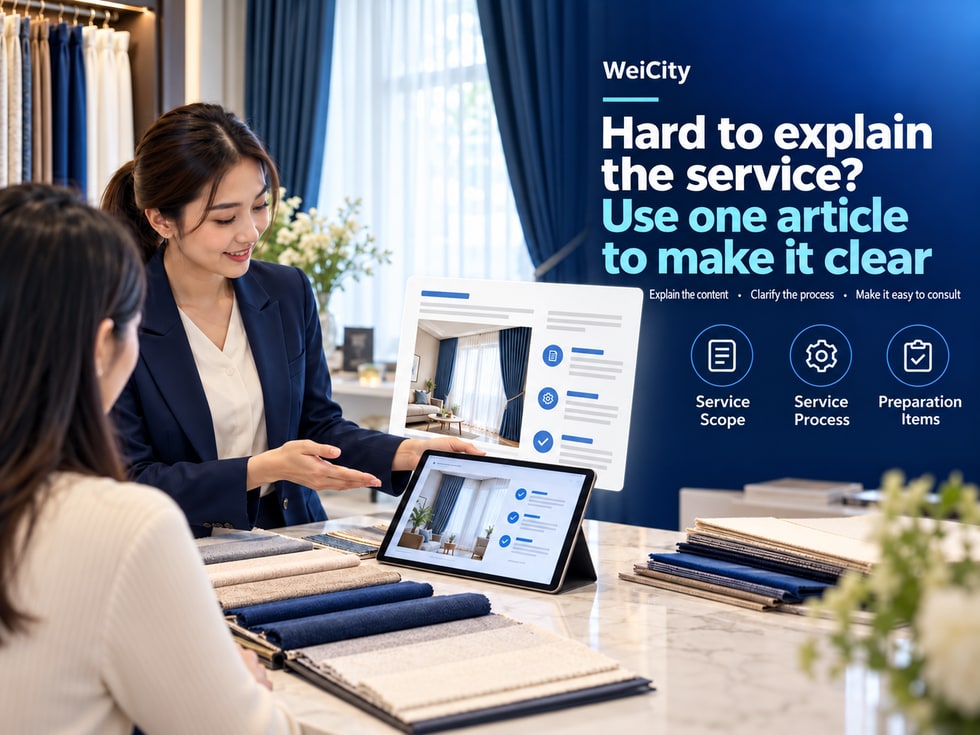
You sent the price, but the customer also wants to know what is included.
You introduced the process, and then the customer asks what materials they need to prepare.
After chatting for a while, you find that the item the customer needs is not within the scope of this service.
If these situations happen often, you can organize a complete service introduction into an article so customers can understand the basics first and then ask about their own needs.
🔍 First, explain: what can this service help customers do?
Customers may not be familiar with your industry terms. At the start of the article, use simple language to explain the purpose of the service.
For example, a custom curtain merchant could write:
“We help select curtain fabrics and styles based on window size, room use and customer preferences, and provide related measuring and installation arrangements.”
After reading this, customers can get an initial sense of whether this is the service they are looking for.
Explain the actual items provided one by one to help customers understand the scope of the service.
For example:
🔸 Requirement discussion and style suggestions.
🔸 Choice of fabric, color and light-blocking level.
🔸 Window measurement and size confirmation.
🔸 Curtain making.
🔸 Installation arrangements.
Fill in the above items according to the merchant's actual services. If certain items require additional fees or are only available in specific areas, please also note this in the corresponding place.
A clear introduction can reduce customer misunderstandings about the service content.
Use specific scenarios to help customers judge their own needs.
Using custom curtains as an example, you can introduce:
🏠 Moving into a new home and needing curtains for multiple spaces.
☀️ The room is too bright and they want to learn about light-blocking options.
🛋️ Redecorating the living room and wanting to match different colors and styles.
🔄 Existing curtains need replacing and they want to confirm whether the track can still be used.
Customers will more easily find situations relevant to them and can describe their needs more easily when inquiring.
Customers care not only about the result but also want to know what will happen next.
Based on your actual arrangements, explain each step:
① Provide basic information
Customers share their area, window photos and general needs.
② Initial communication
The merchant understands the purpose of the space, style preferences and budget range.
③ Confirm measurements and plan
Arrange measuring according to the actual service, and confirm materials and production details.
④ Provide a quote
Explain the items, fees, and matters the customer needs to confirm.
⑤ Production and installation
After confirmation, arrange the next steps and communicate the estimated timeline.
When each step is clearly described, customers can more easily understand how they need to cooperate.
If fees will change depending on size, materials or scope of work, you can explain the main influencing factors.
For example:
🔸 Price differences between different fabrics and styles.
🔸 How size and quantity affect the quote.
🔸 Whether tracks, accessories or installation are charged separately.
🔸 Whether special construction conditions need separate assessment.
You may provide reference prices that actually apply, but state the corresponding conditions. For services that require assessment before a quote, you can also tell customers directly what information they should provide.
Service articles can include relevant images, such as style examples, material details, measuring processes or finished results.
Add a short caption to each photo to help customers know what they are looking at.
📷“Light-transmission examples of different fabrics.”
📷“Window positions to confirm during measurement.”
📷“The style and installation method used in this case.”
Images and captions work together to help customers understand details that are hard to express in words.
Rather than only writing “Contact us,” give a more specific next step.
For example:
“To learn about custom curtains, please prepare your area, window photos, approximate dimensions and the light-blocking effect you want. After you contact us, we will explain the next steps based on your information.”
Customers know what to provide, and merchants can more easily begin effective communication.
📝 Your service introduction can follow this order
✅ Purpose of the service: what needs it can help customers solve.
✅ Scope of service: what items are included.
✅ Suitable customers: which situations may be considered.
✅ Process: how things are arranged from inquiry to completion.
✅ Fee information: which factors affect the price.
✅ Preparation: what customers need to provide.
✅ Contact information: how to make further inquiries.
🌟 Explain the service clearly so customers come to you with clearer needs.
👉 Choose one of the services you are asked about most often, write a complete introduction in your WeiCity merchant channel, and share it directly in your next conversation.