

3 🛒 How do customers choose dishes? Explain the ordering process clearly
From picking dishes to confirming quantities and combinations, make each choice clearer
When ordering online, customers need to confirm the dishes, portions, and any specifications, flavors or add-ons provided on the page. This article focuses on the dish selection process in WeiCity Menu and Online Ordering, explains how customers should review and verify their choices, and helps merchants clearly explain required items, extra charges and special requests to reduce wrong or missed selections.
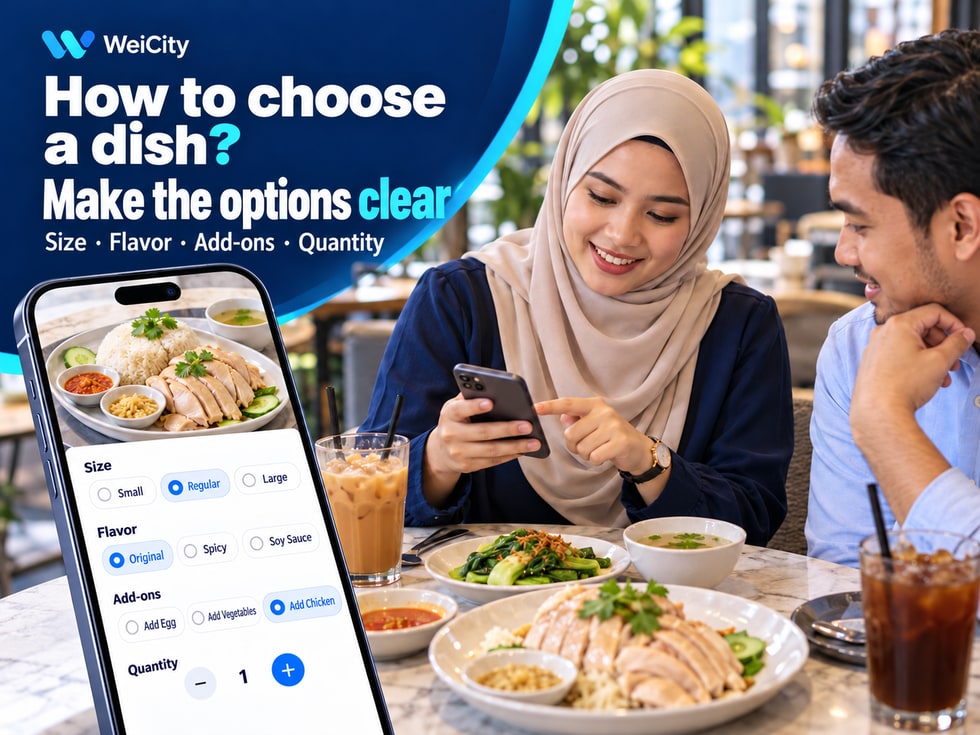
After a customer sees a dish they want online, how should they make their selections?
For example, if a customer wants to buy a chicken rice meal, they may need to confirm:
🍚 Regular portion or large portion?
🌶️ Not spicy, mildly spicy, or very spicy?
🥚 Do they want an egg added?
🍗 Do they want extra meat added?
🥤 Does the set meal include a drink?
🔢 Finally, how many portions should be purchased?
If menu options are not clearly explained, customers may choose the wrong specification, miss add-ons, or not understand why the final price differs from the price they saw originally.
WeiCity Online Ordering allows customers to select dishes, specifications, flavors, add-ons, and purchase quantities based on the options provided on the current menu page.
For restaurant merchants, clear option settings not only make ordering easier for customers but also help the kitchen understand the actual preparation requirements for each order.
This article introduces common specifications, required items, optional items, add-on charges, and quantity management in Online Ordering, helping restaurants, cafés, drink shops, and other food and beverage merchants organize menus that are easier to understand.
Specific size options, required selections, multiple-choice rules, add-on charges, and how orders are displayed depend on WeiCity's current Online Ordering features and the merchant's actual settings.
After seeing a dish photo, customers usually first decide whether the food meets their needs.
However, some dishes look similar but may actually contain different things.
For example:
🍗 Roast Chicken Rice.
🍗 Roast Chicken Rice Set.
🍗 Double Roast Chicken Rice.
Although the names are similar, the included items may differ.
Confirm:
🍚 Type of staple.
🍗 Meat selection.
🍜 Type of dish.
🎁 Whether it is a set meal.
For example:
Pan-fried chicken chop rice
Includes:
🍗 Pan-fried chicken chop.
🍚 Steamed rice.
🥗 Designated side dish.
🧂 Black pepper sauce.
For example:
Pan-Fried Chicken Chop Rice Set
May include:
🍗 Chicken chop rice.
🥤 Designated drink.
🍟 Designated snack.
The actual contents must follow the merchant's description.
For example:
🍛 Chicken chop rice, a la carte: RM15.
🍛 Chicken chop rice set: RM20.
The above prices are examples only.
If the image shows a drink, side dish, or other accompaniment but the product description does not state whether it is included, customers should confirm first.
📌 Before choosing a dish, check the name, photo, description, and price so you know exactly what you are buying.
The same dish may be offered in different sizes.
For example:
🍚 Regular and large portions.
🍕 Pizzas in different sizes.
🥤 Drinks in different volumes.
🍗 Fried chicken in 4-piece and 6-piece packs.
👥 Individual sets and sharing sets.
For example:
🍚 Regular portion.
🍚 Large portion.
If a large portion requires an extra charge, this should be clearly stated.
For example:
🍕 9 inch.
🍕 12 inch.
🍕 15 inch.
Merchants should fill in the sizes they actually offer.
For example:
🥤 350ml.
🥤 500ml.
🥤 700ml.
For example:
🍗 Fried chicken, 4 pieces.
🍗 Fried chicken, 6 pieces.
🍗 Fried chicken, 10 pieces.
For example:
👤 Individual meal.
👥 Set for two.
👨👩👧👦 Family sharing meal.
If descriptions such as "suitable for two people" are used, state that they are suggestions only, as actual needs may vary with individual appetite.
For example:
❌ Style A.
❌ Style B.
❌ Option 1.
❌ Option 2.
If numbering must be used, it is recommended to also state the actual contents.
For example:
Style A | Chicken rice, regular portion
Style B | Chicken rice, large portion
📌 The more specific the size name, the easier it is for customers to tell which portion or size they need.
Some dishes require customers to complete specified selections first so the actual preparation can be determined.
For example:
🍚 Choose one staple.
🌶️ Choose one spice level.
🥤 Choose one drink.
🍜 Choose one type of noodles.
These can be called required items.
Chicken Chop Set
Please choose one staple:
🍚 Steamed rice.
🍟 French fries.
🍝 Pasta.
Curry Chicken Noodles
Please choose one spice level:
🌶️ Not spicy.
🌶️ Mildly spicy.
🌶️🌶️ Medium spicy.
🌶️🌶️🌶️ Extra spicy.
Lunch Set
Please choose one drink:
🥤 Iced lemon tea.
🍵 Hot tea.
💧 Mineral water.
Because the merchant needs to know what the customer actually wants.
If the customer does not choose a staple, the kitchen may not know whether to prepare steamed rice or french fries.
Recommended:
Please choose one staple.
Please choose one spice level.
Please choose one drink.
Instead of only writing:
"Staple"
"Spice level"
"Drink"
Whether WeiCity currently supports setting an option as mandatory, and whether it can prevent orders from being submitted without a completed selection, should be confirmed based on the actual features.
If the system has no such restriction, merchants cannot assume the system will check automatically based on written instructions alone.
📌 The purpose of required items is to ensure customers clearly complete the choices needed to prepare the dish.
Optional items differ from required items.
Optional items usually mean customers can decide for themselves whether to add certain things.
For example:
🥚 Add egg.
🧀 Add cheese.
🍗 Add meat.
🍚 Add rice.
🥤 Add a drink.
Base dish:
🍗 Chicken chop.
🍚 Steamed rice.
🥗 Side dish.
Optional add-ons:
🥚 Add egg.
🧀 Add cheese.
🍚 Add rice.
Base drink:
🥤 One cup of milk tea.
Optional toppings:
🧋 Pearls.
🍮 Pudding.
🧊 Other toppings actually offered.
Base pizza:
🍕 Pizza in the designated flavor.
Optional add-ons:
🧀 Extra cheese.
🍄 Mushrooms.
🍗 Chicken.
🏷️ Add-on name.
💰 Whether there is a charge.
🔢 Quantity that can be selected.
🍽️ Which dish it applies to.
For example:
The product description says:
"Chicken chop rice with egg."
But the egg actually costs extra.
This kind of description easily causes misunderstanding.
It is recommended to clearly distinguish:
What the base dish includes.
How much extra add-ons cost.
📌 Optional items should let customers know what extra they can choose and how their choice will change the order.
Dish options may use different selection methods.
Means customers can choose only one item from the specified options.
For example:
Please choose one staple
🍚 Steamed rice.
🍟 French fries.
🍝 Pasta.
Means customers can choose multiple items.
For example:
Extra add-ons may be selected
🥚 Add egg.
🧀 Add cheese.
🍗 Add meat.
Some sets may specify:
"Please choose two side dishes."
For example:
🥗 Salad.
🍟 French fries.
🥦 Vegetables.
🍚 Steamed rice.
Because customers need to know:
Can one be chosen?
Can two be chosen?
Or can multiple be chosen?
If WeiCity currently supports the relevant settings, they can be arranged according to actual functions.
If there is no automatic limit, merchants need to use an actual handling method that accurately reflects the purchase requirements.
📌 Rules for single choice, multiple choice, and the number of selections should be clear to avoid different understandings of the order between customers and merchants.
When customers choose dishes online, the final amount may change due to size or add-ons.
For example:
🍛 Base chicken rice: RM12.
🥚 Add egg: RM2.
🍗 Extra meat: RM4.
🍛 Chicken rice: RM12.
Dish amount: RM12.
🍛 Chicken rice: RM12.
🥚 Add egg: RM2.
Dish amount: RM14.
🍛 Chicken rice: RM12.
🥚 Add egg: RM2.
🍗 Extra meat: RM4.
Dish amount: RM18.
The prices above are for illustration only.
For example:
🥤 Small milk tea: RM6.
🥤 Large milk tea: RM8.
For example:
The original set includes a designated drink.
The customer wants to switch to another drink.
If an extra charge applies, it should be explained before selection.
💰 Base price.
➕ Add-on charges.
📏 Size price difference.
🎁 Set meal upgrade fee.
🧾 Final order amount.
Do not only write:
"Extra charge applies."
but the specific amount is not stated.
It is recommended to let customers know the actual charge before they make a selection.
📌 Price changes should have a clear reason, so customers know what each additional charge corresponds to.
When ordering online, item quantity and add-on quantity are different concepts.
For example:
The customer orders two portions of chicken rice.
But only one of them needs an egg.
If this is not clearly distinguished, the kitchen may not know how to prepare it.
For example:
🍛 Chicken rice.
🌶️ Mildly spicy.
🥚 Add egg.
🔢 Quantity: 2 portions.
If the page supports quantity adjustment for identical configurations, you may choose based on the actual operation.
For example:
First portion
🍛 Chicken rice.
🌶️ Not spicy.
🥚 No egg.
Second portion
🍛 Chicken rice.
🌶️🌶️ Medium spicy.
🥚 Add egg.
Although the two items have the same name, their preparation requirements are different.
For example:
The customer purchases:
🍛 Chicken rice x 2 portions.
Including:
🥚 1 portion with egg.
🍛 1 portion without egg.
🏷️ Item name.
🌶️ Flavor for each portion.
🧩 Add-ons for each portion.
🔢 Corresponding quantity.
How specific options and quantities correspond should be based on what is actually displayed on the WeiCity order page.
If customers cannot clearly express different requirements for different items, it is recommended to contact the merchant first to confirm.
📌 When ordering for multiple people, the most important thing is that the specifications, flavors, and add-ons of every portion can be accurately matched.
A set meal may include multiple items.
For example:
🍔 Burger.
🍟 French fries.
🥤 Drinks.
However, customers need to know which items are already included in the set meal price.
Chicken burger set meal | RM18
Includes:
🍔 1 chicken burger.
🍟 1 portion of fries.
🥤 1 cup of designated drink.
If the merchant allows drink selection:
🍵 Hot tea.
🥤 Iced lemon tea.
💧 Mineral water.
If the merchant allows side selection:
🍟 French fries.
🥗 Salad.
🥦 Vegetables.
For example:
🧀 Extra cheese.
🍗 Extra chicken.
🥤 Drink upgrade.
If an upgrade requires an additional charge, it should be clearly listed.
For example:
The set meal already includes one cup of drink.
But the customer does not know this and buys another cup.
For this reason, the set meal description should clearly list the items already included.
📌 Set meal options should first explain the basic contents, then explain the items that can be replaced or added extra.
Some items may involve customers' special requests.
For example:
🧅 No onion.
🌶️ Less spicy.
🥗 Substitute side dish.
📦 Pack separately.
🍚 No plain rice.
If the page provides a remarks field, customers can fill in instructions as needed.
However, please note:
Filling in remarks does not mean the merchant will necessarily be able to meet the request.
If the item already has:
🌶️ Not spicy.
🌶️ Mildly spicy.
🌶️ Medium spicy.
It is recommended to choose from the options provided on the page first.
For example:
The customer wants to replace a certain ingredient.
It is recommended to contact the merchant first to confirm.
For example:
Sauce separately.
Drinks packed separately.
Confirm whether the merchant can arrange this.
If a customer is allergic to certain ingredients, this should be clearly told to the merchant before placing the order, and it should be confirmed whether the ingredients and preparation process meet the need.
Merchants also need to consider the risk of cross-contact, and a remark alone cannot guarantee that the food is safe.
Customers may choose another suitable item based on their actual situation.
📌 Special requests should be confirmed first, to avoid customers assuming that a remark has already been approved by the merchant.
After completing item selection, customers should review the order contents again.
Confirm that the correct item has been selected.
For example:
🍚 Regular portion.
🍚 Large portion.
For example:
Not spicy.
Mildly spicy.
Medium spicy.
For example:
🥚 Add egg.
🧀 Add cheese.
Confirm:
1 portion.
2 portions.
Or another quantity.
Check whether it includes:
💰 Base price.
➕ Add-on charges.
📏 Size price difference.
Item 1: Pan-fried chicken chop rice
📏 Specification: Regular portion.
🌶️ Flavor: Mildly spicy.
🥚 Add-on: With egg.
🔢 Quantity: 1.
Item 2: Pan-fried chicken chop rice
📏 Specification: Large portion.
🌶️ Flavor: Not spicy.
🥚 Add-on: None.
🔢 Quantity: 1.
Once items are submitted, the merchant may start preparing them.
If an error is found, first adjust it using the method currently provided on the page, then continue to submit the order.
📌 Checking once before submitting can reduce errors in specifications, flavors, add-ons, and quantities.
When setting up their WeiCity online menu, merchants can arrange the instructions in the order in which customers actually make their selections.
For example:
Pan-fried chicken chop rice
For example:
Please choose a portion size:
🍚 Regular portion.
🍚 Large portion.
For example:
Please choose a spice level:
🌶️ Not spicy.
🌶️ Mildly spicy.
🌶️🌶️ Medium spicy.
For example:
Optional add-ons:
🥚 Add egg: RM2.
🧀 Add cheese: RM3.
🍚 Extra rice: RM2.
For example:
Please choose the number of portions to order.
Confirm that customers can understand the charges corresponding to different options.
For example:
For adjustments not listed on the page, please contact the merchant first to confirm.
Confirm:
🏷️ Option names are complete.
📏 Specifications are easy to understand.
💰 Prices are clear.
🔢 Quantities are accurate.
For example:
For a regular chicken rice, if only extra egg and extra rice are offered, there is no need to create a complicated selection process just to add more options.
📌 Good item options should match actual preparation needs, rather than making customers complete too many unnecessary steps.
Different food and beverage merchants have different menu structures.
Options can be arranged based on actual supply:
🍚 Portion size.
🌶️ Spice level.
🥚 Add egg.
🍗 Add meat.
Options can be arranged based on actual supply:
🍜 Noodle type.
🌶️ Spice level.
🥬 Side dishes.
🥚 Add-ons.
Options can be arranged based on actual supply:
☕ Coffee type.
🧊 Hot or iced.
🥤 Cup size.
🥛 Milk options.
Options can be arranged based on actual supply:
🥤 Volume.
🍯 Sweetness.
🧊 Ice level.
🧋 Toppings.
Options can be arranged based on actual supply:
🍕 Size.
🧀 Cheese.
🍄 Toppings.
🎁 Set meal combinations.
Options can be arranged based on actual supply:
🎂 Size.
🍫 Flavor.
🎨 Design.
📝 Necessary ordering instructions.
Options can be arranged based on actual supply:
🍚 Staple foods.
🍗 Main dish.
🥗 Side dish.
🔢 Ordering quantity.
Because customers care about different choices when buying different items.
For example:
When buying bubble tea, customers may care about sweetness and ice level.
When buying pizza, customers may care about size and toppings.
When buying bento, customers may care about the main dish and side dishes.
📌 Item options should be set according to the actual characteristics of the products, so customers can more easily complete their selection.
The following is a hypothetical example illustrating the structure of item options, and does not represent a fixed setting or automatic processing rule of WeiCity.
Signature chicken chop rice.
RM12.
🍚 Regular portion: base price.
🍚 Large portion: additional RM3.
🌶️ Not spicy.
🌶️ Mildly spicy.
🌶️🌶️ Medium spicy.
🥚 Add egg: RM2.
🧀 Add cheese: RM3.
🍗 Extra meat: RM4.
Choose according to customer needs.
Customer selection:
🍛 Signature chicken chop rice.
📏 Large portion.
🌶️ Mildly spicy.
🥚 Add egg.
🔢 Quantity: 1.
Base price: RM12.
Large portion: RM3.
Add egg: RM2.
Dish amount: RM17.
The above amounts are examples only.
The actual settlement amount should be based on the current product settings and the price shown on the page.
Customers can gradually understand:
🍽️ What dish they are buying.
📏 Which size to choose.
🌶️ Which flavour they want.
🧩 Whether to add any extras.
🔢 How many portions to buy.
💰 How much they need to pay in the end.
📌 A clear option structure makes it easier for customers to complete their order, and easier for the kitchen to understand the order requirements.
After setting up dish options, it is recommended that merchants check them once on a mobile phone.
Confirm that the name matches the actual product.
For example:
Regular portion.
Large portion.
Confirm that the option names are clear.
Confirm:
🥚 Name is correct.
💰 Prices are accurate.
If the current feature supports single selection, multiple selection, or required-selection limits, check that actual operation matches the description.
Confirm that different dish configurations and quantities correspond correctly.
Confirm:
Base price.
Size price difference.
Add-on fees.
Confirm that the content customers select can be displayed clearly.
Confirm that customers know how to contact the merchant.
Confirm:
🏷️ Name is complete.
📏 Options are easy to read.
💰 Prices are clear.
🔢 Quantities are easy to verify.
If the current system provides a test mode, you may use it first.
If you need to submit a real order to verify, handle the related order and stock properly to avoid affecting normal business records.
📌 Before publishing dish options, it is recommended to fully check the actual selection and order display results once.
Clear dish names and introductions can help visitors understand the products and help search engines understand the topic of the page.
However, whether dish options are read by search engines, and whether they help with indexing and ranking, depends on page structure, technical settings, and other factors.
For example:
Pan-fried chicken chop rice
For example:
Main ingredients.
Flavors.
Served with meals.
For example:
Regular portion.
Large portion.
For example:
Add egg.
Add cheese.
Extra rice.
Avoid product descriptions that do not match the actual settlement amount.
For example:
“Best chicken rice, recommended chicken rice, chicken rice online ordering, chicken rice delivery……”
If the content provides no real value, it may actually reduce the reading experience.
📌 Option descriptions should first help customers order accurately, rather than adding complicated text to increase keywords.
If the current dish type offers size options, customers can make selections according to the actual page.
These are specified selections that customers must complete, such as a staple or flavour.
These are extra items customers can choose as needed, such as an added egg or cheese.
Whether automatic required-item checks are supported depends on the current actual features.
Whether single-choice settings are available depends on the current dish editing features.
Whether multiple selection and quantity limits are supported depends on the current features.
Whether add-on price settings and automatic calculation are supported depends on the current actual features.
Whether size price differences are supported depends on the current dish settings.
This depends on the current dish selection and order display method, and you should confirm whether different flavours can be recorded separately.
If the current dish offers related options, customers can make selections according to the actual page.
It is not recommended to treat remarks directly as confirmed add-ons or preparation requirements.
Customers should contact the merchant before ordering to confirm whether the ingredients and preparation conditions meet their needs.
This may involve add-on fees, size upgrades, or set meal adjustments. Check the actual order amount.
If the order has not been submitted, adjust it using the method provided on the page; after submission, contact the merchant as soon as possible to confirm.
Use clear size names, selection requirements, add-on prices, and quantity descriptions, and check the actual order display results.
📌 The clearer the sizes, flavours, add-ons, and quantities are, the easier it is for customers to make the correct selections.
✅ The name is correct.
✅ Image is accurate.
✅ Introduction is complete.
✅ Size names are clear.
✅ Portion descriptions are accurate.
✅ Different specifications are easy to distinguish.
✅ Flavour names are clear.
✅ Actually available.
✅ Selection requirements are clear.
✅ It is stated what must be selected.
✅ Selection rules match the actual features.
✅ Add-on names are correct.
✅ Optional range is clear.
✅ Extra charges are clear.
✅ Single-choice rules are clear.
✅ Multiple-choice rules are clear.
✅ Selection quantity limits are reasonable.
✅ Base selling price is correct.
✅ Size price differences are accurate.
✅ Add-on fees are complete.
✅ Dish portions are correct.
✅ Different configurations are easy to distinguish.
✅ Add-ons correspond to the correct dishes.
✅ Basic content is complete.
✅ Replaceable items are clear.
✅ Upgrade fees are clear.
✅ Contact information is valid.
✅ Purpose of remarks is clear.
✅ Special preparation requirements need to be confirmed.
✅ Options are easy to read.
✅ Price display is clear.
✅ Order content is easy to verify.
📌 Fully checking once before publishing can reduce customers choosing the wrong dishes, and make it easier for merchants to prepare food according to orders.
Online ordering is not just about choosing a dish name.
Customers also need to confirm:
🍽️ Dish content: What they are buying.
📏 Dish size: Which portion or size to choose.
🌶️ Flavour selection: Which taste they want.
📌 Required items: What must be confirmed.
➕ Optional items: What can be added extra.
🔘 Selection rules: Whether they can choose one or multiple options.
💰 Add-on charges: How much the extra fees are.
🔢 Purchase quantity: How many dish portions are needed.
🎁 Set meal combinations: What is already included.
💬 Special requests: Whether they need to contact the merchant first to confirm.
🧾 Order check: Whether the final selection is correct.
The meal options for WeiCity Online Ordering should be organized around what customers actually need when placing an order, so that every specification, flavor, add-on and quantity is clearly explained.
For customers:
🍽️ Selections are easier to understand.
🌶️ Flavors are easier to confirm.
💰 Price changes are clearer.
🔢 Quantities are easier to check.
For merchants:
📋 Order details are clearer.
👨🍳 The kitchen can more easily understand preparation requirements.
🧩 Add-ons are less likely to be missed.
💬 Repeated confirmations can be reduced.
🍽️ Choose the right dish first.
📏 Then confirm the specification.
🌶️ Select the flavor you want.
➕ Check add-ons and charges.
🔢 Finally, confirm the quantity and order total.
From choosing a dish to submitting an order, explaining each item clearly makes it easier for customers to order the food they want and for merchants to prepare the correct dishes.
Specific specifications, flavors, required items, optional items, add-on charges, quantity limits and order management features are subject to WeiCity's current Online Ordering page, merchant settings and the services you have activated.
👉 Open WeiCity: https://wei.city/