

1 What Is an Online Video Course? How Can Merchants Start Online Teaching?
From course planning and teaching video production to online promotion, learn how education centres, training institutions and professional instructors can use WeiCity to showcase teaching content and attract prospective learners.
Which merchants suit online video courses? How can education centres, tuition centres, trainers and content creators start from scratch to produce teaching videos and plan online courses, and use the WeiCity merchant channel to introduce courses and showcase professional knowledge, making it easier for prospective learners to learn about and enquire about them? This article introduces how video courses are run and how they are applied in practice.
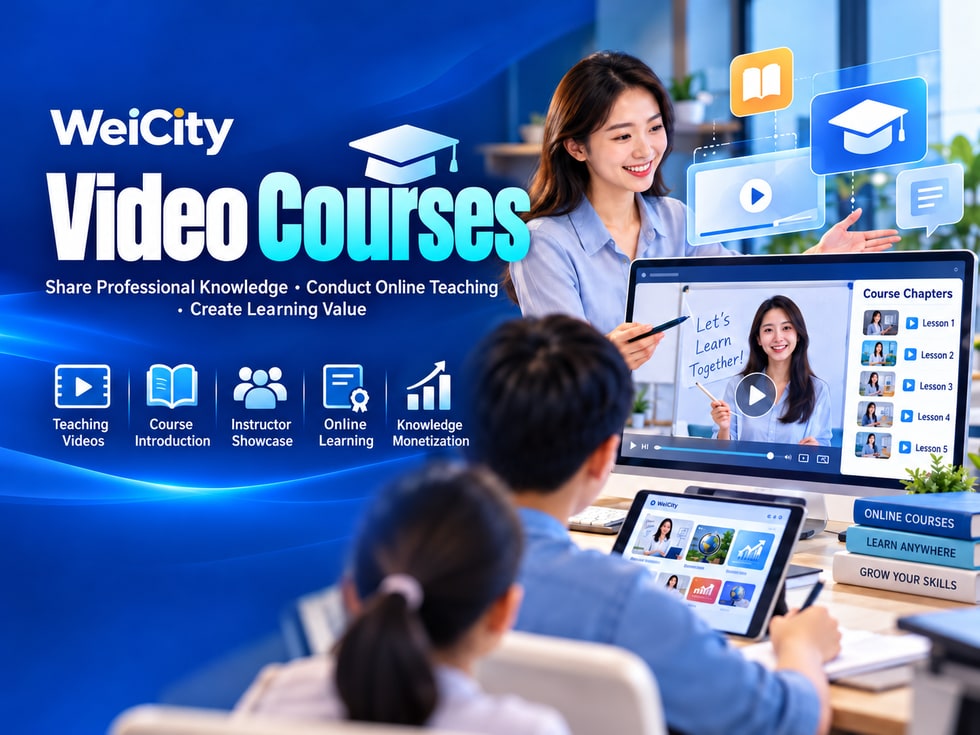
More and more education centres, training institutions and professional instructors are now exploring online teaching.
In the past, students usually had to go to a classroom at a set time to learn.
Today, through online video courses, many knowledge areas and skills can also be learned on phones, computers and tablets.
For merchants, video courses are not just another teaching method. They may also become a new opportunity to showcase professional expertise, reach potential students and grow an education business.
Online video courses (Online Video Courses) are a form of course in which teaching videos are recorded so that students can learn knowledge and skills online.
Common courses include:
📚 Academic tutoring: mathematics, science, English and exam preparation.
🗣️ Language teaching: English, Chinese, Malay and other languages.
💻 Computer training: Excel, design software and computer operation.
🎨 Interest courses: painting, music, photography and handicrafts.
🍳 Life skills: cooking, baking and everyday knowledge.
💼 Business training: marketing, entrepreneurship knowledge and corporate skills.
👶 Children's education: early learning, parent-child activities and education knowledge.
As long as the teaching content can be expressed well through video, it can be considered for an online course.
Face-to-face teaching is usually limited by location, class times and number of participants.
For example, a tuition centre in Penang mainly serves students in nearby areas.
If suitable teaching content is organised into videos, parents and students in other areas may have the chance to learn about the centre's teaching approach.
✅ Expand the reach of your students by letting people in different areas learn about your courses.
✅ Reduce repeated explanations by organising basic knowledge into videos that can be watched again and again.
✅ Showcase teaching features so potential students can get to know the teachers and teaching content.
✅ Increase enquiry opportunities by letting customers learn about courses before enrolling.
✅ Build up teaching resources so that completed content keeps working for you over time.
Video courses do not necessarily replace face-to-face teaching. They can also serve as a supplement to in-person classes.
Yes.
When you first start running video courses, you do not necessarily need a professional studio or expensive equipment.
📱 Phone or computer: record teaching videos.
🎤 Microphone: help students hear explanations clearly.
💡 Lighting: make the teaching visuals clearer.
📋 Course outline: plan teaching topics and content.
🖥️ Editing software: organise the finished recordings.
For example:
📖 A tuition teacher can record the solving process for a maths problem.
🍰 A baking teacher can demonstrate the steps for making a cake.
💻 A computer instructor can record software operation on screen.
🎨 An art teacher can demonstrate painting techniques.
It is recommended to start with one short but complete teaching video, then gradually add more content after collecting students' feedback.
If there is only one teaching video, students may find it hard to judge the full scope of the learning content.
Merchants can plan different chapters according to topic, difficulty level and learning goals.
For example, a basic English course:
📘 Lesson 1: Get to know common English words.
📘 Lesson 2: Learn simple English sentences.
📘 Lesson 3: Practise basic pronunciation.
📘 Lesson 4: Learn everyday conversation.
📘 Lesson 5: Course review and practice.
In addition to teaching videos, it is recommended to prepare the following materials:
🔹 Course name and introduction.
🔹 Suitable learners for the course.
🔹 Course content and learning goals.
🔹 Teaching language and course duration.
🔹 Instructor background and professional experience.
🔹 Course fees and enquiry methods.
When the materials are clear, students can more easily judge whether a course meets their needs.
Producing teaching videos is only the first step.
Merchants also need to help customers learn about their teaching services and provide convenient ways to find out about courses.
Through the WeiCity merchant channel, education institutions and instructors can gather merchant introductions and course-related information in one place.
🏪 Showcase the teaching institution
Introduce the background and areas of expertise of education centres, training institutions or individual instructors.
📚 Introduce course content
Explain course topics, suitable learners, teaching features and learning goals.
🎬 Share teaching information
Based on the content features provided by the platform, showcase course introductions, teaching images and related updates.
📱 Make it easy for potential students to get in touch
Provide contact details and enquiry channels so parents or students can learn more about the courses.
🔗 Share the channel link
Share the WeiCity merchant channel link on social media or other promotion channels.
If a merchant needs course purchasing, paid viewing, progress tracking or learning access management, first confirm whether the corresponding feature is currently supported.
Online video courses can be run in different ways.
🎁 Free trial lessons: let students first learn about the course and teaching style.
💳 Single paid courses: set a purchase fee for individual courses.
📦 Course series: organise related topics into a complete course bundle.
🏫 Online plus in-person: combine pre-recorded videos with face-to-face teaching.
🔄 Ongoing updates: regularly add new courses suited to learners.
Merchants can choose suitable approaches based on their teaching content, target learners and actual business needs.
Different payment models require corresponding payment and course management arrangements, and not every platform automatically provides these features.
If you want to attract potential students through Google search, the course name and text description are very important.
For example:
❌ Not recommended: English Course 01.
✅ Recommended: Beginner English Speaking Course | Everyday conversation teaching for beginners.
❌ Not recommended: Computer Teaching.
✅ Recommended: Basic Excel Course | A spreadsheet operation guide for beginners.
A good course introduction should include:
🔹 A clear course topic.
🔹 Suitable age or skill level.
🔹 Main teaching content.
🔹 Teaching language and course format.
🔹 Instructor or institution background.
🔹 Registration or enquiry methods.
This not only helps students understand the course but also helps search engines understand the page content.
However, whether a page can be indexed by Google and rank depends on factors such as whether the page is open to crawling, website technical settings, content quality and search competition.
It is recommended to start with the following steps:
✅ Step 1: Choose a teaching topic that students need most.
✅ Step 2: Clarify the course's target learners and goals.
✅ Step 3: Plan a simple set of course chapters.
✅ Step 4: Record your first teaching video.
✅ Step 5: Prepare the course name, introduction and related images.
✅ Step 6: Organise course materials on the WeiCity merchant channel.
✅ Step 7: Share course information through social media.
✅ Step 8: Collect learner feedback and keep improving the content step by step.
There is no need to create a large number of courses at the start.
First build a set of clear courses suited to your target learners, then consider expanding.
For education centers, training institutions, professional instructors and content creators, video courses are a teaching approach worth exploring.
They make knowledge easier to spread, and also give prospective learners a chance to understand the course content before signing up.
Merchants can start with simple teaching videos, gradually organize course materials, introduce their teaching features, and choose a business model that suits them.
🎓 Start with one teaching video and explore the many possibilities of online teaching.