

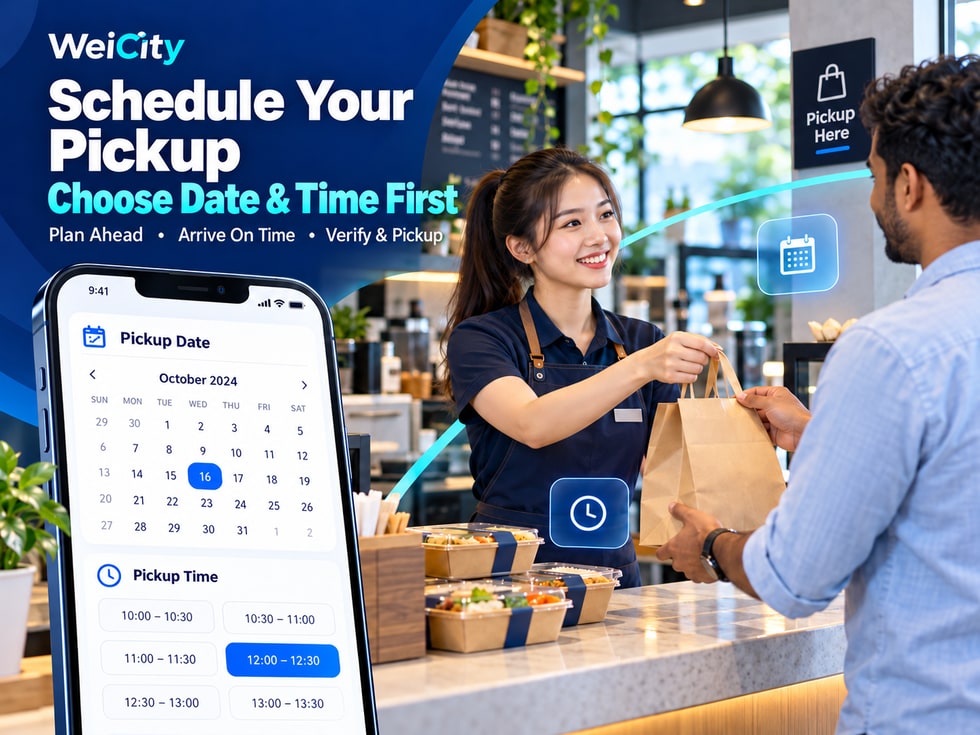
5 📅 How does pre-booked pickup work? Let customers choose a date and time slot
Confirm when to collect the food in advance, so customers can plan and merchants can prepare
Pre-booked pickup allows customers to arrange a pickup date and time slot when ordering, and helps merchants understand preparation needs. This article introduces the basic process of pre-booked pickup, including checking booking requirements, choosing a time, confirming the order and collecting the food in store, and explains what information merchants should state clearly so both sides have a consistent understanding of pickup arrangements.
After choosing dishes online, customers usually want to know a few important things:
🍽️ Is it still available today?
🕒 Is it still in time to order now?
📅 How far in advance do I need to make a reservation?
🏪 Where should I collect my food?
🚚 Can delivery be arranged?
💰 Is there a minimum order amount?
🔔 After submitting an order, do I still need to wait for the merchant to confirm?
If this information is not clearly stated, customers may still need to contact the merchant repeatedly with questions, even if the dish images, names, and prices are complete.
More importantly, customers may only find out after submitting an order that the dish has stopped being available, the pickup time is unsuitable, or the selected branch is not where they wanted to go.
In addition to a clear menu, WeiCity online ordering also needs complete information on availability hours, reservation conditions, pickup locations, delivery arrangements, and order confirmation.
For restaurants, cafés, bakeries, bento merchants, and other businesses that accept dish reservations, this information helps customers understand purchase conditions before ordering and makes it easier for merchants to prepare and hand over orders.
This article explains how to organize availability and pickup information on WeiCity ordering pages, and provides sample wording and a checklist for reference.
Specific availability time settings, reserved pickup, delivery areas, minimum order amounts, payment, and order management features depend on the current WeiCity pages and the merchant's actual settings.
An online menu mainly answers:
What dishes does the merchant offer?
Availability and pickup information further answers:
When can customers buy, and how can they collect the food?
For example:
A restaurant offers pan-fried chicken chop rice.
The menu already states:
🍛 Dish name: Pan-fried chicken chop rice.
💰 Price: RM15.
📷 Image: Shows chicken chop, white rice, and side dishes.
📝 Description: Pan-fried chicken chop served with white rice, seasonal vegetables, and black pepper sauce.
However, customers may still not know:
📅 Is it available on Sunday?
🕒 Can it still be ordered at 3 p.m.?
⏳ Does it need to be reserved in advance?
🏪 Which branch should they go to for pickup?
🚚 Is delivery available?
Therefore, complete ordering information should include two parts.
🍽️ Name.
📷 Image.
💰 Prices.
📝 Description.
🌶️ Flavor.
🔢 Quantity.
📅 Supply dates.
🕒 Order acceptance times.
⏳ Reservation requirements.
🏪 Pickup location.
🚚 Delivery Arrangements.
🔔 Order confirmation method.
📌 Dish information helps customers decide what to buy; availability and pickup information helps them decide when to buy and how to collect it.
A dish appearing on the menu does not necessarily mean it can be purchased every day.
For example:
🍳 Breakfast is only available on weekdays.
🍛 The lunch set meal is only offered from Monday to Friday.
🥐 Some breads are only baked on weekends.
🎂 Birthday cakes need to be prepared in advance.
🎁 Festive foods are only sold during designated periods.
Therefore, merchants should state the supply dates according to their actual situation.
For example:
Supply dates: Monday to Sunday.
However, if there is a fixed weekly closing day, it should not be written as available daily.
For example:
Supply dates: Monday to Friday.
For example:
Available dates: Saturday and Sunday.
For example:
This item is only offered during the designated festive ordering period.
For example:
Limited to 30 portions per day. Actual availability is subject to confirmation by the merchant.
Because customers may plan ahead:
🍱 Office lunch.
🎂 Birthday parties.
🥐 Weekend breakfast.
🍽️ Family gatherings.
If supply dates are unclear, customers may submit orders at times when the items are not available.
Some food and beverage merchants in Malaysia may adjust their business and supply arrangements on public holidays.
For example:
🧧 Chinese New Year.
🌙 Hari Raya Aidilfitri.
🪔 Deepavali.
🎄 Christmas.
If holiday supply arrangements differ from regular days, it is recommended to update the relevant information in advance.
📌 Supply dates should accurately reflect actual business arrangements, so customers do not mistakenly assume that all items can be ordered every day.
This is one of the areas where online ordering is most likely to cause misunderstanding.
Because:
A store being open does not mean all items can still be ordered.
Likewise:
A merchant still accepting orders does not mean customers can collect them immediately.
It is recommended that merchants explain the three types of times separately.
Business hours are the times when the outlet is open to the public.
For example:
Monday to Saturday: 10:00 a.m. to 8:00 p.m.
Order acceptance hours are the time range during which the merchant accepts orders for the relevant meals.
For example:
Lunch order acceptance times: 9:00 a.m. to 5:00 p.m.
Orders for specific same-day or future dates should be explained further.
Pickup times are the times when customers can collect their food according to the merchant's arrangements.
For example:
Pickup window: 11:30 a.m. to 7:00 p.m.
All of the above times are hypothetical examples.
🏪 Business hours: 10:00 a.m. to 8:00 p.m.
📱 Order cut-off time: 5:00 p.m.
📦 Latest pickup time: 7:00 p.m.
If you only write:
"Open until 8 p.m."
customers may mistakenly believe they can still order all items at 7:50 p.m.
However, the actual situation may be:
👨🍳 The kitchen has stopped taking orders.
🍱 Some items have sold out.
📦 Pickup service has ended.
📌 Explaining business hours, order acceptance and pickup times separately can reduce customer misunderstanding about item availability.
Some items require a longer preparation time.
For example:
🎂 Birthday cakes.
🍱 Group bento boxes.
🥐 Large-quantity baking orders.
🎁 Festive food gift boxes.
🍽️ Party meals.
If the merchant only writes:
“Please order in advance.”
Customers still do not know:
How many hours in advance?
One day in advance?
Or three days in advance?
Therefore, booking requirements should be as specific as possible.
For example:
Please submit bookings at least one day in advance.
For example:
Orders for the next day must be submitted before 5:00 p.m. the previous day.
For example:
Birthday cakes must be booked at least three full calendar days in advance.
If the period is actually calculated by working days, it should be clearly stated as working days.
For example:
For orders of more than 20 lunch boxes, please contact the merchant first to confirm supply capacity and delivery time.
For example:
The booking deadline for festive gift boxes is the specified date. Actual collection arrangements are subject to confirmation by the merchant.
For example:
A customer submits an order at 11:00 p.m. on Friday for Saturday's lunch.
If the merchant requires bookings to be made before 8:00 p.m. the previous day, this order may already be past the deadline.
Whether WeiCity currently supports automatic order cut-offs, date restrictions or blocking of late orders should be based on actual functionality.
If there are no related automatic restrictions, merchants still need to check through their actual order handling process whether booking requirements are met.
📌 Stating the number of advance days and the deadline clearly is easier for customers to understand than simply writing "Please book in advance."
Some items may be restricted by ingredients, production capacity or supply methods.
For example:
🥐 Only 50 croissants are made each day.
🍱 Group lunch boxes require a minimum order of 10 portions.
🎂 Certain cake designs can only accept a limited number of orders each day.
🍗 A specialty item has limited quantities.
Merchants can explain quantity requirements according to their actual situation.
For example:
This meal is limited to 30 servings per day.
For example:
Group lunch boxes require a minimum order of 10 boxes per order.
For example:
Each box of this gift set contains 6 items.
For example:
For single orders of more than 30 portions, please contact the merchant in advance for confirmation.
Because customers may need to:
🍱 Order office lunches.
🎉 Prepare food for events.
👨👩👧👦 Arrange family gatherings.
If quantity requirements are not clearly stated, customers may only find out after submitting an order that their needs cannot be met.
Whether daily limits, minimum order quantities or automatic order stoppage are supported should be based on WeiCity's actual current functionality.
If the page does not have corresponding restrictions, merchants need to separately check actual supply quantities.
📌 Quantity limits should let customers know in advance how many they can order, the minimum they must order, and when they need to contact the merchant.
For merchants offering in-store pickup, the pickup location is very important information.
Especially:
🏪 The same brand has multiple branches.
🏢 The store is located inside a shopping mall.
🚪 The pickup counter is different from the main entrance.
📦 Items must be collected from a designated area.
For example:
Pickup outlet: XX Restaurant George Town Branch.
We recommend providing:
Street names.
House numbers.
Floor or unit number.
City.
Postal code.
For example:
Please collect at the in-store cashier counter.
Or:
Please go to the designated meal collection counter.
If customers cannot find the pickup location, they can contact the merchant.
If the page provides a map or navigation entry, check:
📍 Whether the pin is accurate.
🏪 Whether it corresponds to the correct store.
🛣️ Whether navigation leads to an actual reachable location.
For example:
A customer intended to collect in Bukit Mertajam.
but mistakenly selected the George Town branch.
If the order has already entered the preparation process, it may not be possible to change it directly.
Therefore, merchants should clearly display the pickup store on the page.
📌 Pickup instructions should not only say "In-store pickup"; they should also tell customers exactly where to collect the order.
After customers arrive at the store, the merchant usually needs to verify the order before handing over the correct meals.
Therefore, it is recommended to explain collection requirements in advance.
If the page provides an order number, it can be used to look up related records.
For example:
The contact name entered by the customer when submitting the order.
If the merchant requires it, customers may need to show the order page or related confirmation information.
Used to verify the order when necessary.
If a family member, friend or colleague is collecting on the customer's behalf, confirm in advance what verification information the merchant requires.
It is recommended to check:
🍽️ Meal name.
🔢 Purchase quantity.
🌶️ Flavours and main options.
📦 Package quantity.
If the quantity or contents of the food do not match the order, please raise the issue with staff on site and verify it against the order record.
📌 The clearer the collection requirements, the easier it is for customers to pick up their food, and the easier it is for merchants to confirm the correct order.
It is recommended to write them separately.
Because the information to be confirmed differs between the two delivery methods.
Customers mainly need to know:
📍 Where to collect.
🕒 When to collect.
🧾 What order information to provide.
Customers mainly need to know:
📍 Whether they are within the delivery area.
💰 How much the delivery fee is.
🛒 Whether there is a minimum order requirement.
🕒 When delivery will be arranged.
🏠 What delivery address to enter.
For example:
A restaurant may offer both of the following:
🏪 In-store pickup.
🚚 Delivery to specified areas.
If they are not explained separately, customers may mistakenly believe that all items can be delivered to any area.
If the merchant only offers self-pickup, you can simply write:
This item is available for in-store pickup only and delivery is not currently offered.
If delivery is offered, the relevant conditions should be stated according to the actual business arrangements.
📌 Pickup and delivery instructions should match the actual service, so customers do not mistakenly assume that the merchant offers a delivery method that is not available.
If the merchant offers delivery, customers need to know which areas can be reached.
For example:
Specified city.
Specified residential areas.
Specified commercial areas.
For example:
Within a specified distance around the store.
However, the actual method of calculation should be stated clearly, so customers do not assume it is straight-line distance or driving distance.
If the delivery area cannot be listed simply, you may state that the merchant needs to verify the address further.
For example:
The delivery area is based on the address confirmed by the merchant. For addresses outside the area, please contact us first to check.
Whether WeiCity supports postal code, area, or distance restrictions depends on the features currently available.
If there is no automatic restriction, the merchant needs to confirm whether delivery is possible through its actual order handling process.
📌 The delivery area should let customers know whether they qualify for delivery, rather than discovering after submitting an order that delivery is not possible.
If the merchant offers delivery, it is recommended to clearly explain how fees are calculated.
For example:
Delivery fee for designated areas: RM5.
For example:
Zone A: RM5.
Zone B: RM8.
If fees are actually charged by distance, explain the applicable calculation method.
For example:
When a specified order amount is met, the applicable delivery discount may apply.
Whether such offers are provided and how they are calculated should be filled in according to actual business rules.
Merchants should clarify:
💰 How much the delivery fee is.
📍 Which areas it applies to.
🛒 Whether there is a minimum order amount.
🎟️ Whether there are any other conditions for offers.
Assumed:
🍛 Food amount: RM30.
🚚 Delivery fee: RM5.
Assuming there are no other fees or discounts:
Order total: RM35.
The above is a hypothetical example.
📌 Letting customers know delivery fees in advance can reduce questions about charges after submitting an order.
Some food merchants may require that an order reach a specified amount before delivery is offered.
This is usually called:
Minimum Order Amount.
For example:
Merchant rule:
The minimum food amount for delivery orders is RM25.
Customer selection:
🍛 Chicken rice: RM12.
🥤 Drinks: RM5.
Food subtotal:
RM17.
If the minimum order amount is RM25, this condition has not been met.
Customer selection:
🍛 Chicken rice: RM12.
🍜 Curry noodles: RM13.
Food subtotal:
RM25.
If the merchant calculates based on the food subtotal and there are no other restrictions, the minimum amount in the example is met.
It is recommended to clearly state:
The minimum food amount for delivery orders is RM25, excluding the delivery fee.
If coupons or discounts affect the minimum amount calculation, also state whether the amount is judged before or after the discount.
For example:
Minimum order amount: RM25.
versus:
Order at least 5 lunch boxes.
These are two different conditions.
Whether WeiCity supports automatic checks for minimum order amounts, and whether orders are blocked when the amount is not met, should be confirmed based on current actual features.
📌 A starting price should clearly state the amount and the calculation scope, so customers know what conditions must be met to use delivery.
After customers click to submit an order, they may think the purchase is already complete.
In fact:
Order submission, payment completion, and merchant acceptance may be different stages.
Therefore, the merchant should explain how submitted orders are handled.
The customer completes the information required on the page and submits it.
The confirmation page shows whether the order was successfully created.
If the order involves payment, confirm based on the actual process.
If the order requires further acceptance by the merchant, wait for a clear confirmation.
The merchant arranges food preparation based on confirmed orders.
Deliver the food according to the arrangement confirmed by both parties.
If the merchant uses a payment method that requires manual verification, a payment screenshot does not necessarily mean the funds have arrived.
After you submit your order, please check the page status and merchant notifications. If the order requires further confirmation, please refer to the merchant's clear reply.
📌 The clearer the order confirmation method, the easier it is for customers to know what to wait for after submitting and what to do next.
Food orders may change after submission.
For example:
A customer temporarily needs to add food.
The customer wants to change the pickup time.
The merchant finds that a certain dish has sold out.
The customer is late due to traffic.
All of these situations require timely communication.
For example:
Originally chose chicken rice.
Later wants to change to noodles.
Contact the merchant first to confirm whether the adjustment is still possible.
For example:
Originally ordered 5 portions.
Later wants to increase to 8 portions.
The merchant needs to confirm whether there are enough ingredients and preparation time.
For example:
Originally scheduled pickup at 12 PM.
Later, they want to change it to 1 p.m.
The merchant needs to confirm the new arrangement.
It is recommended to notify the merchant as early as possible.
Whether cancellation is possible, and whether it involves a refund or other fees, should be handled according to the purchase conditions already stated, the preparation progress, and applicable rules.
For example:
A certain dish is temporarily sold out.
The merchant should contact the customer promptly to confirm whether they accept an alternative or other arrangement.
After making a request, customers should wait for the merchant to confirm.
📌 Food orders involve actual preparation and delivery arrangements. When changing or cancelling, communicate promptly and confirm the outcome.
When ordering online, customers usually want to find the most important information quickly.
Therefore, it is recommended to organize information in the order of the actual purchase process.
Instructions:
📅 Supply dates.
🕒 Service hours.
📦 Whether the quantity is limited.
Instructions:
📆 How far in advance it must be placed.
🕔 The latest time to place an order.
🍱 Whether large-quantity orders require confirmation.
Instructions:
📍 Store address.
🚪 Pickup location.
🕒 Pickup time slot.
If delivery is offered, explain:
📍 Delivery range.
💰 Delivery fees.
🛒 Minimum order amount.
🕒 Delivery time.
Instructions:
🧾 Submission result.
💳 Payment requirements.
💬 How the merchant confirms orders.
Instructions:
📞 Contact channels.
🕒 Change deadlines.
❌ Cancellation conditions.
Because customers usually consider the following in this order:
Can I buy it?
When can I buy it?
How do I collect it?
How much do I need to pay?
How will I be confirmed after submitting?
📌 Organizing explanations in the order customers actually shop is easier to read than putting all rules in one paragraph.
The following provides a format for explanations that food merchants may refer to.
Merchants may modify it according to actual business operations and should not directly use times, amounts, or conditions that do not match their own services.
📅 Supply dates: Monday to Saturday.
🕒 Supply hours: 11:30 AM to 2:30 PM.
📦 Some dishes are supplied in limited daily quantities.
📋 Orders for the next day must be submitted before 5:00 PM the previous day.
🍱 For large-quantity orders, please contact the merchant in advance to confirm.
🎉 Supply arrangements on public holidays may change; please check the latest notice.
📍 Pickup location: designated store.
🚪 Collection point: in-store pickup counter.
🕒 Please arrive at the store during the confirmed pickup time slot.
📍 Only for designated areas where the merchant actually provides service.
💰 Delivery fees are calculated based on the actual order details.
🛒 If there is a minimum order amount, please refer to the conditions published by the merchant.
🧾 After submitting an order, please check the result on the page.
💳 If payment is required, please follow the actual prompts on the page.
💬 For orders that need further confirmation from the merchant, the clear reply shall prevail.
📞 If you need to change dishes or the pickup time, please contact the merchant as early as possible.
🍱 Whether food that has already started preparation can be changed or cancelled depends on actual circumstances and applicable conditions.
🍽️ Clear supply times.
⏳ Specific advance order requirements.
🏪 Clear pickup method.
🚚 Separate delivery explanation.
🔔 Easy-to-understand confirmation process.
📌 Merchants can refer to this structure, but all times, amounts, and service conditions should be filled in with real information.
After menus and supply information are published, it is recommended that merchants check them once on a phone.
Confirm:
📅 Dates are correct.
🕒 Time slots are accurate.
📦 Quantity limit explanations match reality.
Confirm:
Number of days in advance.
Cut-off time.
Special order conditions.
Confirm:
Store name.
Full address.
Pickup position.
If a map or navigation is provided, confirm the location is accurate.
Confirm:
Delivery area.
Delivery fee.
Minimum order amount.
Confirm it matches the current actual payment process.
Confirm customers know how to view the result after submitting.
Confirm customers can contact the merchant.
For example:
The menu says food supply stops at 2 PM.
But the online ordering information says 3 PM.
This situation needs to be adjusted.
Confirm:
📝 Paragraphs are easy to read.
📅 Times are easy to find.
📍 Address is displayed in full.
💰 Fee explanations are clear.
📌 Checking from the customer's perspective before publishing can help merchants identify information that may cause misunderstandings.
Clear supply and pickup explanations not only help customers but can also supplement the merchant's service information.
For example:
🍛 Penang lunch pre-orders.
🍱 Corporate lunch box pre-orders.
🎂 Birthday cake pre-order pickup.
🥐 In-store pickup of baked bread.
🚚 Food delivery to designated areas.
These terms may be used in genuine, relevant service descriptions, but adding keywords does not guarantee a search ranking.
For example:
Lunch pre-order pickup
Compare:
"Service Description"
Makes it easier for customers to understand.
Let customers know when the service is available.
For example:
order acceptance times.
pickup time slots.
Help customers understand the actual service location.
Do not write in delivery or appointment services that are not actually provided just to attract search traffic.
Make it easy for customers to find important information.
Whether a page is crawled, indexed, and displayed by Google also depends on platform technical settings, page quality, accessibility, and other factors.
📌 Clear and accurate supply and pickup information first improves the customer's Online Ordering experience and also helps search engines understand the service.
Not necessarily.
Check the merchant's actual supply dates, time periods and stock availability.
Not necessarily.
The store may still be open, but some dishes may have stopped accepting orders.
Order acceptance time is when the merchant accepts orders; pickup time is when the customer collects the food according to the arrangement.
This depends on the food preparation requirements and the merchant's actual rules.
Whether automatic limits are supported depends on the current actual features.
Whether automatic quantity limits are supported depends on the current features.
Generally, prepare the order number, the name used for the order, or other verification details as required by the merchant.
Clearly state which store handles the order and the actual pickup address.
Actual delivery options and handling methods depend on the current features and merchant settings.
It refers to the minimum order amount condition the merchant sets for a specific purchase or delivery method.
This depends on the merchant's actual rules; the calculation scope should be stated clearly.
Whether automatic checks are supported depends on the current actual features.
Not necessarily.
Judge based on the actual order status and the merchant's confirmation process.
Not necessarily.
Payment confirmation and completion of food preparation may be separate stages.
Contact the merchant as soon as possible to confirm whether the food can be held and how it will be handled.
Confirm based on the order status, system features and how the merchant actually handles changes.
Contact the customer promptly to confirm whether they accept a substitute or another appropriate arrangement.
Update the relevant information promptly when prices, times, locations, supply or delivery conditions change.
📌 Clear supply and pickup information helps customers confirm key conditions before ordering and reduces repeated communication after an order is submitted.
✅ Supply date is accurate.
✅ Supply time slot is clear.
✅ Restrictions for specific dishes are clear.
✅ Quantity limit notes match actual conditions.
✅ The business hours are correct.
✅ Order acceptance times are clear.
✅ Pickup time slot is clear.
✅ Advance-notice days are clear.
✅ Cut-off time is specific.
✅ Conditions for large-quantity orders are clear.
✅ Store name is accurate.
✅ Address is complete.
✅ Collection point is clear.
✅ Navigation pin is correct.
✅ Order number instructions are clear.
✅ Name verification requirements are clear.
✅ Conditions for collection by someone else are explained.
✅ List delivery only if it is actually provided.
✅ Delivery area is clear.
✅ Delivery fee is clear.
✅ Minimum order conditions are accurate.
✅ Dish prices are correct.
✅ Additional charges are clear.
✅ The scope for calculating the minimum order amount is clear.
✅ The submission result is easy to understand.
✅ Payment requirements are clear.
✅ The merchant confirmation process is clear.
✅ Contact information is valid.
✅ Conditions for changes are clear.
✅ Late arrival handling is clearly explained.
✅ Cancellation and refund rules match actual arrangements.
✅ Mobile reading is clear.
✅ Times are easy to find.
✅ Address is fully displayed.
✅ Menu and Online Ordering instructions are consistent.
📌 When supply, times, location, fees, and confirmation methods are fully organized, customers can more clearly decide whether to place an order.
A complete WeiCity Online Ordering page does not only display dish photos, names and prices.
It should also help customers understand:
🍽️ Dish availability: whether food is offered today or on specified dates.
📅 Supply dates: which days purchases are available.
🕒 Order acceptance times: the latest time orders can be placed.
⏳ Pre-order requirements: whether arrangements must be made in advance.
🔢 Quantity conditions: whether there are limited quantities or minimum order requirements.
🏪 Pickup location: which store to collect from.
🚪 Pickup point: where to go after arriving at the store.
🧾 Pickup details: what information is needed to verify the order.
🚚 Delivery arrangements: whether delivery is offered and its coverage.
💰 Delivery fees: how much extra customers need to pay.
🛒 Minimum order requirements: whether a minimum order amount must be reached.
🔔 Order confirmation: how to confirm whether an order is accepted after submission.
🔄 Order changes: how to handle changes, cancellations or late arrivals.
For customers:
📋 Clear information reduces questions before ordering.
📅 Clear timing makes it easier to plan a meal.
📍 An accurate location makes it easier to find the pickup point.
💰 Complete fee information makes it easier to decide whether to buy.
For merchants:
🍽️ Clear supply rules reduce orders that do not meet the conditions.
👨🍳 Clear reservation requirements help arrange food preparation.
🏪 Complete pickup instructions reduce the chance of customers going to the wrong place.
🚚 Accurate delivery conditions reduce delivery disputes.
💬 A clear confirmation process reduces repeated communication.
The key point of WeiCity Online Ordering supply and pickup information is to let customers clearly know, before submitting an order, when dishes are available, what conditions apply, and how to collect them.
🍽️ State dish availability first.
🕒 Then explain order acceptance and pre-order times.
🏪 Clearly list pickup locations.
🚚 If delivery is offered, explain the service conditions separately.
💰 Clearly list the applicable fees.
🔔 Finally, explain order confirmation and contact methods.
Organizing this information clearly not only makes the online menu more complete, but also helps customers order more smoothly and makes follow-up food preparation and handover easier for merchants.
Specific supply time periods, pre-order dates, quantity limits, minimum order amounts, delivery, payment, order confirmation and change features depend on the current WeiCity Online Ordering page, merchant settings and enabled services.
👉 Open WeiCity: https://wei.city/