

11 How to Attract Learner Enquiries and Sign-Ups Through Video Courses? From Course Introductions to Improving Sign-Up Conversion
Help prospective learners move from seeing a course, to understanding its teaching content, to building trust, and then to actively enquiring and signing up. Help education centres and trainers improve course introductions, trial lesson arrangements and customer contact processes.
Video courses are being viewed, but no learners are signing up? This article introduces how education centres, training institutions and independent instructors can improve enquiry experience and sign-up conversion for online courses through clear course introductions, authentic teaching demonstrations, free trial lessons, price explanations, frequently asked questions, WhatsApp enquiries and simplified sign-up steps. It also explores how the WeiCity merchant channel can help prospective learners learn about teaching services in one place.
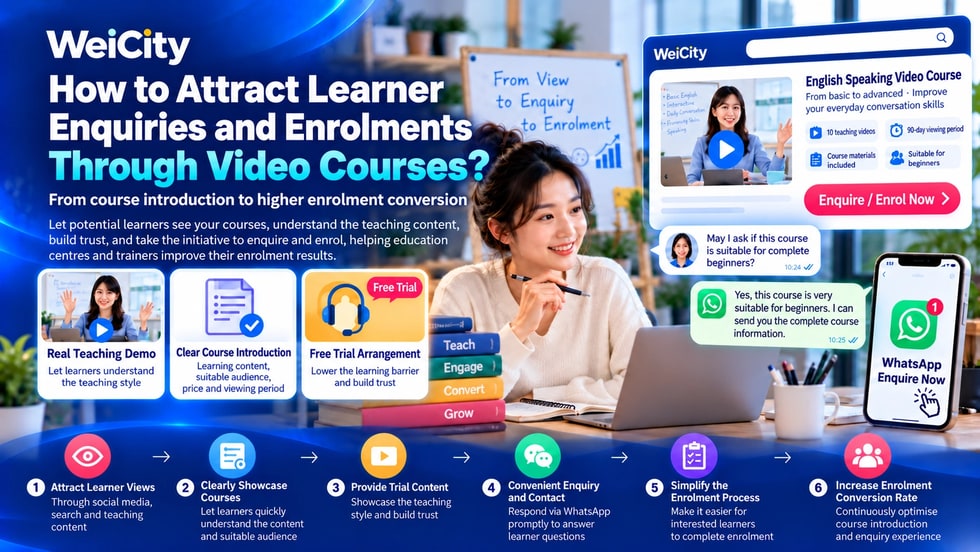
For education centers, training institutions, and professional instructors, successfully creating an online video course is only the first step.
Once the course starts being promoted, people may already be finding your teaching content through Google, Facebook, TikTok, or YouTube.
However, merchants often run into one problem.
People viewing a course does not mean they will actively inquire; people inquiring does not mean they will ultimately enroll.
For example:
🔸 The course page gets views, but no one contacts the teacher.
🔸 After prospective students asked about the fee, they stopped replying.
🔸 Parents read the course introduction but were not sure whether the course suited their child.
🔸 The merchant offered many teaching videos, but how to enroll was unclear.
🔸 Customers wanted to learn about the teacher's teaching style first but could not find trial materials.
🔸 The course promotion attracted many people, but the actual number of enrollments did not clearly increase.
These situations do not necessarily mean the course quality is poor.
Sometimes the problem may lie in the course introduction, customer trust, consultation methods, or the enrollment process.
For merchants who want to run an online teaching business over the long term, in addition to increasing exposure, they should also make it easier for people who truly need to learn to understand the course and take the next step.
The enrollment conversion rate (Course Enrollment Conversion Rate) is a metric used to understand how many prospective students ultimately complete enrollment.
For example, an English video course received 1,000 page visits within a certain period.
Of these, 50 people made inquiries.
In the end, 10 people completed enrollment.
From this, merchants can understand the performance of course promotion and the enrollment process.
📊 Page visits: 1,000.
💬 Course inquiries: 50 people.
📝 Completed enrollments: 10 people.
If the number of visits is temporarily used as the denominator, the ratio of enrollments to visits is 1%.
If the 50 people who made inquiries are used as the denominator, the enrollment ratio after inquiry is 20%.
These are only hypothetical numbers used to explain the calculation method, and do not represent industry averages.
In actual analysis, you should also distinguish between page visit counts, unique visitors, and actual inquiry numbers, and avoid mixing different measurement bases.
For education providers, what matters is not only how many people click on a course, but also understanding:
✅ Do prospective students understand the course content?
✅ Are students willing to contact you proactively?
✅ What questions do inquirers care about most?
✅ Which factors influence the enrollment decision?
✅ How can the overall learning and consultation experience be improved?
Many course introductions do not clearly answer customers' most basic questions.
For example:
❌ Quality English course, limited spots, sign up now!
Although this is promotional wording, prospective students still do not know what specific service is being offered.
It can be changed to:
✅ Adult beginner English speaking course.
🗣️ Learning content: common English sentences, basic pronunciation, and everyday conversation.
👨🎓 Suitable for: adult beginners who want to improve their English communication skills.
🎬 Learning format: video learning according to the actual course schedule.
📚 Course structure: basic knowledge, scenario-based practice, and course review.
📱 Consultation method: contact the instructor to learn about the course schedule.
An introduction like this helps prospective students quickly judge whether the course meets their needs.
The most important task of a course page is not to include as much promotional text as possible, but to help customers understand the course.
When choosing a course, prospective students usually want to know whether it suits their level.
For example, an office worker with no Excel experience may not be suited to taking an advanced data analysis course directly.
When parents look for a math course for their child, they also need to confirm the grade level and learning foundation the course is designed for.
Therefore, the course introduction should clearly state:
📘 Whether it suits beginners or advanced learners.
🎯 What main learning problems the course helps solve.
👶 Whether there is a suitable age range.
🗣️ What language is used for teaching.
💻 Whether computer or other skill foundations are required.
⏱️ How much study time students need to invest.
For example:
💻 Course name: Excel Basic Operations Video Course.
👨🎓 Suitable for: office beginners with no Excel experience.
📚 Learning goals: master basic spreadsheet operations, common formulas, and simple charts.
If students find that the course clearly meets their needs, they are more likely to look further into fees and enrollment arrangements.
For customers meeting an instructor for the first time, course introduction text is usually not enough.
They may want to see how the teacher actually teaches.
For example:
🎥 Clip of an English teacher's pronunciation lesson.
💻 Software operation demonstration by an Excel instructor.
🍰 Actual baking process by a baking teacher.
🎨 Step-by-step explanation by a painting teacher.
📚 Problem-solving demonstration by a math teacher.
Real teaching demonstrations allow prospective students to observe:
✅ Whether the teacher explains things clearly.
✅ Whether the teaching pace is easy to follow.
✅ Whether the course content suits their level.
✅ Whether the teaching style suits their learning habits.
✅ Whether they are willing to continue with the full course.
Demonstration content does not necessarily need to be long.
The key is to show a teaching approach that is authentic, clear, and genuinely helpful.
It is not recommended to use promotional videos that do not match the actual course, or to exaggerate teaching results.
For students who have not yet decided to purchase a course, a free trial can lower the barrier to understanding the course.
For example, for a 10-lesson English speaking course, you could consider offering one section of the basic teaching content as a trial.
🎬 Free trial: get to know the course and the teacher.
📚 Full course: study more content according to the teaching structure.
💬 Further inquiries: learn about course fees and service arrangements.
Merchants may consider the following approaches.
✅ Provide one complete basic teaching demonstration.
✅ Show one practical knowledge point from the course.
✅ Introduce the course learning goals and main chapters.
✅ Explain the difference between free content and paid content.
✅ Provide a consultation method for students who need it.
Trial content should help students make a choice that suits them, rather than create unreasonable purchase pressure.
If the merchant does not currently offer a free trial, they can also prepare a clear course outline, instructor introduction, or public teaching samples.
Some prospective students do not continue with enrollment after asking about the price, possibly because they are unclear about what the fee covers.
For example, a video course priced at RM99.
Customers may want to know:
❓ Is RM99 a one-time fee or a monthly fee?
❓ How many teaching videos are included?
❓ How long can the course be watched?
❓ Are teaching handouts provided?
❓ Is one-to-one instructor guidance included?
❓ Are there any additional fees?
Therefore, merchants can use a clear explanation of course fees.
For example:
📚 Course name: Excel Basic Video Course.
💰 Course fee: RM99.
🎬 Teaching content: 10 pre-recorded teaching videos.
⏱️ Viewing period: 90 days after purchase.
📄 Learning materials: includes specified practice files.
💬 Instructor support: individual coaching not included.
The above is only an example of how to present information and is not WeiCity's official course price or a platform feature commitment.
When actually publishing, fill in details according to the services the merchant actually provides.
When fees and conditions are clear, customers can more easily judge whether the course fits their budget and learning needs.
Many course inquiries involve similar questions.
If you have to explain everything from scratch each time, merchants and prospective students may spend a lot of time.
Therefore, you can organize common questions in advance (FAQ).
For example:
❓ Is the course suitable for complete beginners?
Explain the course level and whether prerequisite knowledge is needed.
❓ What language is the course in?
Explain whether teaching is in Chinese, English, Malay, or another language.
❓ Can I watch on my phone?
Answer according to the actual course delivery platform and technical requirements.
❓ Can I rewatch after purchase?
Explain the actual permitted number of viewings and the viewing period.
❓ Is there a free trial?
Provide an actual trial arrangement or public teaching demonstration.
❓ Does the course include instructor support?
Explain whether questions, grading, or other learning support are provided.
❓ How do I start learning after payment?
Describe the actual payment and course delivery process.
❓ Can I get a refund if the course is not suitable?
Explain according to the actual refund policy and applicable laws.
Organizing these questions in the course introduction can help prospective students learn about the service more efficiently.
When students already understand the course content and are ready to ask questions, they should not need to spend a lot of time looking for contact details.
For example, a customer may have decided to make an inquiry but encounters:
🔸 No clear contact information.
🔸 Unable to find a WhatsApp number.
🔸 The course introduction does not explain how to sign up.
🔸 Customers have to go through several pages before they can contact the merchant.
Therefore, it is recommended to provide clear next steps in the course description.
For example:
📱 Ask about courses via WhatsApp.
📞 Call the education center to learn about schedules.
📧 Send an email to ask for details.
📝 Use the sign-up method the merchant actually offers.
🏫 Find out whether there are physical classrooms or in-person consultation.
More contact channels are not necessarily better.
What matters is using methods that the merchant can manage promptly and that customers are familiar with.
For prospective learners who are interested, a sign-up process that is too complicated may affect their final decision.
For example, for a simple video course, requiring customers to fill in a large amount of unrelated information may add unnecessary burden.
It is recommended to arrange clear sign-up steps according to actual business needs.
✅ Step 1: Review the course introduction.
✅ Step 2: Confirm the course meets your learning needs.
✅ Step 3: Check the fees and service terms.
✅ Step 4: Sign up or purchase through the specified method.
✅ Step 5: Receive a confirmation message.
✅ Step 6: Start learning by following the instructions.
Merchants should only collect personal information that is actually necessary and protect that information properly.
For underage learners, guardian consent and enrollment arrangements should also be handled in accordance with applicable requirements.
If a formal student assessment is required, the sign-up process may need more information, but the reason for collecting it should be explained.
Before deciding to sign up, prospective learners may want to refer to other people's learning experiences.
For example:
💬 Whether the teacher's explanations are easy to understand.
💬 Whether the teaching content matches the promotion.
💬 Whether the course difficulty suits beginners.
💬 Whether the learning materials are practical.
💬 Whether the education provider delivers services as agreed.
Genuine reviews can help new learners understand the course experience.
However, merchants should note:
✅ Use genuine reviews that can be reasonably verified.
✅ Obtain appropriate authorization for display.
✅ Do not fabricate learner numbers or success stories.
✅ Do not guarantee that all learners will achieve the same results.
✅ Protect the personal information of students and parents.
Especially for teaching photos, videos, or learning cases involving children, privacy and authorization should be taken seriously.
Long-term professional trust should be built on genuine course quality and responsible service.
When prospective learners contact a merchant proactively, the quality of the response also affects the customer experience.
For example, a parent asks whether an English course is suitable for their child.
If the merchant only replies:
“We have courses, RM99, sign up now.”
The parent may still not know whether the course is suitable.
A more helpful approach is to first understand the needs.
💬 What is the child's current level of learning?
📚 Which aspects of English ability do you hope to improve?
🎯 Are there clear learning goals already?
🗣️ Do you need explanations in Chinese or English?
⏱️ What kind of study schedule would be suitable?
Then, based on the actual situation, introduce suitable courses.
If a course is not suitable, this should also be stated honestly.
Merchants do not need to keep pressing customers to pay.
Clear, respectful, and timely consultation services are more conducive to building long-term trust than creating a sense of urgency.
For education centers, training institutions, and independent instructors, course materials may be scattered across different platforms.
For example:
▶️ YouTube: Share teaching demonstrations.
📱 TikTok: Publish learning tips.
👥 Facebook: Introduce course activities.
💬 WhatsApp: Answer course questions.
If customers have to keep switching between different channels to find basic information, it may become harder for them to understand the courses.
Merchants can use the WeiCity merchant channel to consolidate their teaching business introductions.
🏪 Showcase the teaching institution
Help prospective learners understand the merchant's background and service content.
📚 Introduce course content
Explain the topics, target audiences, and learning goals of different courses.
👨🏫 Showcase instructor profiles
Introduce genuine professional backgrounds and teaching experience.
🎬 Share teaching-related content
Publish course introductions and knowledge content in the ways the platform actually supports.
💰 Explain course fees and terms
Provide clear fee information and related service descriptions.
📱 Provide contact information
Help customers find the inquiry methods the merchant actually offers.
🔗 Share a unified channel link
Let prospective learners on social media learn more about the teaching services.
Through this arrangement, merchants can keep course introductions and inquiry information more centralized.
However, please note:
Features such as automatic course sign-up, access authorization after payment is completed, instant chat, form statistics, and conversion tracking should be based on what WeiCity has actually launched.
The content displayed on the merchant channel does not mean that all of these features are already supported.
After improving course introductions, merchants can regularly monitor the actual situation.
For example:
👀 Is the course page getting more effective views?
💬 How many prospective learners are proactively making inquiries?
📚 What questions do customers ask most often?
📝 How many inquirers complete sign-up?
⏱️ At which step do customers usually stop?
💰 Which courses receive more actual purchases?
Merchants can choose suitable statistical methods based on the data they can obtain.
For example, record:
📅 Inquiry date.
📚 Course of interest.
🌐 Which promotion channel the customer came from.
💬 Main inquiry question.
📝 Whether sign-up was completed.
📌 Known reasons for not signing up.
When recording customer information, applicable personal data protection requirements must be observed, and unnecessary information should be avoided.
It is not recommended to conclude that a particular promotion method is definitely effective based on only a small amount of data.
Through ongoing observation and appropriate comparison, course introductions and service processes can be gradually improved.
To make it easier for prospective learners to find courses, merchants may pay attention to Google search keywords.
However, course introductions also need to be easy for real customers to read.
For example:
❌ English course, English teaching, online English course, English video course, English sign-up.
Repeating keywords in this way does not necessarily help readers understand.
It can be changed to:
✅ Adult Beginner English Speaking Online Video Course | Daily Conversation and Pronunciation Practice.
Then explain in the body text:
📚 Main teaching content.
👨🎓 Suitable learner profile.
🎯 Course learning goals.
👨🏫 Instructor background.
🎬 Learning format.
💰 Course fees.
📱 How to inquire about the course.
This not only helps prospective learners quickly understand the course, but also helps search engines determine the page topic.
However, whether Google indexes the page and ranks it depends on page accessibility, website technical settings, content quality, and actual competition.
If a course page already exists but inquiries or sign-ups are not performing well, the following items can be checked first.
✅ Step 1: Confirm that the course name is clear.
✅ Step 2: Clarify the target learners for the course.
✅ Step 3: Add the main teaching content and learning goals.
✅ Step 4: Provide genuine instructor background information.
✅ Step 5: Add teaching demonstrations or trial lesson information where appropriate.
✅ Step 6: Clearly explain the payment method.
✅ Step 7: List common questions and service terms.
✅ Step 8: Check that the contact information is accurate.
✅ Step 9: Reduce unnecessary inquiry and sign-up steps.
✅ Step 10: Respond promptly to questions from prospective learners.
✅ Step 11: Regularly monitor inquiry and sign-up results.
✅ Step 12: Continuously improve course descriptions based on genuine feedback.
Improving the course experience does not necessarily require an immediate increase in advertising budget.
Sometimes, simply organizing existing course materials clearly can reduce the difficulties customers face when learning about a course.
Operating an online video course is not just about getting more people to see course ads.
More importantly, people who truly need to learn should be able to clearly judge whether the course suits them.
For education centers, training institutions, and professional instructors, the following should be emphasized at the same time:
📚 Clear course content.
👨🎓 Clearly defined target learners.
👨🏫 Genuine instructor backgrounds.
🎬 Appropriate teaching demonstrations.
💰 Transparent course fees.
💬 Convenient ways to get in touch.
📝 A simple and clear registration process.
🤝 Responsible student service.
When course introductions and inquiry processes are more complete, prospective students can more easily make learning decisions that suit them.
🌐 WeiCity | Help your courses be discovered, and make it easier for prospective students to learn about, inquire about, and register for them.
🎓 From seeing a course, to actively learning more, to making a registration decision, every step becomes clearer.