

2 Why Do You Still Need Your Own Video Course Page If You Already Have YouTube?
Public videos help attract viewers, while course pages help learners understand teaching content, course schedules and sign-up methods, allowing education institutions and instructors to run their online teaching business more effectively.
If you already share teaching videos through YouTube, Facebook or TikTok, why do you still need a dedicated video course introduction page? This article analyses the differences between public video platforms and course pages, and explains how education centres, training institutions and professional instructors can use the WeiCity merchant channel to present course materials, teaching features and enquiry methods in one place, making it easier for prospective learners who watch videos to understand the courses and contact the merchant.
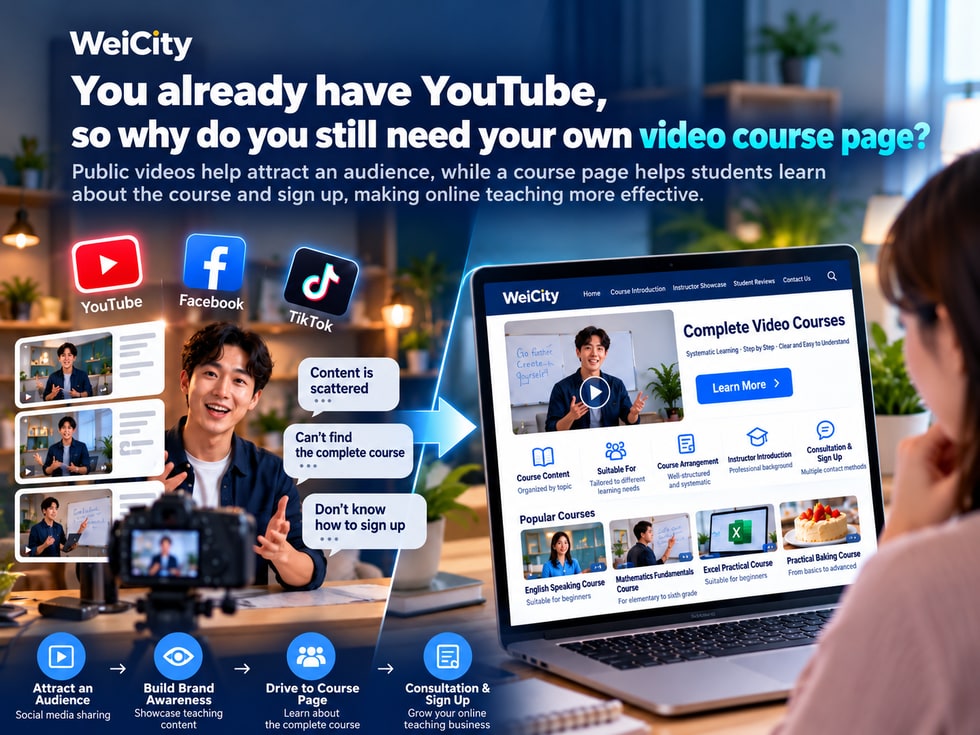
Today, more and more teachers, education centers, training institutions, and content creators share instructional videos through YouTube, Facebook, or TikTok.
These platforms can help merchants spread knowledge, build recognition, and let more potential students learn about their teaching content.
However, merchants running online teaching may encounter some problems.
🔸 Viewers finish a video but don't know where to find the full course.
🔸 Teaching content is scattered across different videos and is hard to find.
🔸 Potential students don't know the course fees, teaching methods, or who it suits.
🔸 Parents want to enroll but cannot find a clear way to inquire.
🔸 Merchants keep posting content but have no page that centrally introduces their courses.
These problems show that someone watching a teaching video does not necessarily mean they understand your course or are ready to enroll.
Therefore, public video platforms and dedicated course pages can serve different business purposes.
YouTube is a common video-sharing platform.
Instructors can upload teaching videos, and viewers can discover content through search, recommendations, and channel subscriptions.
For example:
📚 A math teacher shares free problem-solving lessons.
🗣️ An English instructor publishes speaking practice videos.
💻 A computer trainer demonstrates software operations.
🍳 A baking teacher shows cake-making techniques.
🎨 A painting teacher shares basic drawing knowledge.
These public videos help attract attention and let viewers see the instructor's professional abilities.
However, when viewers start seriously considering enrollment, they usually need more information.
✅ What skill level is the course suitable for?
✅ What does the complete course include?
✅ Does the course have a fee?
✅ Which teacher is responsible for the course?
✅ Are there course times or a study period?
✅ How can I enroll or contact the instructor?
Although this information can also be placed in YouTube video descriptions or channel links, gathering it on a dedicated course introduction page is usually more convenient for learners to browse.
The main goals of the two are not entirely the same.
📺 Public videos: help more people discover your teaching content.
Suitable for:
🔹 Sharing free knowledge.
🔹 Demonstrating teaching skills.
🔹 Attracting potential students.
🔹 Building viewers and followers.
🔹 Promoting your teaching brand.
📚 Course pages: help interested people learn more about your teaching services.
Suitable for:
🔹 Introducing courses in one place.
🔹 Showing course topics and content.
🔹 Explaining who the courses suit.
🔹 Providing instructor and institution information.
🔹 Introducing course fees and enrollment methods.
🔹 Guiding potential students to make further inquiries.
Here is a simple example.
A parent sees a math teaching video from a certain teacher on YouTube and feels the teaching style suits their child.
Next, the parent may want to know whether the teacher offers a complete math course and how to enroll.
At this point, a clear course introduction page can help the parent make a decision.
An education center may offer several courses at the same time.
For example:
📘 Primary school maths tutoring.
📗 English reading and writing.
📙 Science foundation courses.
📕 Early childhood learning.
💻 Computer skills training.
If all course introductions are mixed into social media posts, parents may have to browse many posts to find the relevant information.
A dedicated course page can organize introductions by course topic or target learners.
For example:
📚 Course name: Primary School Math Foundation Course.
👨🎓 Suitable for: Students from Primary 3 to Primary 6.
📝 Course content: basic operations, word problems, and problem-solving techniques.
🎬 Learning format: in-person classes and video review.
👩🏫 Instructor: introduces the teacher's relevant teaching experience.
📞 Inquiry method: provides clear enrollment and contact details.
When the information is clear, parents do not have to keep asking the most basic questions.
It also becomes easier for merchants to introduce their services to potential students.
For education institutions, trainers, and content creators, in addition to sharing teaching videos on social media, they can also use the WeiCity merchant channel to organize information about their teaching services.
🏪 Present your teaching organization in one place
Let customers learn about the background of education centers, training institutions, or individual instructors.
📚 Introduce different courses
Organize course names, learning topics, target learners, and main content clearly.
🎬 Showcase teaching-related content
Based on the features WeiCity actually supports, publish course descriptions, teaching articles, and related showcase content.
👨🏫 Build a professional image
Through organization introductions, instructor information, and teaching content, help potential students learn more about your services.
📱 Make it easy for parents and learners to inquire
Provide clear contact information so interested customers know how to get in touch next.
🔗 Share a unified channel link
Merchants can place the WeiCity merchant channel link in YouTube video descriptions, Facebook Pages, TikTok bios, or other suitable places.
In this way, viewers do not just watch a teaching video; they also have a chance to learn more about the related courses the merchant offers.
Please note that presenting course introductions in the merchant channel is different from a complete online learning management system. Arrangements such as paid viewing, learning progress, and access permissions should be based on the features the platform actually supports.
Suppose an English teacher is running a YouTube channel.
The teacher can first publish free teaching content.
🎬 Video topic: 5 Common English Speaking Mistakes.
The video helps viewers get to know the teacher's teaching style.
If viewers want to take a complete English course, they can then browse the teacher's course introduction.
We suggest the following approach:
✅ Step 1: Publish public videos with real learning value.
✅ Step 2: Introduce related courses in the video description.
✅ Step 3: Provide the corresponding course page link.
✅ Step 4: Explain the learning content and suitable audience on the course page.
✅ Step 5: Provide a clear way to enquire or register.
This helps connect teaching promotion and course introductions that were previously scattered.
However, whether a course page can actually increase registrations still depends on course quality, pricing, learner needs and follow-up consultation services.
Facebook and TikTok can both be used to promote teaching services.
For example:
📱 Facebook: Publish course promotions, learner activities and teaching updates.
🎥 TikTok: Use short videos to showcase teaching techniques and classroom clips.
▶️ YouTube: Share more complete teaching videos and knowledge content.
🌐 WeiCity merchant channel: Centrally organise merchant introductions, course information and related contact entry points.
This does not mean merchants have to give up the platforms they already use.
Instead, different platforms can work together.
Social media is responsible for attracting attention, while the course introduction page helps prospective learners learn more.
Merchants do not need to repeatedly create exactly the same content in every place.
More importantly, clarify the purpose of each channel.
Some teachers initially share only free teaching videos.
As content grows, they may start considering selling complete courses.
But before charging, course planning should be done first.
📋 Define course content
Let learners know which chapters and teaching highlights the course includes.
🎯 Explain learning objectives
Help prospective learners judge whether the course suits them.
👨🏫 Introduce the instructor's background
Let customers know who is responsible for the course and the related teaching experience.
💳 Set up pricing methods
Consider pay-per-lesson fees, course series or other suitable sales models.
🔐 Confirm access rights
Clarify how learners watch after purchase, how long they can access the course, and whether repeat viewing is supported.
📞 Plan after-sales service
Explain how learners can get help when they encounter course or payment problems.
If you plan to run paid video courses through WeiCity, first confirm whether the required payment, video access rights and course delivery features are available.
Avoid promising learners services that have not yet been confirmed as achievable.
A clear, public course page that allows search engines to crawl it has the opportunity to be discovered in Google Search.
For example, prospective learners might search for:
🔍 Online English Courses Malaysia
🔍 Malaysia online English course
🔍 Primary school maths video lessons
🔍 Excel Beginner Course
🔍 Online Baking Classes
🔍 Penang English tuition courses
If the course page's title and introduction match the actual teaching content, it helps search engines understand the page's topic.
Merchants are advised to prepare:
✅ A clear course name.
✅ A detailed but easy-to-understand course introduction.
✅ Suitable learner groups and levels.
✅ Information about the instructor or education institution.
✅ Course format and learning content.
✅ Reasonable, natural search keywords.
✅ Clear enquiry methods.
However, creating a course page does not guarantee a Google ranking.
Actual search performance also depends on website technical settings, content quality, level of competition and page indexing status.
If you already run a YouTube channel or other social media, you can start with your existing content.
✅ Step 1: Organise the teaching videos you have already published.
✅ Step 2: Identify the course topics that learners are most interested in.
✅ Step 3: Group related teaching content into different categories.
✅ Step 4: Prepare course names, learning objectives and suitable audiences.
✅ Step 5: Improve the WeiCity merchant channel introduction and course information.
✅ Step 6: Use public videos to guide prospective learners to learn about related courses.
✅ Step 7: Continuously improve course descriptions based on questions from parents and learners.
Starting by organising existing teaching content is easier to carry out than producing a large amount of new promotional material.
YouTube, Facebook and TikTok can all become important promotional channels for teaching content.
However, for merchants who want to run online courses over the long term, video views alone are often not enough.
Prospective learners also need to understand the course content, the teacher's background, the learning format and registration arrangements.
Therefore, organising course introductions in one place, so customers can more easily find the information they need, is a step worth considering.
🌐 WeiCity | Help your teaching content be discovered, and make it easier for prospective learners to understand your courses.
🎓 It's not just about sharing teaching videos. It's also about letting interested learners know how to contact you further.