

55 How Translation and Interpretation Service Providers Can Use WeiCity: From Service Introduction to Client Commissions
Showcase language pairs, service types, document requirements, and commissioning processes in one place, helping clients find suitable language services more easily and contact you.
How can translation companies, freelance translators, interpretation service providers, and localization teams use WeiCity? Build a channel that makes it easy for clients to understand service scope, prepare materials, and contact you through language categories, service descriptions, document submission requirements, and quotation guidance.
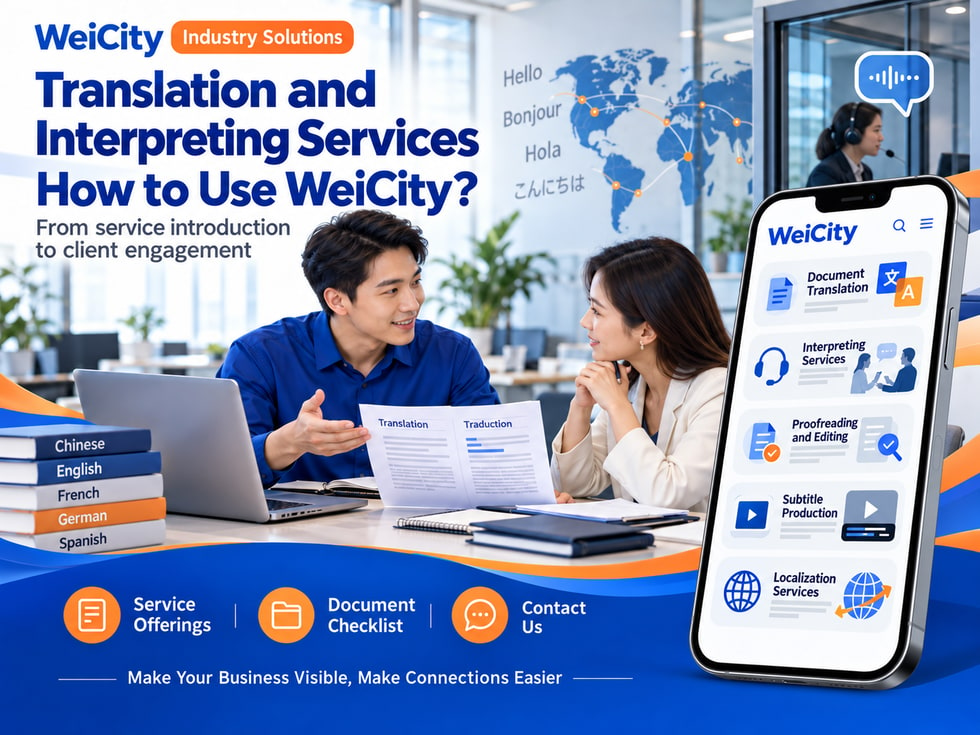
From Service Introduction to Client Commissions
“Can you translate this document?”
“Do you provide Chinese-English interpreting?”
“How long will the translation take?”
“Can you handle scanned files or images?”
“The content is quite technical. Can you assess it first?”
When looking for translation and interpreting services, clients usually first confirm the language pair, file type, purpose, delivery time and scope of service. Explaining the process and material requirements clearly makes communication more efficient for both sides.
💡 With WeiCity, you can set up your own service channel and organize your language services, commissioning process and quotation method, so clients can learn about your services first and then contact you to confirm specific needs.
✅ Translation Companies
Introduce the translation, document translation and related services you actually provide.
✅ Freelance Translators
Show your language pairs, areas of specialization and ways of working together.
✅ Interpreting Service Providers
Introduce arrangements for meetings, events or on-site interpreting.
✅ Localization Teams
Explain website, app, product content or other localization services.
✅ Multilingual Content Providers
Show subtitling, proofreading, copywriting and multilingual editing services.
✅ Certified or Notarization-Related Translation Providers
If you actually hold the relevant qualifications or have such arrangements, state the scope and conditions of these services accurately.
📌 Describe service capabilities, language pairs and qualifications according to what is actually available. Where certification, sworn statements or notarization are required, clients should confirm the specific purpose and required conditions in advance.
You can organize them by type of work:
🔹 Document Translation
Introduce translation services for letters, reports, manuals or other documents.
🔹 Business and Corporate Translation
Explain the scope of services for company materials, product information, business documents and similar content.
🔹 Interpreting Services
Categorize by on-site, meeting, escort or online formats.
🔹 Subtitling and Audiovisual Translation
Introduce subtitle translation, timecode or audiovisual text processing services.
🔹 Proofreading and Editing
Explain language proofreading, polishing and format checking.
🔹 Website and App Localization
Introduce interface text, product content or multilingual version adaptation services.
🔹 Specialized Field Translation
List the fields your team actually works in, and state the scope of services you can provide.
💡 Clients usually look at language direction and file type first, so category names should be simple and clear.
Recommended to specify:
✅ Available language pairs
✅ Service types such as translation, interpreting or editing
✅ File formats that can be handled
✅ Service fields and content scope
✅ Pricing methods or information needed for quotations
✅ How estimated delivery times are confirmed
✅ Whether layout or format processing is provided
✅ Whether rush orders are accepted
✅ Revision and proofreading arrangements
✅ Contact and file submission methods
🔶 For example: Document Translation Service Introduction
Service content: List the language directions and file types you actually provide.
File requirements: Explain the acceptable formats and clarity standards.
Quotation information: Provide the number of pages, word count, language direction and purpose of the document.
Delivery time: Confirmed according to document content, workload and current scheduling.
Submission method: Contact the merchant to confirm an appropriate way to send files.
📌 File complexity, format and purpose affect workload and pricing, and should be confirmed before accepting a commission.
1️⃣ Source Document
Provide a clear, complete document or scan.
2️⃣ Target Language
Specify which language it needs to be translated into.
3️⃣ Purpose of the Document
If it is for internal reading, promotion, submission to an institution or another purpose, please state this in advance.
4️⃣ Word Count or Number of Pages
If unclear, the client can submit the document first for the merchant to assess.
5️⃣ Delivery Time
State the desired completion date and ask whether it can be arranged.
6️⃣ Format Requirements
For example, whether the original layout, tables or subtitle format must be retained.
📌 If a document contains personal, commercial or sensitive information, clients should first learn about the service provider's document receiving and confidentiality arrangements, then choose an appropriate channel to submit it.
You can organize:
🔹 Interpreting Format and Language Pair
🔹 Service Date, Time and Location
🔹 Event Topic and Schedule
🔹 Expected Number of Participants
🔹 On-Site Equipment or Online Platform Requirements
🔹 Interpreting Duration and Break Arrangements
🔹 Whether Materials Need to Be Reviewed in Advance
🔹 Transportation, Accommodation and Additional Costs
🔹 Rescheduling and Cancellation Methods
💡 Clients who provide the agenda, terminology or background materials in advance help both sides confirm the scope of preparation.
📌 Interpreting arrangements should be confirmed according to event content, timing and on-site conditions. When quoting, state the service duration and what is included.
Recommended to specify:
✅ Whether pricing is based on word count, pages, duration or project
✅ Whether proofreading or layout is included
✅ Whether there is a minimum charge
✅ Whether rush arrangements are quoted separately
✅ How additional revisions are calculated
✅ Whether interpreting transportation or equipment costs are charged separately
✅ Payment and delivery methods
✅ When the delivery period starts
🔶 For example:
“Translation fees and delivery times will be confirmed according to language direction, document content, word count and format requirements. Please feel free to provide the materials and their purpose first, and we will reply with a quote and timeline after assessment.”
📌 Before the document has been assessed, an estimated time should not be written as a final delivery commitment.
You can explain the following to clients:
🔹 Document Receiving and Delivery Methods
🔹 Who Can View or Handle Documents
🔹 Whether a Confidentiality Agreement Is Required
🔹 Revision and Version Confirmation Process
🔹 Document Retention and Deletion Arrangements
🔹 How Personal Information in Documents Is Handled
💡 Public channels are suitable for general commissioning processes. Do not display original texts, contracts or personal documents that clients have not authorized for public viewing.
📌 Confidentiality requirements may vary between clients and should be discussed and confirmed before a formal commission.
You can check according to the scope of service:
✅ Whether the language direction and document version are correct
✅ Whether names, dates, numbers and units are consistent
✅ Whether tables and paragraphs are complete
✅ Are the proper nouns using the translations confirmed by the client?
✅ Is the agreed format retained?
✅ Are files named and delivered as required?
✅ Does the client need further proofreading or revisions?
💡 If the client provides a glossary, brand names, or a list of proper nouns, confirm which version to use before starting.
🔹 About Us
Introduce the team, language services, and working methods.
🔹 Translation Services
Organize by language pair, document type, and field.
🔹 Interpreting Services
Introduce service formats, booking requirements, and event arrangements.
🔹 Proofreading and Localization
Showcase the editing and localization projects you actually provide.
🔹 Commissioning Process
Explain the steps for document assessment, quotation, confirmation, and delivery.
🔹 Document Preparation Guide
Tell clients what to check before submitting documents.
🔹 FAQs and Contact
Organize questions about quotations, turnaround times, and bookings.
💡 To start, you can include language pairs, main services, the information needed for a quote, and contact details, then gradually add case studies and FAQs.
🔶 Client asks: “Can you translate this document?”
You can reply:
“Hello, please tell us the source language, the target language, the purpose of the document, and the deadline you have in mind. After we review the document, we will confirm the scope of service, the quotation, and the turnaround time.”
🔶 Client asks: “Do you provide event interpretation?”
You can reply:
“Please first provide the event date, location, language pair, estimated duration, and agenda. We will confirm interpreter availability and service fees based on the actual arrangements.”
🔶 Client asks: “Can you translate certificates or official documents?”
You can reply:
“Please first explain the purpose of the document and the requirements of the receiving institution. Different institutions may have different certification or format requirements, and we will help confirm the options available within our actual service scope.”
1️⃣ Basic Provider Information
Name, service languages, office hours, and contact details.
2️⃣ Languages and Service Categories
Organize the translation, interpretation, and editing services you actually provide.
3️⃣ Commission Information Checklist
Explain what information clients need to provide when requesting a quote.
4️⃣ Quotation and Delivery Process
Introduce the assessment, confirmation, payment, and delivery methods.
5️⃣ Document Handling Notes
Organize document submission, confidential communication, and revision arrangements.
✅ Is the language pair accurate?
✅ Are the service scope and specialized fields genuine?
✅ Are the notes on certification or notarization clear?
✅ Do quotations and turnaround times need to be confirmed after assessment?
✅ Are file formats and submission methods listed?
✅ Is the handling of client information explained?
✅ Have case studies or samples been authorized?
✅ Are the contact details correct?
After organizing your language services, commission process, and inquiry guide in the channel, you can use it for everyday replies, service promotion, and client communication.
Clients can first learn about your language pairs and service types, then provide documents, purposes, and delivery deadlines; providers can also use this to continue assessing the scope of work, quotations, and delivery arrangements.
Want to learn how to set up a Translation and Interpretation service channel?
Feel free to contact us through the official WeiCity channel contact details, and we can work together to organize content that suits your team.
WeiCityMake your business visible and your contact easier.