

17 💎 How do you describe a paid article so readers know what they are buying?
Explain the target audience, content scope, and reading requirements so readers understand the article's value before deciding whether to buy.
When you publish a paid article, how do you help readers tell whether the content suits them? This article explains how to clearly state the target reader, article outline, practical takeaways, article language, and reading requirements, and uses concrete examples to help merchants and creators describe paid content more clearly, so readers have a full understanding before they buy.
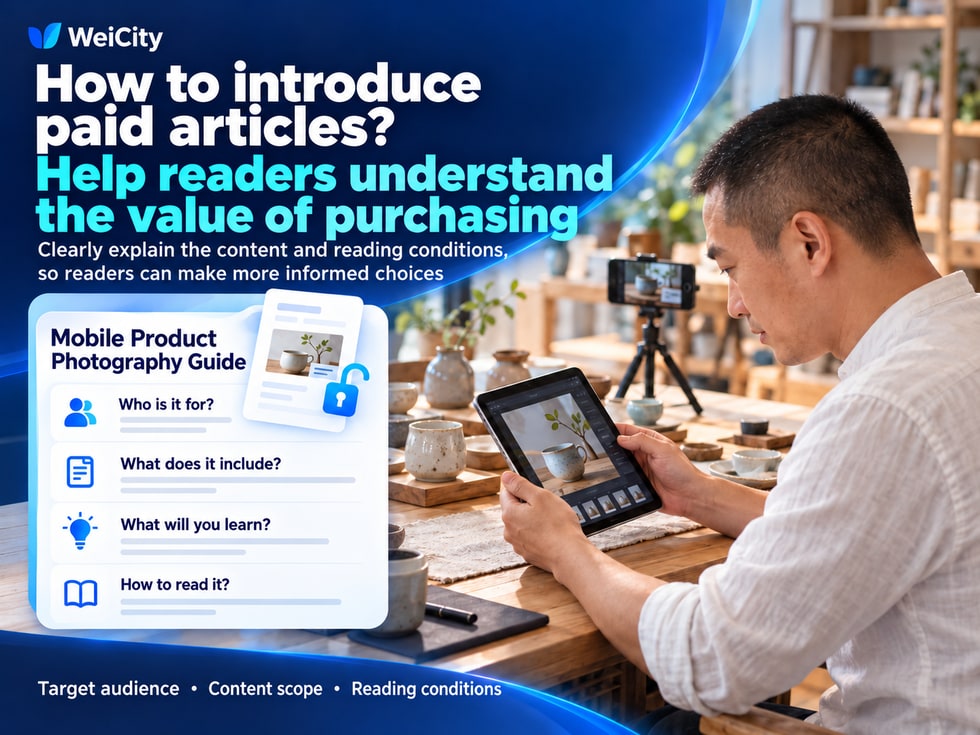
However, before buying, readers may still want to know:
💬 "Is this suitable for my current level?"
💬 "What exactly does it cover?"
💬 "What will I be able to learn after reading it?"
💬 "Am I buying just the article, or does it also include courses and consultation?"
A clear introduction helps readers judge whether this content meets their needs.
For the same topic, different readers may need different levels of depth.
For example, an article about product photography with smartphones could state:
📱 Suitable for small merchants who photograph products with their phones.
🌱 Suitable for beginners who are starting to learn lighting and composition.
🏠 Suitable for people who want to complete basic shooting in a store or at home.
If the content mainly covers basic methods, it should also state:
"This article focuses on introductory techniques and is suitable for readers who want to improve their everyday product photos."
When readers know who the content is for, they can more easily decide whether it is worth exploring further.
"Sharing professional tips" is rather general, and readers may find it hard to imagine the actual content.
You can list the main points the article covers:
✅ How to prepare products and backgrounds before shooting.
✅ How to use window light.
✅ How to adjust angles to reduce obvious reflections.
✅ How to arrange products within the frame.
✅ How to check whether photos are clear after shooting.
These descriptions let readers understand which questions the article covers.
If the article only covers shooting methods and does not discuss post-processing, the scope should be stated clearly.
Connect the content to readers' practical tasks.
For example:
📷 After reading, you can follow the steps to try setting up a simple product shooting scene.
🌱 After reading, you can learn to observe the state of the soil as a reference for deciding when to water.
🧵 After reading, you can practice stitch control and corner handling by following the demonstrations.
Describing the purpose with specific, reasonable language helps readers understand the value of the content better than "become an expert right away."
A practical summary can answer three questions:
① Who is this article for?
② What does it contain?
③ What can it help readers accomplish?
For example:
"This guide is for beginners who use a smartphone to photograph small products. It covers background preparation, use of natural light, shooting angles, and basic composition, and includes a shooting checklist to help readers try to improve their everyday product photos."
Even before reading the main text, readers can understand the purpose and scope of the article.
If the main text of the article is in Chinese, state this in the introduction.
If the content involves hands-on practice, you can also explain what needs to be prepared:
🔹 A smartphone or other device.
🔹 Basic tools and materials.
🔹 A space suitable for practice.
🔹 Basic knowledge needed beforehand.
For example:
"The main text is in Simplified Chinese. Practice requires a smartphone, small products, a simple background, and a shooting position where natural light is available."
This information helps readers judge whether they can conveniently follow along with the practice.
When using WeiCity's paid article feature, the public description should match the actual settings.
💎 Paid Unlock
Clearly state that this is an article whose full text must be unlocked with payment.
👥 Membership Reading Benefits
If a membership level exemption is set, state which specified membership levels can read the article for free.
📖 What Is Included in the Purchase
State that the purchase includes the full text of the article and the content actually included in the main text.
If video courses, individual consultation, or other services are not included, the reading scope should be stated to avoid misunderstandings.
The more closely the introduction shown to customers matches what they actually receive, the clearer the reading experience will be.
Using "Introductory Guide to Smartphone Product Photography" as an example:
👤 Target Audience
Small merchants and beginners who want to improve product photos with their phones.
📚 Content includes
Background preparation, use of natural light, shooting angles, basic composition, and a shooting checklist.
🛠️ Practical Takeaways
Following the article's steps, you can try to complete a simple product shooting scene.
🌐 Language of the Main Text
Simplified Chinese.
📱 Requirements
A smartphone, small products, a simple background, and a location where natural light is available.
🔓 Reading Method
The full article is unlocked with payment; if a membership level exemption is set for this article, the corresponding membership reading benefits are provided as described on the page.
📌 Content Scope
Mainly illustrated introductory guidance; does not include individual photography consultation or video courses.
When publishing, replace these instructions with the actual content and settings of your article.
Final checks:
✅ Is everything mentioned in the introduction actually provided in the main text?
✅ If a checklist is said to be included, has it actually been added?
✅ Are the images and examples clear?
✅ Does the target audience match the difficulty of the content?
✅ Are the language and reading conditions accurate?
✅ Does it promise any results the main text cannot support?
If the body text is revised, also check the title, summary, and introduction for consistency.
A clear introduction to paid content can reduce repeated questions before purchase and help readers choose articles that suit their needs.
You can use the title to attract relevant readers, use the summary to explain the value, and then deliver the content promised in the full body text.
Over time, each article becomes a concrete reference for readers to understand your professional focus.
Before publishing your next paid article, make clear:
who it is for, what it covers, what help it offers, and how to read it.
If you explain these four things clearly, you have a clear introduction to your paid article.
👉 Start writing: https://wei.city