

6 How Can Instructors and Trainers Build an Online Course Brand? From Professional Presentation to Attracting Learners
It is not enough to simply upload teaching videos. You also need to help prospective learners understand your professional abilities, teaching style and course value, gradually building a personal teaching brand that people can trust.
How can independent instructors, trainers and knowledge creators build their own online course brand? This article introduces personal teaching positioning, professional background presentation, course features, learner trust, content promotion and enquiry conversion methods. It also explores how to use the WeiCity merchant channel to present instructor information and teaching services in one place, so that more prospective learners can understand your professional abilities.
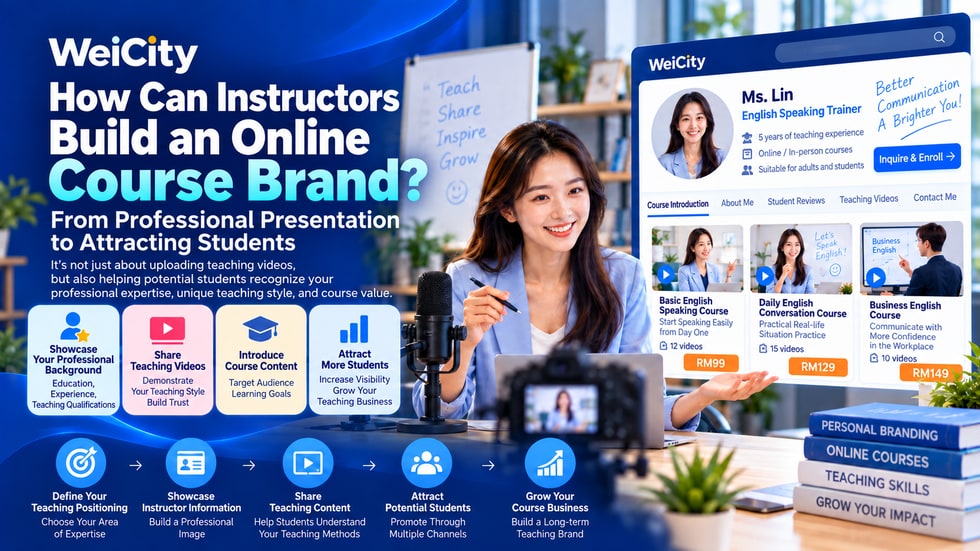
Today, more and more professionals are sharing their knowledge and teaching experience online.
Some teach English.
Some provide computer skills training.
Some teach baking, painting, photography, or design.
Others organize years of industry experience into professional courses.
However, being able to make teaching videos does not mean that potential learners will actively sign up.
Many lecturers encounter these problems.
🔸 Many teaching videos have been published, but few people ask about the courses.
🔸 Professional experience exists, but potential learners do not know your background.
🔸 Social media has views, but there is no clear course introduction.
🔸 There are many similar courses, and it is unclear how to present your unique strengths.
🔸 Want to build a personal teaching brand but do not know where to start.
For independent lecturers, what really needs to be built is not just the number of courses, but a professional teaching brand that learners can get to know, understand, and trust.
A personal teaching brand (Personal Teaching Brand) refers to learners' overall impression of a lecturer's professional field, teaching style, experience, and service features.
For example, when potential learners think of learning Excel, they may look for a trainer who specializes in office software teaching.
When parents want their child to learn English, they may look for an English teacher suitable for children.
When someone wants to learn baking, they may look for a baking mentor who specializes in teaching beginners.
A lecturer brand can be built in the following ways.
👨🏫 Professional field: What do you mainly teach?
🎯 Target learners: Which learners are your courses suitable for?
📚 Teaching content: What can learners learn?
💡 Teaching features: What are the characteristics of your teaching approach?
🏆 Professional background: What relevant experience or qualifications do you have?
💬 Learner support: What support can learners receive before signing up and during the course?
When this information is clear, potential learners can more easily judge whether a course suits their needs.
Many professionals have multiple skills.
However, if every skill is promoted at the same time, potential learners may find it hard to understand what the lecturer is best at.
For example, a computer trainer may teach:
💻 Microsoft Excel.
📊 Business data analysis.
🎨 Graphic design.
📱 Social media operations.
🌐 Basic website knowledge.
All of these have teaching value.
However, in the early stage of building a personal brand, you can first choose one clear main field.
For example:
✅ Excel office skills trainer.
✅ Beginner English speaking lecturer.
✅ Beginner baking mentor.
✅ Children's drawing teacher.
✅ Digital marketing trainer for small businesses.
A clear positioning does not mean you cannot add courses in the future.
Rather, it helps potential learners first understand the main teaching services you provide.
When learners consider taking a course, they usually want to learn more about the instructor.
Therefore, lecturer introductions should try to provide authentic, clear, and relevant information.
Suggested contents include:
👤 Lecturer name or professional title.
📚 Main teaching areas.
🎓 Relevant academic background or professional qualifications.
💼 Actual industry experience.
👨🏫 Relevant teaching experience.
🗣️ Teaching language.
📍 Service area or online teaching method.
For example, an Excel trainer with many years of work experience can introduce the types of work they have used Excel for.
An English teacher can introduce the age group of students they mainly teach, their teaching level, and course focus.
A baking mentor can show authentic baking works and teaching experience.
⚠️ Lecturers should ensure that professional qualifications, teaching experience, and other promotional materials are true and accurate, and should not exaggerate abilities or promise learning outcomes that cannot be guaranteed.
For online lecturers, teaching videos are more than just a tool for spreading knowledge.
They also allow potential learners to understand the teaching style in advance.
For example:
📘 English lecturer demonstrates common pronunciation mistakes.
💻 Excel teacher explains a practical formula.
🍰 Baking mentor shows cake-making techniques.
🎨 Art teacher shares basic painting methods.
📷 Photography lecturer explains shooting composition.
These are the things viewers can use to evaluate:
✅ Whether the instructor explains things clearly.
✅ Whether the teaching content is easy to understand.
✅ Whether the teaching style suits you.
✅ Whether the instructor has relevant practical experience.
✅ Whether you want to continue with a more complete course.
However, teaching videos do not need to turn into a sales advertisement every time.
Providing genuinely useful knowledge first usually builds long-term trust more effectively than constantly asking viewers to buy a course.
The internet offers a large number of free and paid courses.
For this reason, simply emphasizing the number of courses or the length of videos may not attract learners.
Merchants can consider differentiating themselves through their actual teaching features.
🎯 Focus on a clear target audience
For example, designing an English speaking course specifically for adult beginners.
📚 Provide a clear learning path
Let learners know where to start and how the course progresses step by step.
💻 Emphasize hands-on practice
Provide real-life cases, exercises, and practical demonstrations.
🗣️ Use languages suitable for learners
For example, offering explanations in Chinese, English, or Malay for Malaysian learners.
👨🏫 Showcase professional experience
Share real problems you have encountered in a relevant industry and how you solved them.
💬 Provide clear learning support
Explain how learners can ask questions or get assistance, based on your actual service arrangements.
Teaching features should come from real course design and services, not just slogans.
For independent instructors, besides running social media accounts, they also need a convenient entry point where prospective learners can learn about their teaching services in one place.
The WeiCity Merchant Channel can be used to organize information about your personal brand and teaching business.
👨🏫 Present your instructor profile
Describe your areas of expertise, teaching background, and service features.
📚 Introduce your courses in one place
Help prospective learners understand the different course topics and who each course is suited for.
🎬 Share teaching-related content
Publish teaching descriptions, knowledge articles, and course introductions in the content formats the platform actually supports.
🏆 Showcase professional work and experience
Demonstrate your professional capabilities through real cases, portfolio introductions, or relevant content that has been properly authorized.
📱 Provide enquiry methods
Let interested learners know how to contact you.
🔗 Share a unified channel URL
Place the channel link on social media, in your personal bio, or in other promotional channels.
For example, an independent English instructor could introduce the following in one place:
🗣️ Adult English speaking courses.
📘 Basic English pronunciation training.
💼 Workplace English communication courses.
🎬 English teaching demonstration content.
📞 Course inquiry and enrollment information.
This way, prospective learners can get to know the instructor first, and then learn about the course content.
Please note that displaying information in the Merchant Channel does not mean you already have full teaching management, course payment, or paid-viewing features.
For such features, refer to what WeiCity actually supports at launch.
Different platforms can serve different promotional purposes.
▶️ YouTube
Share more complete teaching content, demonstrations, and knowledge explanations.
📱 TikTok
Introduce techniques or course highlights through short videos.
Share course news, teaching activities, and related content.
🌐 WeiCity Merchant Channel
Centrally organize your instructor profile, teaching services, course materials, and contact information.
For example, a computer trainer could share a simple Excel tip on TikTok.
Interested viewers can use the link provided by the instructor to browse the course introduction further.
If the course meets their needs, they can then contact the instructor to learn about how to enroll.
This arrangement can create a clearer connection between content promotion and course introductions.
When prospective learners first get to know an instructor, they may not be ready to buy a course immediately.
They usually want to find out more information.
Therefore, a course introduction should not only say "Welcome to enroll."
It can clearly answer common questions.
❓ Is the course suitable for complete beginners?
❓ What language is used for teaching?
❓ How many lessons are there?
❓ Is it held in person or online?
❓ Are there fixed class times?
❓ What equipment do learners need to prepare?
❓ Does the course provide learning materials?
❓ What are the fees and payment arrangements?
❓ How can I contact the instructor or enroll?
When the information is complete, prospective learners can more effectively judge whether the course suits them.
If you offer trial lessons, experience classes, or consultation services, also clearly explain the applicable conditions.
Besides promoting on social media, instructors can also organize course text content in a way that search engines can understand.
For example, prospective learners might search for:
🔍 Excel Training Malaysia.
🔍 Online English Tutor Malaysia.
🔍 Malaysia online English teacher.
🔍 Penang Baking Classes.
🔍 Beginner Photoshop Course.
🔍 Malaysia computer training courses.
If an instructor's public page clearly states the teaching areas, course descriptions, and relevant professional information, it helps search engines understand the page topic.
It is recommended to prepare:
✅ A clear instructor name.
✅ Clearly defined areas of teaching expertise.
✅ Genuine relevant teaching experience.
✅ Specific names for different courses.
✅ Appropriate teaching keywords.
✅ Suitable service areas.
✅ Course inquiry and contact information.
For example:
❌ Title: Professional teacher, welcome to enroll.
✅ Title: Excel Basic Training Instructor | Practical Courses for Office Beginners in Malaysia.
A clear title not only helps Google understand the page but also lets searchers quickly judge whether the content meets their needs.
However, search engine indexing and ranking still depend on the page's public accessibility, technical settings, content quality, and actual competition.
Building an online teaching brand does not necessarily require launching many paid courses right away.
You can develop it step by step, according to your actual progress.
✅ Step 1: Choose a clear area of teaching expertise.
✅ Step 2: Organize your personal introduction and relevant professional experience.
✅ Step 3: Identify suitable target learners.
✅ Step 4: Create several valuable teaching demonstrations.
✅ Step 5: Prepare a complete course introduction.
✅ Step 6: Establish a clear entry point for presenting your teaching services.
✅ Step 7: Share professional content through social media.
✅ Step 8: Collect questions that prospective learners often ask.
✅ Step 9: Improve courses based on learners' needs.
✅ Step 10: Once the appropriate conditions are in place, expand your range of courses and business model.
Over the long term, instructors can also regularly update teaching content, refine course materials, and improve the learning experience based on real feedback.
For independent instructors and trainers, building a personal teaching brand is not just about having a social media account or uploading a large number of teaching videos.
More importantly, prospective learners should clearly understand:
👨🏫 Who you are.
📚 What you teach.
🎯 Who your courses are suitable for.
💡 What makes your teaching distinctive.
🏆 What real professional experience you have.
📱 How learners can further contact you.
When this information is clearly organized, course introductions are no longer isolated promotional content, but an important entry point that helps prospective learners understand your entire teaching service.
🌐 WeiCity | Let your expertise be seen, and make it easier for learners who need it to get to know your teaching services.
🎓 Start with showcasing your expertise, and gradually build your own online teaching brand.