

61 How Recycling and Renewable Resource Merchants Can Use WeiCity: From Recycling Items to Customer Bookings
Showcase recyclable categories, acceptance conditions, pickup areas, and booking methods in one place, helping residents and businesses learn more about recycling arrangements and contact you more easily.
How can scrap recyclers, renewable resource suppliers, and corporate recycling service providers use WeiCity? Build a channel that makes it easy for customers to check which items can be recycled, understand handover methods, and contact you through recycling categories, item descriptions, pickup conditions, and booking guidance.
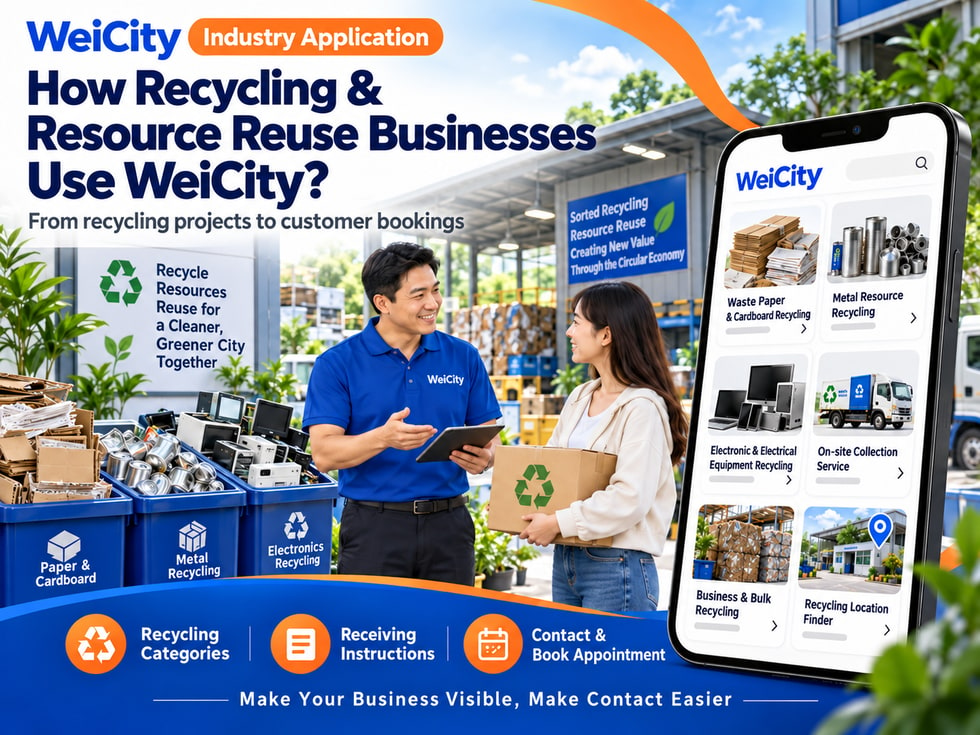
From recycling items to customer bookings
“Can these old cardboard boxes be recycled?”
“Do you collect old household appliances?”
“How much quantity is needed before you can come to collect?”
“How is the recycling price confirmed?”
“Our company has a batch of waste materials. Can you arrange collection?”
When customers contact a recycler, they usually first want to know which items are accepted, how they need to be sorted, whether collection at their location is possible, and how fees or recycling arrangements are confirmed.
💡 Through WeiCity, you can set up your own recycling service channel and organize recycling categories, acceptance conditions and booking methods, so customers can first understand the service and then contact you to confirm items and handover arrangements.
✅ Waste paper and cardboard recyclers
Explain the conditions for accepting paper, cardboard and related items.
✅ Metal and recycled material recyclers
Organize the metal or other material categories actually accepted.
✅ Electronic product recycling providers
Introduce the types of equipment that can be accepted and handover requirements.
✅ Corporate waste recycling providers
Explain bulk recycling, on-site assessment and booking methods.
✅ Old goods recycling and removal merchants
If actually provided, you may introduce moving, removal or sorting services.
✅ Second-hand goods recyclers
Show the furniture, equipment or other reusable items actually purchased.
📌 Recycling categories, service scope and disposal methods should be explained according to actual operations. Acceptance conditions may differ for different items.
You can organize them by item category:
🔹 Paper and cardboard
Explain the types of paper and cardboard accepted and the sorting requirements.
🔹 Metal materials
List the metal categories actually accepted and how they should be delivered.
🔹 Electronic products
Explain the types of equipment accepted and condition requirements.
🔹 Furniture and large items
State sizes, quantities and whether moving service is provided.
🔹 Plastic or other materials
List the sorting categories and packaging methods actually accepted.
🔹 Corporate bulk recycling
Introduce how bulk items are quoted and arranged.
🔹 Removal and on-site collection services
If actually provided, explain the areas served, minimum collection conditions and booking process.
💡 List common categories first, then explain which items require photos or quantity confirmation.
Recommended to specify:
✅ Categories of items accepted
✅ Acceptable condition or sorting requirements
✅ Whether cleaning, dismantling or packing is required
✅ Minimum quantity or weight requirements (if any)
✅ On-site collection areas
✅ Drop-off location and opening hours
✅ Recycling prices or valuation method
✅ Whether moving or removal is provided
✅ Information needed when booking
✅ Items not accepted or special restrictions
🔶 Example: cardboard recycling description
Accepted categories: list the cardboard or paper actually accepted.
Preparation: explain whether folding, bundling or sorting is required.
Quantity requirement: if there is a minimum quantity, state it according to actual conditions.
Delivery method: state the self-delivery location or the scope of on-site collection.
Fee confirmation: contact the merchant to confirm according to quantity, quality and current arrangements.
📌 Accepted categories and prices may change with material condition, quantity and market conditions, and should be confirmed again before handover.
1️⃣ Overall photos of the items
Take clear photos showing the item types and general condition.
2️⃣ Quantity or weight
Provide approximate piece count, volume or weighing information.
3️⃣ Item location
Provide the area, floor and access route conditions.
4️⃣ Sorting and packaging status
State whether the items are already sorted or packed, or need on-site handling.
5️⃣ Preferred handover date
Helps the merchant arrange staff and vehicles.
6️⃣ Whether Pickup Labor Is Needed
Explain in advance any large, heavy, or hard-to-move items.
📌 Photos and estimated quantities help with initial communication. Final acceptance and quotation should be confirmed by the merchant.
Suggested items to organise:
🔹 Service Area
🔹 Whether There Is a Minimum Quantity or Order Requirement
🔹 Floors, Elevator, and Vehicle Access Conditions
🔹 Whether Handling Is Included in the Service
🔹 Whether the Customer Needs to Help Sort Items
🔹 Appointment Time and Estimated Arrival Arrangements
🔹 Fees for Remote Areas or Special Items
🔹 How to Reschedule or Cancel
💡 When customers provide photos, quantities, locations, and floor information for their items, the merchant can more easily assess whether a door-to-door service can be arranged.
📌 On-site conditions may affect handling and vehicle arrangements, so they should be clarified before an appointment is confirmed.
Recommended to specify:
✅ Whether pricing is based on piece, weight, quantity, or material type
✅ How item condition affects the estimate
✅ Whether there is a minimum collection quantity
✅ Whether pickup or handling fees apply
✅ Whether dismantling or removal is charged separately
✅ How bulk orders are quoted
✅ Payment and handover methods
✅ How long the price is valid or how it is confirmed
🔶 For example:
“Collection prices are confirmed based on item type, quantity, condition, and delivery location. Please first provide photos and an approximate quantity, and we will reply with whether we can accept the items and how the estimate will be made.”
📌 Information on the online channel is not a final quotation. Actual collection conditions and fees should be determined after the merchant inspects or confirms the items.
You can ask customers to provide:
🔹 Item Categories and Sources
🔹 Estimated Quantity, Weight, or Volume
🔹 Item Photos and Sorting Status
🔹 Site Address and Delivery Location
🔹 Whether Door-to-Door Removal Is Needed
🔹 Expected Processing Date
🔹 Whether Regular Collection Is Needed
🔹 On-site Access and Loading Conditions
💡 For regular cooperation, you may explain the frequency, quantities, and how each handover will be communicated.
📌 Business customers should first confirm details such as handover items, service scope, fees, and processing records before arranging collection.
If computers, phones, or storage devices are actually accepted, you may remind customers:
✅ Back up any data you want to keep first
✅ Sign out of personal accounts and remove device locks
✅ Delete or erase personal information
✅ Remove SIM cards, memory cards, and accessories
✅ State whether the device can still be powered on
✅ Understand the merchant's device acceptance and processing procedures
📌 Electronic devices may contain personal data. Customers should handle their data before handover and confirm with the merchant how devices will be accepted and processed afterward.
🔹 About Us
Introduce the merchant, recyclable categories, and service areas.
🔹 Recyclable Items
Organize by paper, metal, electronic devices, and other categories.
🔹 Acceptance Conditions
Explain requirements for condition, sorting, quantity, and packaging.
🔹 Pickup and Removal
Introduce service areas, handling conditions, and how to make an appointment.
🔹 Corporate bulk recycling
Explain what information customers should prepare when requesting a quote.
🔹 Delivery Location and Time
Provide the address, business hours, and handover instructions.
🔹 FAQ
Organize questions on estimates, minimum quantities, and items not accepted.
💡 At first, you can include the main recyclable categories, acceptance conditions, and appointment methods, then gradually add bulk service details.
🔶 Customer asks: “Do you collect these old cardboard boxes?”
You can reply:
“Hello, here is information about the paper and cardboard we accept. Please send photos, an approximate quantity, and your area, and we will help confirm the acceptance conditions and drop-off or pickup method.”
🔶 Customer asks: “Can you pick up old appliances from my home?”
You can reply:
“Please tell us the types and quantity of appliances, your area, and the floor situation. You can also send a few photos, and we will then confirm whether we accept them and whether pickup can be arranged.”
🔶 Customer asks: “Our company has a batch of metal materials. Can you give a quote?”
You can reply:
“Yes. Please provide the material type, quantity or weight, on-site photos, and delivery location, and we will confirm the acceptance arrangements and how the estimate will be made based on the actual situation.”
1️⃣ Basic merchant information
Name, address, service area, and contact information.
2️⃣ Recyclable Categories
List the items and materials actually accepted.
3️⃣ Acceptance Conditions
Clearly state sorting, quantity, condition, and packaging requirements.
4️⃣ Pickup and Handover Guide
Explain appointments, handling, removal, and handover methods.
5️⃣ Bulk Inquiry Checklist
Tell business customers what information they need to provide.
✅ Are the accepted and non-accepted categories clear?
✅ Are requirements for quantity, condition, and sorting explained?
✅ Are the methods for confirming estimates and pickup fees clear?
✅ Are the service area and delivery location accurate?
✅ Is the reminder on electronic device data handling complete?
✅ Do the images correspond to the actual recycling items?
✅ Are the appointment and bulk inquiry methods clear?
✅ Are the contact details correct?
After organizing recyclable items, acceptance conditions, and appointment guidance in the channel, you can use them for daily replies, service promotion, and business recycling communication.
Customers can first browse recyclable categories, then provide item photos, quantities, and locations. The merchant can use this to continue confirming acceptance, estimates, and handover arrangements.
Want to learn how to set up a recycling and resource recovery merchant channel?
Feel free to contact us through WeiCity's official channel contact details, and we can work together to organize display content suited to your business.
WeiCity
Make your business visible and contact easier.