

7 How to Follow Up After Sharing a Digital Business Card: Turning a First Meeting Into Effective Communication
Make future contact more natural and clear by referring to the meeting context, the client's needs and relevant materials
After exchanging digital business cards, how can you start the next conversation? This article introduces how to follow up after sharing a WeiCity digital business card, from reminding each other of where you met, responding to specific needs to sending relevant materials, helping clients remember you and giving later communication clear content and next steps.
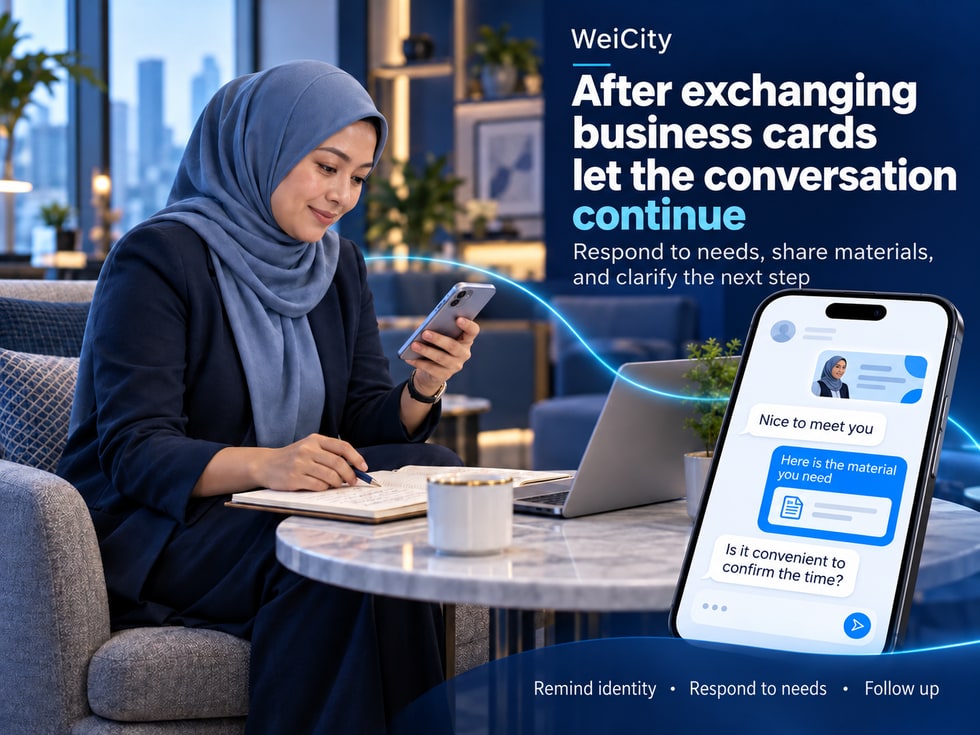
When attending business events, visiting clients or meeting new partners, exchanging digital business cards is usually only the first step in building a connection.
What really matters is: After exchanging cards, how do you help the other person remember you and remain willing to keep in touch when they need you?
Many salespeople run into situations like these.
👤 A customer has received your digital business card but has not followed up further.
💬 You want to send a message but don't know what to say.
🛍️ A customer asked about products but has not yet decided whether to buy.
🛠️ A customer is interested in a service but has not provided complete requirements.
📅 Both sides agreed to contact each other again, but you're not sure how to start the conversation naturally.
📄 You have prepared product materials or a service introduction but are unsure when it is best to send them.
If you keep sending only "Hello", "Let me know if you need anything" or "Have you thought about it?", the customer may not know how to respond.
Effective customer follow-up is not about constantly reminding someone to buy; it is about helping the customer recall who you are, responding to previously discussed questions, and offering a useful next step.
A WeiCity digital business card can help customers review your name, professional role and contact details again.
If you also run a merchant channel, you can share relevant products, services, Gallery content or articles based on the customer's actual needs.
This article introduces customer follow-up methods after sharing a digital business card, WhatsApp business contact scripts, sample communications for different situations, and how to use your WeiCity digital business card and merchant channel to help a first meeting grow into ongoing communication.
Exchanging cards means both parties have had a chance to meet, but it does not mean the other person fully understands your business.
Especially at exhibitions, business gatherings or large events, a person may meet many new contacts in a short time.
After the event, the other person may remember talking with you but forget:
Your name.
Which company you represent.
What services you provide.
What you discussed.
What materials you promised to send.
A simple reminder of where you met can help the other person connect the memory.
Help the customer better understand what you are responsible for.
For example:
Send product information.
Provide service details.
Share additional case photos.
Confirm appointment times.
Let the customer know you have noted what was discussed earlier.
Even if the customer has no immediate need, you can maintain appropriate contact while respecting their wishes.
You met a customer at the Penang Furniture Fair.
The customer asked about a two-seater sofa but did not decide right away.
After the event, you could send:
"Hello, I'm Jason, the person you spoke with today at the furniture fair, responsible for furniture purchase consultation. We discussed how your living room space is fairly limited, so I've put together some sofa size information for your reference."
This makes the reason for contacting them easier to understand than simply sending "Hello, are you interested in buying?"
📌 The first step in following up with a customer is to continue the earlier conversation, not to start selling all over again.
When contacting a newly met customer for the first time, you can use a simple structure:
Identity reminder + conversation topic + useful material + next step
State who you are.
For example:
"Hello, I'm Mr. Chan, the person you spoke with today."
Remind them where you met.
For example:
"We met today at the Penang Furniture Fair."
Explain what you discussed earlier.
For example:
"You asked about sofa sizes suitable for a small living room."
Provide relevant materials or ask a simple question.
For example:
"I've put together two smaller sofa models for your reference."
"Hello, I'm Jason, the person you spoke with today at the Penang Furniture Fair, responsible for furniture purchase consultation.
We discussed how you are looking for a sofa suitable for a small living room.
I've put together product information for two related models, so you can check the sizes first. If it's convenient, you can also tell me the width of the space you plan to place it in, and I'll help you compare them."
Because the message explains:
Who you are.
Why you are getting in touch.
What help you are offering.
How the customer can respond.
📌 A first follow-up does not need to be long, but it should make clear to the customer why you are reaching out after they read it.
Many business staff send this directly at the first follow-up:
"Hello, do you remember me?"
This approach may make the customer feel awkward.
Because they may not remember your name.
A more natural approach is to proactively provide clues to help them identify you.
"Hello, I'm Miss Lam, whom you met yesterday at a business networking event. I mainly provide brand design services."
"Hello, I'm Jason, who served you at the furniture store today. We discussed dining table sizes earlier."
"Hello, I'm David, who visited your company today to introduce office furniture. Thank you for taking the time to speak with me."
"Hello, I'm Amy from today's course exchange event. I mainly handle course consultations."
"Hello, I'm Mr. Chan, who discussed garden maintenance needs with you yesterday."
If the other person may not remember you, you can attach your WeiCity digital business card.
For example:
"Here is my digital business card, which contains my work introduction and contact details so you can review them again anytime."
Also, don't send multiple reminders just because the customer did not recognize you immediately.
📌 Clearly explaining when, where and what you discussed is more natural than asking the customer to actively recall you.
A digital business card can serve as a supplementary identity introduction in later communication.
When a customer forgets your professional role, they can review your publicly available information through the card.
Let the customer know exactly who they are speaking with.
Help the customer match online information with the person they actually met.
Explain what business you are responsible for.
If the digital business card shows related information, it can help customers learn about the company they work for.
Makes it easy for customers to find you again when they need to.
Customers can keep your personal link according to how they prefer to use it.
You met a restaurant operator at a business event.
Send after the event:
“Great talking with you today. I'm Jason, and I mainly handle online merchant presentation and business consultations.
This is my WeiCity digital business card, so you can check my introduction and contact details later.”
Sharing a business card does not mean the platform will automatically send reminders, record customer interest, or arrange follow-up communication.
These capabilities depend on WeiCity's actual features at the time.
📌 The digital business card helps customers get to know you and find you, while follow-up messages continue the actual conversation.
For retail merchants, a customer may only be comparing products during the first conversation.
For example:
Furniture.
Hardware tools.
Electronics.
Household goods.
Automobiles.
Clothing.
For example:
Product type.
Size.
Color.
Budget.
Usage scenario.
These may include:
Product photos.
Specification details.
Price information.
Other options worth comparing.
Let the customer know the material relates to their earlier needs.
For example:
“May I ask how wide the space where you plan to place it is?”
“Hello, you mentioned earlier that you are looking for a two-seater sofa suitable for a small living room.
I've put together information on two related products so you can compare sizes and styles first.
If it's convenient, you can tell me the width of the spot where you plan to place it in the living room, and I'll help you check whether it fits.”
“Hello, the drill specification information you asked about earlier is now ready.
This document includes the main specifications and applicable uses, so you can review it first.
If convenient, you can also tell me whether it will mainly be used for wood, metal, or wall work, so I can confirm your needs further.”
If the customer has not mentioned a budget, do not write:
“You said earlier that your budget is only RM500.”
📌 Product follow-up should focus on needs the customer has actually expressed, rather than resending every product.
Service businesses usually need to understand the customer's situation before they can discuss arrangements further.
For example:
Renovation.
Photography.
Gardening.
Repairs.
Education and training.
Design.
You can find out:
Property type.
Location area.
Expected renovation timeline.
Main design requirements.
You can find out:
Shoot date.
Shoot location.
Number of participants.
Shoot types.
You can find out:
Service area.
Garden size.
Issues that need to be addressed.
Site conditions.
You can find out:
Equipment type.
Fault situation.
Service location.
Whether relevant photos are already available.
“Hello, we previously discussed your apartment renovation needs.
I've put together a design case with a space type that is quite similar, so you can refer to the layout and style.
If convenient, you can tell me roughly the size of the property and your expected renovation timeline, and I'll learn more about your plans.”
“Hello, you mentioned earlier that you wanted to arrange family photography.
I've organized the related shoot introduction so you can learn about the service content.
Do you have a shoot date in mind yet?”
Because the customer may still be in the early stage of learning about you.
Asking more than a dozen questions at once may add to the reply burden.
📌 For service follow-up, you can first confirm the one or two most important details, then continue the conversation based on the customer's replies.
Customers may not have time to open every link.
If you send a lot of content at once, they may not know which one to look at first.
Therefore, before sharing, it is best to explain:
What is this page?
Why is it related to their needs?
How can they continue after viewing it?
“This is the dining table information you asked about earlier. It includes size and style details, so you can compare it with your space at home.”
“This case is quite similar to the type of apartment you mentioned, so you can refer to how the space is planned.”
“This article outlines what to prepare before a booking, so you can understand the whole process.”
“This is our WeiCity merchant channel, where you can first learn about our brand and main services.”
“This is our store information, which includes the address and opening hours, so you can check before heading out.”
Respond to the need + explain key points of the material + attach the link + suggest the next step
For example, if a customer only asked about sofas but receives many links to dining tables, bed frames, and cabinets.
📌 Sharing one or two of the most relevant materials at a time usually makes it easier for customers to find the key points than sending many links at once.
If a merchant has already published business content on WeiCity, they can choose what to share based on the customer's actual questions.
Suitable when the customer wants to learn more about the merchant.
Suitable when the customer asks about specific products.
Suitable when the customer wants to understand the service content and scope.
Suitable when the customer wants to view actual work.
Suitable for explaining common questions and preparation steps.
Suitable when the customer needs the address or opening hours.
A customer met a furniture salesperson at an exhibition.
At the first follow-up, the salesperson shares their personal business card.
The customer then asks about sofas.
The salesperson then shares the corresponding product page.
The merchant channel is provided only when the customer wants to understand the store's full furniture selection.
Because customers need different information at different stages.
The personal business card helps customers get to know the person in charge.
The merchant channel helps customers understand the business.
Specific content pages help customers address their current questions.
Whether WeiCity supports automatic customer management, follow-up reminders, or sales process records should be confirmed against its current actual features.
📌 The merchant channel can serve as a source of materials during business follow-up, but actual communication still needs to be based on customer needs.
WhatsApp is a common everyday communication tool in Malaysia.
When used for business follow-up, it is recommended to keep messages:
Brief.
Clear.
Polite.
Related to previous communication.
"Hello, I'm Jason, whom you met today at the business networking event.
It was great talking with you.
This is my WeiCity digital business card, so you can easily check my work introduction and contact details later."
“Hello, the dining table information you asked about earlier is now ready.
I've sent you the related product link, which includes size and style details for your reference.”
“Hello, the service introduction we discussed earlier is now ready.
This document outlines the main service scope and preparation steps. Feel free to review it, and let me know if you have any questions.”
“Hello, you mentioned earlier that you like a clean design style.
This case may help you refer to the spatial layout and color combinations, and hopefully it helps you organize your needs.”
“Hello, we mentioned earlier that we would confirm the shoot time this week.
I'd like to know whether you already have a suitable date. If convenient, please let me know and I'll check the schedule.”
“Hello, it was great discussing possible cooperation directions with you last time.
I've organized the service introduction we mentioned earlier so you can learn more about it.
If you think it's suitable, we can discuss next steps.”
"Understood, thank you for letting me know.
If you have related needs in the future, feel free to contact me again.”
Do not pretend both sides have already reached an agreement.
Do not make up needs the customer has not expressed.
Do not create false urgency.
📌 A good WhatsApp follow-up message should let the customer know why they are receiving it, rather than making them feel pressured.
There is no fixed timing that suits every customer.
A more reasonable approach is to arrange it based on previous communication and agreements.
If you have agreed to provide materials, complete them within the agreed time.
For example:
Product specifications.
Service description.
Quotation materials.
Portfolio case studies.
Follow up as agreed.
For example:
"Let's confirm again this Friday."
Handle it according to the actual agreement.
Respect the customer's arrangements.
Do not repeatedly chase right away.
Accept the current decision.
Do not keep sending promotional messages over and over.
If both sides are willing to stay in touch, you may send a brief reminder of who you are and a thank-you message at an appropriate time.
Was a specific time agreed on?
Are there any unfinished items?
Is the customer willing to keep receiving contact?
For example:
Sending "How are you thinking about it?" at the same time every day.
Continuing to send promotional messages whether or not the customer replies.
📌 Follow-up timing should be determined by actual business progress and the customer's wishes, not simply by the number of contacts.
At the end of a follow-up message, you may ask one simple question if it is needed.
However, the question should relate to the current matter.
"Could you tell me the width of the space where you plan to place it?"
"Which day would you like to have the shoot?"
"Could you share the service area and some photos of the site?"
"What date and roughly how many people do you need?"
"Could you describe the equipment model and the problem you are currently experiencing?"
"Is the property currently at the newly delivered stage or preparing for renovation?"
"Which age group are you interested in for the course?"
Because the customer knows what to answer.
By comparison:
"What are your thoughts?"
"Do you have any other questions?"
These may require the customer to reorganize all their needs.
First ask for the information that the current conversation actually needs.
📌 A clear, easy-to-answer question can help both sides communicate more efficiently.
In business discussions, customers may not decide immediately but may ask for additional materials.
For example:
Product specifications.
Price explanation.
Service package.
Case photos.
Booking process.
Review what was discussed earlier.
Make sure the content is accurate.
There is no need to send all files at once.
Tell the customer what the material mainly introduces.
If you promised to send something by a certain time, try to complete it as agreed.
"Hello, the service description you asked for earlier is now ready.
It includes the service scope, the basic process, and the materials to prepare before booking.
Please take a look, and if anything is unclear, feel free to let me know."
Explain the situation honestly instead of sending unconfirmed content.
📌 Following through on what you have promised is a very important part of customer follow-up.
Price is a common question in customer inquiries.
However, a quotation is not always just a single number.
Some products or services also involve:
Specifications.
Quantity.
Scope of services.
Delivery.
Installation.
Appointment times.
Other conditions.
You may specify:
Product name.
Specifications.
Price.
Applicable conditions.
You may specify:
Service items.
Included scope.
Excluded items.
Conditions that need further confirmation.
If there is a validity period, it should be stated clearly.
"Hello, the dining table price information you asked about earlier is now ready.
This quotation corresponds to the size and style you mentioned.
Please check the specifications first, and if you need to adjust the size, we can confirm further."
Also do not describe an estimated price as a final confirmed quotation.
Because customers may save the information and compare it later.
📌 Price follow-up should provide accurate conditions and scope so the customer knows what the quotation applies to.
If a customer does not reply right away, it does not necessarily mean they are not interested.
They may simply be:
Busy at work.
Not yet had time to look.
Need to discuss it with family.
Comparing other options.
Temporarily without a relevant need.
However, you also should not assume the other party will definitely buy.
Have you already explained:
Who you are.
The reason for contacting.
The purpose of the materials.
The next step.
If you promised to provide additional materials, complete them first.
If both sides agreed to confirm again, handle it according to the agreement.
Do not send a large number of messages in a row.
If the other party clearly says they do not need it or do not wish to keep receiving messages, stop the related promotional contact.
"Hello, I'm sending the product information I shared earlier for your reference.
If you would like to learn more about the size or style later, feel free to contact me again."
"Why aren't you replying?"
"I've already sent it to you. Do you want it or not?"
"If you don't buy today, there will be no more chances."
Unless there is a verified deadline or condition, do not create false urgency.
📌 Customer follow-up requires patience and respect for whether the other person wishes to keep communicating.
Not every inquiry results in an order immediately.
Some customers may need:
More time.
To wait for their budget.
To confirm dates.
To discuss with family.
To wait for a project to begin.
Do not treat a decision not to buy for now as something that must be changed immediately.
If the customer needs them, you can provide relevant content that is easy to review later.
Make sure your digital business card and business contact details are up to date.
Do not repeatedly send large amounts of promotional content just because you exchanged business cards.
If the customer contacts you later, you can communicate again based on their new needs.
"Understood, thank you for letting me know.
This is my WeiCity digital business card, which contains my contact information.
If you have a relevant need in the future, feel free to contact me again."
Because it does not require the customer to decide immediately.
It also keeps the possibility of reconnecting in the future.
📌 Maintaining a good relationship does not mean you must keep sending messages; it means letting the customer know they can find you when they need to.
If you often attend business events, you may meet many people in a short period of time.
Remembering only names may not be enough to help you continue the conversation.
You may organize necessary business contact records in a manner that is appropriate and complies with legal and privacy requirements.
Confirm the correct form of address.
Record work-related materials related to the conversation.
For example:
Exhibition.
Business activities.
Client visits.
Store inquiry.
For example:
Sofa size.
Photography booking.
Renovation needs.
Product specifications.
Record the items you promised to complete.
If both sides agreed to contact again, record the actual agreement.
Only save business-necessary information and respect the other person's contact preferences.
Contact: Jason
Where you met: Furniture fair
Discussion topic: Small living room sofa
Materials pending: Size details for two sofa models
Next step: Send product information as agreed
Customer records, automatic reminders, sales stage management and similar functions should be confirmed based on what the actual system supports.
If no related function is available, you may use a work record method that suits you.
📌 Recording the key points of each conversation can reduce the need to ask the same questions again the next time you get in touch.
Exchanging business cards and agreeing to receive marketing messages are not the same thing.
A customer being willing to view your digital business card does not mean they are willing to keep receiving large amounts of advertising.
For example:
Send the materials you promised.
Confirm the appointment.
Respond to the customer's questions.
If the other person does not wish to continue receiving promotional information, their choice should be respected.
Do not assume that all contact methods are suitable for marketing just because you obtained a phone number.
Especially content that has nothing to do with your previous conversation.
When doing business in Malaysia, customer contact information should be handled in accordance with applicable personal data protection requirements.
A customer being willing to exchange contact details does not mean they have agreed to receive marketing messages without limits.
Good business communication is not only about making customers remember you; it also means respecting their time and choices.
📌 Customer follow-up should have a clear and reasonable purpose of contact, and respect the other person's contact preferences.
Is the name correct?
Is the event or location remembered correctly?
Does it match what was actually discussed?
Does it match the customer's needs?
Is it accurate?
Is it suitable to share publicly?
Are the amounts and conditions correct?
Does it match what was agreed?
Can it be opened?
Are the contact details valid?
Is it clear and easy to respond to?
Is the other person willing to continue the conversation?
Does the customer know who I am?
How does this message help the customer?
Does the customer know how to respond after reading it?
📌 If all three questions have clear answers, the follow-up message generally has basic communication value.
Not necessarily. This should be decided based on the actual conversation, any agreements made, and the other person's wishes.
It is recommended to state your identity, the context in which you met, the topic discussed, and the purpose of contact.
You can briefly explain where you met and attach your personal digital business card.
You may use the relevant contact channel when it is appropriate and in line with the other person's wishes.
Not necessarily. If the customer needs to understand your business, you may share it.
Usually this is unnecessary; prioritize providing relevant materials.
First understand the actual need, then provide the relevant service description or case examples.
Continuous reminders are not recommended; respect the other person's time and willingness to communicate.
You may express understanding and arrange further communication according to what both sides have agreed.
This should be decided based on the other person's wishes and actual needs; do not repeatedly send unrelated promotions.
Yes, it can serve as a supplement to your personal identity and contact information.
If related content has already been published, you may share it according to the customer's needs.
Whether automatic reminders are supported cannot be determined from the digital business card feature alone; refer to the current actual functions.
Do not assume this feature exists; refer to what the actual system supports.
No. Respect the customer's contact preferences and applicable personal data protection requirements.
No guarantee can be given, but accurate, relevant and helpful communication can reduce obstacles customers may face when learning about your business.
📌 The key to customer follow-up is not how many messages you send, but whether each contact has a clear purpose.
If you have already started getting to know customers through a WeiCity digital business card, you can build a simple follow-up habit.
Confirm that your name, work role and contact details are correct.
Organize the needs the customer actually mentioned.
Check whether you promised to send materials or to get in touch again.
For example:
Product information.
Service description.
Portfolio case studies.
Merchant channel.
Remind the customer who you are and what was discussed previously.
Choose the page that corresponds to the current question.
For example, confirm a size, date or service area.
Continue the conversation based on their actual reply.
Context of meeting → Previous needs → Relevant materials → Next step
For example:
“Hello, I am Jason, whom you spoke with at the furniture fair yesterday.
You mentioned earlier that you were looking for a sofa suitable for a small living room.
I have put together information on two related products for your reference.
If it is convenient, you could tell me the width of the space where you plan to place it, and I can help you compare further.”
📌 Starting with one clear and helpful contact is more practical than preparing a large set of fixed sales scripts.
Exchanging digital business cards is the beginning of a customer getting to know you.
However, whether a customer is willing to keep communicating often depends on whether later exchanges are clear, accurate, and matched to their actual needs.
Let customers know who you are.
Help the customer recall previous conversations.
Continue around the issues actually discussed.
Provide product information that matches their needs.
Help the customer understand the scope and arrangements of the service.
Supplement explanations with relevant work samples.
Provide the correct page as needed.
Communicate according to agreed arrangements and actual progress.
Make it possible for the customer to find you again in the future.
Avoid unnecessary repeated promotion.
The value of a WeiCity digital business card is not only letting customers save your name and contact details; it can also serve as an entry point for introducing your identity in later business communication.
When a customer needs to get to know you again, you can share your personal digital business card.
When a customer wants to learn about your company, you can share the Merchant Channel.
When a customer asks about products, you can share the relevant product information.
When a customer needs service case examples, you can provide the corresponding works.
When a customer is ready to make further inquiries, you can discuss next steps around their actual needs.
For salespeople, good customer follow-up does not need to be complicated.
The key is to:
👤 First, help the customer remember who you are.
💬 Build on things that were actually discussed.
📄 Complete the materials you have already promised to provide.
🛍️ Share product or service content related to the customer's needs.
🎯 Ask one clear question that is easy to respond to.
📅 Keep to the contact times that have already been agreed.
🤝 Respect whether the customer is willing to continue the conversation.
📞 Keep your digital business card and contact details accurate.
Do not understand customer follow-up as constantly reminding the other person to buy.
A more practical approach is to provide the information the other person truly needs at the right time.
Start with a clear introduction of yourself. Use your WeiCity digital business card, Merchant Channel, and related content pages so that every customer contact has a clear purpose.
Do what you promise and answer customer questions clearly, so that a first introduction can more easily grow into valuable business communication.
Specific digital business card, personal link, Merchant Channel, product sharing, contact entry, customer records, automatic reminders, and other related features are subject to WeiCity's current actual pages and features available in your account.
👉 Open WeiCity: https://wei.city/