

8 How to Use WeiCity Coupon Features? From Publishing Offers to Customer Redemption
Explain offer content, eligibility conditions, and how to use it clearly, giving customers a reason to learn more and visit your business.
How can merchants use WeiCity coupon features to promote products and services? From offer design, claim conditions, and validity dates to customer use, merchant redemption, and record management, this guide helps you set up offers that are clear, reasonable, and easy to carry out.
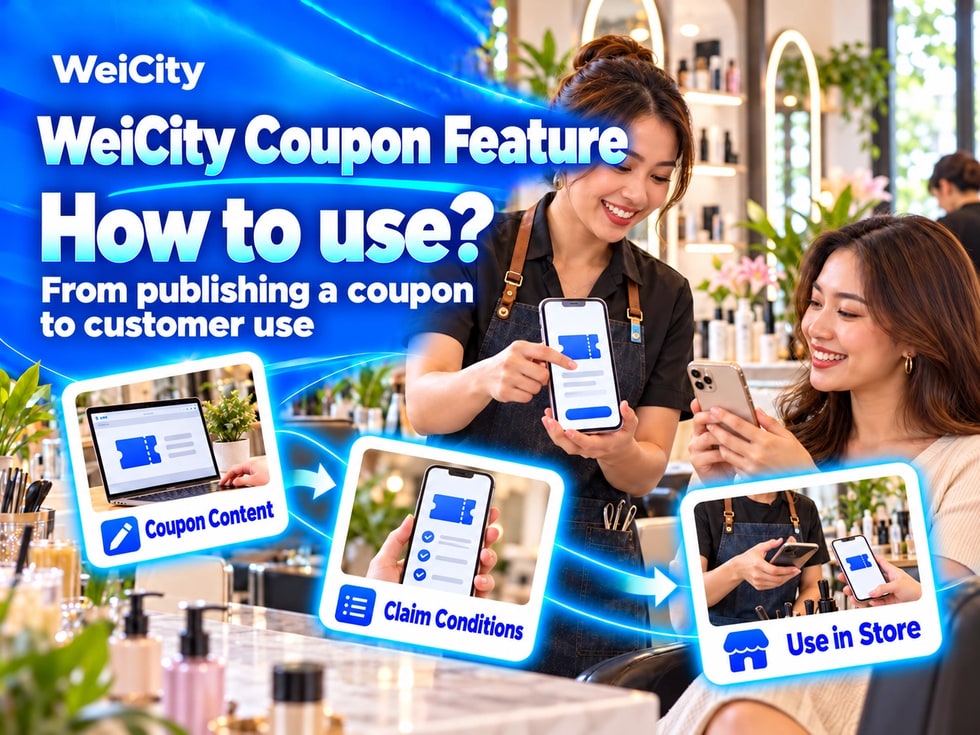
"What kind of offer can I publish to attract new customers to my store?"
"What conditions should be clearly stated on a coupon?"
"How many coupons can each customer claim?"
"How can merchants confirm and use a coupon when the customer arrives at the store?"
Offers give customers a reason to learn about new products, try a service or visit again.
However, if the offer content, dates and conditions are not clearly explained, it can easily lead to misunderstandings between customers and merchants.
💡 With the WeiCity coupon feature, merchants can clearly explain the offer content, how to claim it and the conditions of use, so customers understand the rules first and then claim and use the offer according to actual arrangements.
The coupon feature is suitable for merchants who want to publish promotions with clear content, conditions and valid dates.
For example:
✅ In-Store Experience Offers
✅ Offers on Specified Products
✅ Offers on Specified Services
✅ New Customer Welcome Offers
✅ Gift or Add-on Offers
✅ Holiday Promotion Offers
✅ Class Trial Offers
✅ Dining In-Store Offers
✅ Membership or Repeat-Visit Campaigns
🔹 What offer they can get
🔹 Which products or services it applies to
🔹 When it can be used
🔹 How to claim it
🔹 How to use it in store
🔹 What restrictions apply
📌 The coupon types offered, claim quantities, redemption, records and other features should be based on the channel backend and the services you have activated.
✅ Restaurants and Cafés
Publish offers on specified dishes, drinks, set meals or in-store experiences.
✅ Beauty and hair
Offer discounts on specified care, hair, nail or first-visit experience services.
✅ Retail stores
Promote new products, specified items, spend-threshold promotions or gifts.
✅ Education and training
Publish trial classes, open days or specified course promotions.
✅ Sports and Fitness
Offer discounts on trial classes, venues or specified activities.
✅ Pet Services
Promote grooming, washing or specified product campaigns.
✅ Automotive Services
Publish offers on car washes, inspections or specified maintenance items.
✅ Travel and accommodation
Offer accommodation or event discounts that meet the date and condition requirements.
📌 Coupons should apply only to products and services that the merchant can actually provide.
Do not reduce prices simply because "others are offering discounts."
First, decide what you want to achieve:
🔹 Attract new customers to learn about your business
🔹 Promote a new product or service
🔹 Encourage customers to visit during specified times
🔹 Boost items that are chosen less often
🔹 Support holiday or opening activities
🔹 Invite former customers to return
🔹 Promote trial courses or activities
🔶 For example:
If a café wants customers to discover a new drink, it can offer a trial discount on the new drink for specified dates.
If an education center wants to promote a new course, it can offer one qualifying trial class discount.
If a beauty salon wants to increase weekday bookings, it can limit the offer to specified weekday time slots.
💡 The clearer the purpose of the activity, the easier it is to design the offer content and conditions.
We recommend that a coupon include:
✅ Coupon name
✅ Offer content
✅ The products or services it applies to
✅ Start and end dates
✅ Applicable stores or areas
✅ Usage time slots
✅ Claiming conditions
✅ Quantity each customer may claim or use
✅ Whether a booking is required
✅ Whether a minimum spend applies
✅ Whether it can be combined with other offers
✅ How customers use it when they visit the store
🔶 Example: New Customer Drink Trial Coupon
Offer content: Applies to specified drinks.Usage dates: Enter the actual start and end dates.Applicable stores: List the locations where it can be used.How to use: Check business hours before visiting, and show a valid coupon to staff when ordering.Restrictions: Each customer may use it once only and it cannot be combined with other offers.
📌 Example content should be modified according to the merchant's actual activity. Do not publish conditions that have not yet been confirmed.
Offers do not have to rely only on price reductions.
You may consider:
✅ Specified Product Offers
Apply to a particular product or service.
✅ Trial Offers
Let new customers try a specified item in an easier-to-accept way.
✅ Gift Promotions
Receive a specified gift when conditions are met.
✅ Add-on Offers
After purchasing a specified product, customers can add another item at a discounted price.
✅ Bundle Offers
Combine related products or services into a clear package.
✅ Time-Slot Offers
Apply to dates or time periods when fewer customers visit.
✅ Return Visit Offers
Invite existing customers to use a specified service again.
📌 Offers should be designed within the cost and service capacity the merchant can bear, and should not publish content that cannot be fulfilled.
A coupon should clearly list:
🔹 Start date
🔹 End date
🔹 Days of the week it can be used
🔹 Time slots it can be used
🔹 Dates it does not apply
🔹 Holidays or special arrangements
🔹 Whether advance booking is required
🔹 Whether it can still be used after expiry
🔶 For example:
"This coupon is valid from October 1 to October 31, Monday to Thursday, excluding public holidays. Please contact the store before use to confirm opening hours and booking arrangements."
📌 Do not simply write "Limited-time offer" without an end date.
If business hours or service arrangements change, update the offer details promptly.
If the number of coupons is limited, merchants should set reasonable claiming and usage rules in advance.
Common approaches include:
🔹 Limit one coupon claim per customer
🔹 Limit one use per customer
🔹 Limit one coupon per order
🔹 Limit one per table or group
🔹 Daily quantity limited to a set number
🔹 Total number of offers in the campaign is limited
Quantity limits can help merchants:
✅ Control campaign costs
✅ Keep offer distribution orderly
✅ Prevent the same person from claiming repeatedly
✅ Schedule customers according to service capacity
✅ Reduce disputes on site
📌 If the system uses "one coupon per person" or other claim restrictions, clearly inform customers in the offer description.
If the merchant has multiple locations, specify:
✅ Which stores can use the offer
✅ Whether it applies only to designated branches
✅ Whether it applies to online orders
✅ Whether it applies to pickup or delivery
✅ Whether it must be redeemed at a specified location
✅ Business hours of each store
🔶 For example:
"This coupon is only valid for in-store purchases at designated stores and does not apply to delivery orders. Please check the store address and business hours before visiting."
📌 Customers should not find out only after arriving at a location that the coupon cannot be used there.
The coupon can briefly explain the process:
1️⃣ Review the offer details and conditionsConfirm the applicable products, dates and stores.
2️⃣ Claim the couponFollow the actual claim method shown in the channel.
3️⃣ Book in advance if neededProvide the date, number of people or the service you would like to use.
4️⃣ Confirm arrangements before visitingCheck business hours, stock or booking results.
5️⃣ Present the coupon when visitingLet staff confirm it according to the merchant's instructions.
6️⃣ Merchant completes redemptionThe coupon should be processed by the merchant according to the actual procedure.
📌 Do not let customers perform redemption operations on the merchant side themselves. Once a coupon is redeemed, it may not be restorable, so process it only after confirming that the conditions are met.
Staff can verify:
🔹 Coupon name
🔹 Validity dates
🔹 Applicable products or services
🔹 Redeeming store
🔹 Whether the customer meets the claim conditions
🔹 Whether it has already been used
🔹 Whether the minimum spend has been reached
🔹 Whether a booking is required
🔹 Whether it can be used together with other offers
If the conditions are not met, politely explain the specific reason to the customer.
📌 All staff who handle cashiering, reception or service should understand the currently valid offers and how to redeem them.
If the backend provides relevant records, merchants can view:
✅ Which coupons have been claimed
✅ Which coupons have been used
✅ Redemption dates and times
✅ How many units remain available in the current campaign
✅ Which types of offers are used by more customers
✅ Whether the campaign needs adjustment
Records can help merchants evaluate:
🔹 Is the activity easy to understand
🔹 Whether the offer meets customer needs
🔹 Whether anyone uses the offer during specified time periods
🔹 Whether staff carry it out correctly
🔹 Whether the campaign should be stopped or extended
📌 Only review the information needed to run the business, and protect customer information appropriately. Redemption records should not be shown publicly to other customers.
✅ Coupons + Posts
Use posts to introduce new offers, validity dates and main conditions.
✅ Coupons + Articles
Use articles to fully explain large campaigns, package contents and how to participate.
✅ Coupons + Gallery
Showcase applicable products, service environments or actual gifts.
✅ Coupons + Videos
Introduce the experiences, services or products the offer applies to.
✅ Coupons + Shop or Online Ordering
Based on the features you have actually enabled, offer discounts on eligible items, dishes or in-store purchases.
💡 Coupons provide a clear benefit, while other content helps customers understand the products and services.
✅ Dining and food
• Designated drink experience• Package offers• Weekday afternoon tea campaign• In-store gifts
✅ Retail stores
• New product trial• Discounts on designated items• Gifts with minimum spend• Holiday campaigns
✅ Education and training
• Trial classes• Open day events• Registration benefits• Discounts on textbooks or supplies
✅ Beauty and hair
• First-time experience• Designated treatments• Weekday appointments• Combined services
✅Sports and Fitness
• Trial sessions• Designated time-slot campaigns• Small group classes• Venue usage discounts
✅ Automotive Services
• Car wash trial• Designated inspection items• Maintenance packages• Weekday visit offers
📌 Offer names and content should match the merchant's actual services. Do not use misleading terms such as "free" or "all-inclusive".
✅ Offer content is too vague
Writing only "Special offer" leaves customers unsure what they can get.
✅ No end date
Customers may keep asking to use the offer after the campaign has ended.
✅ Restrictions are hidden
Customers only learn on arrival that a minimum spend or a specific time slot is required.
✅ Staff do not understand the campaign
Different staff members give customers different explanations.
✅ Offer quantity exceeds service capacity
The merchant cannot serve all customers within the specified time.
✅ Redeemed too early
The coupon is processed before the customer has received the product or service.
✅ Expired offers are still being promoted
Customers who visit based on outdated content may easily cause disputes.
1️⃣ Choose one main product or serviceDo not include every item in the campaign at the start.
2️⃣ Define the campaign goalAttract new customers, promote a new product or increase visits during designated time slots.
3️⃣ Calculate how many offers you can affordPlan based on stock, staffing and service capacity.
4️⃣ State the dates and conditions clearlyLet customers understand the full rules before claiming.
5️⃣ Train the staff who will carry it outMake sure everyone knows how to check and redeem coupons.
6️⃣ Test the customer journeyCheck the full process once, from claiming to in-store redemption.
💡 Keep your first campaign simple, then adjust based on actual usage after it ends.
🔍 Check these items before publishing a coupon
✅ Is the offer name easy to understand?
✅ Is the offer content clear?
✅ Are the applicable products or services listed?
✅ Are the start and end dates correct?
✅ Are store, date and time-slot restrictions explained?
✅ Is the quantity each person can claim and use clear?
✅ Are the minimum spend and any additional fees listed?
✅ Is a booking required?
✅ Can it be used together with other offers?
✅ Do staff understand the redemption process?
✅ Are customer information and usage records protected?
An effective coupon does more than offer a lower price. More importantly, it gives customers a reason to try a product, experience a service or visit again.
The clearer the offer content, the easier it is for customers to decide whether it suits them; the simpler the redemption process, the easier it is for merchants to carry out and manage.
Start with a simple, genuine and deliverable offer, then keep adjusting based on actual claims and usage.
Want to learn how to use the WeiCity coupon feature?
Feel free to contact us through the WeiCity official channel contact details, and design customer-friendly offers based on your products, services, and promotion goals.
WeiCityMake your business visible and your contact easier.