

6 How Personal Cards and Merchant Channels Work Together: Helping Clients Move From Getting to Know You to Understanding Your Business
Your personal card introduces your identity, your merchant channel presents your business, and you share the right WeiCity pages based on client needs
After getting to know you, clients may want to view products, services, menus or case studies. This article explains how a WeiCity personal card and merchant channel can work together, describes what materials suit different stages of communication, and provides everyday reception examples, helping clients move more smoothly from getting to know the person in charge to learning more about the merchant's business.
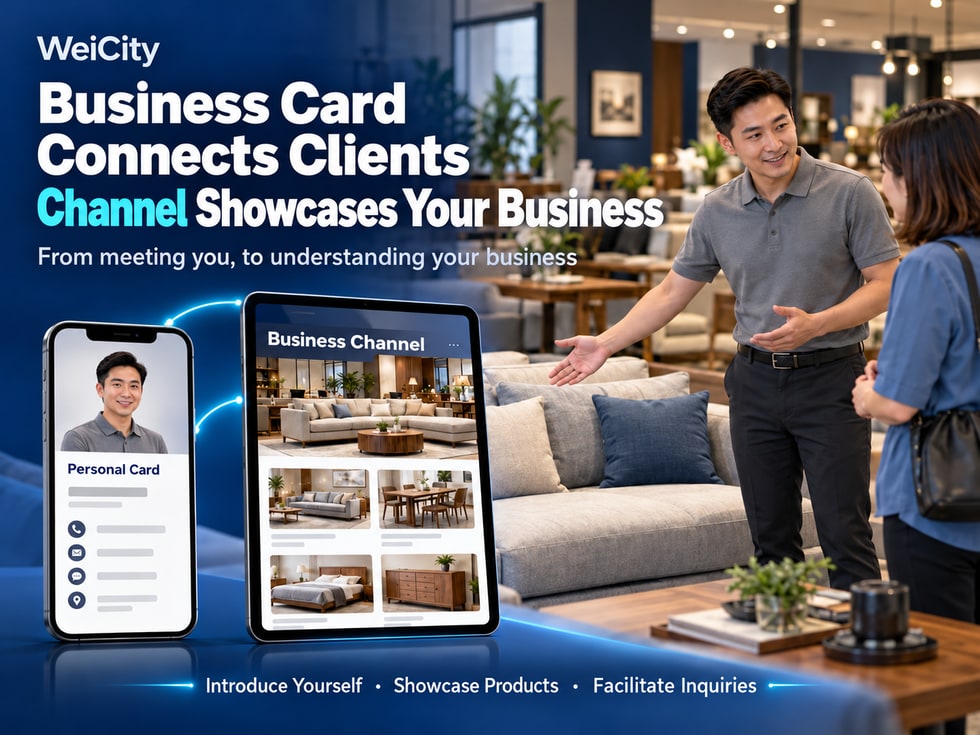
When you meet a new customer, do you usually introduce yourself first, or go straight to your company's products and services?
At business events, when receiving clients or communicating with partners, customers may initially only want to know who you are.
As the conversation continues, they may ask more questions.
👤 What is your responsibility at the company?
🏪 What does your company mainly do?
🛍️ What products are available?
🛠️ What services are available?
📷 Are there any real cases or works?
📍 Where is the store, and when is it open?
📞 Who should be contacted to make a purchase or booking?
If all information is concentrated in one very long personal introduction, customers may find it hard to locate the key points.
If product photos, service descriptions and company information must be resent every time, sales staff also spend time repeating the same introduction.
WeiCity Digital Business Cards and Merchant Channels can handle different introduction tasks: digital business cards help customers get to know the person in charge, while merchant channels help customers understand the brand, products and services.
When customers raise more specific questions, you can also share corresponding product, service, Gallery or article pages based on the content actually published.
In this way, customers can start by getting to know a person, then gradually learn about the business behind them before deciding whether to make further inquiries.
This article introduces the differences between WeiCity Digital Business Cards and Merchant Channels, how they work together in practice, and how they can be applied in industries such as retail, food and beverage, design, education and professional services.
When customers first contact a merchant, besides learning about products, they may also want to know who they are communicating with.
Especially for businesses involving consultations, bookings, quotations or long-term cooperation, a clear identity for the person in charge helps reduce questions during communication.
Let customers know how to address you.
For example:
Sales Consultant.
Customer Service Lead.
Interior designer.
Property consultant.
Course Consultant.
Let customers understand which merchant or organization you represent.
For example:
Product inquiries.
Order coordination.
Service arrangements.
Schedule a consultation.
After-sales contact.
Makes it easy for customers to get in touch again later.
A customer walks into a furniture store and gets to know the staff member who handles reception.
If the staff member only says:
“I'm Jason, you can come to me with any questions.”
The customer may still not know what Jason mainly handles.
A clearer introduction would be:
“Hello, I'm Jason, and I handle furniture selection and order inquiries. This is my WeiCity digital business card, so you can easily reach me later.”
This way, the customer knows not only the name but also which matters they can ask about.
📌 The main purpose of a digital business card is to help customers get to know a specific person and understand what that person is responsible for.
Once a customer knows the person in charge, they usually want to learn about the actual business next.
At this point, the merchant channel can serve as an entry point for showcasing brand and business information.
Depending on the sections the merchant has enabled and the content published, different types of information can be organized.
Explains the merchant's name, business direction, and key highlights.
Showcases published product information.
For example:
Product name.
Product photos.
Specifications.
Price.
Related notes.
Lets customers see what services are offered.
For example:
Service items.
Intended readers.
Service area.
Consultation methods.
Showcased through the Gallery or related content:
Store environments.
Product photos.
Service case studies.
Completed projects.
Answers questions customers ask frequently.
For example:
Product selection guides.
Service processes.
Preparation required.
Frequently asked questions.
If related information has been made public, it can help customers understand:
The merchant's address.
Business hours.
Contact information.
Arrangements for visiting the store.
A furniture store in Penang can organize the following in its merchant channel:
🏪 Store introduction.
🛋️ Sofa series.
🪑 Dining tables and chairs.
🛏️ Bedroom furniture.
📷 Product and showroom photos.
📍 Store location and business information.
When a customer asks about a certain type of furniture, the sales staff can provide the corresponding page based on the actual content.
📌 The main purpose of the merchant channel is to help customers understand what the business offers, along with the products and services they can explore further.
Although both can be used for outreach, they serve different purposes.
| Comparison Item | 👤 WeiCity Digital Business Card | 🏪 WeiCity Merchant Channel |
|---|---|---|
| Main Users | Individual | Merchant or brand |
| Core purpose | Introduces identity and contact information | Showcases business and merchant content |
| Main information | Name, job title, introduction | Brand, products, services |
| Contact focus | Finding the specific person in charge | Finding the merchant or business entry point |
| Suitable scenarios | Initial introductions and business networking | Product inquiries and service introductions |
| Sharing purpose | Helping customers get to know you | Helping customers understand your business |
When a customer wants to know:
Who are you?
What do you handle?
How can I contact you?
When a customer wants to know:
What the company does?
What products it has?
What services it provides?
Whether there are case studies to refer to?
If the customer wants to get to know a person, share a personal business card.
If the customer wants to learn about the business, share the merchant channel.
If the customer asks specific questions, you can share the related content pages.
📌 The two do not replace each other; they play useful roles at different stages of communication.
The process of a customer getting to know a merchant usually does not happen all at once.
Materials can be shared gradually, based on how the conversation goes.
The customer has just met you.
At this point, you can first introduce:
Name.
Work role.
Your areas of responsibility.
Contact information.
Suitable for using a personal digital business card.
The customer starts asking about the company's business.
For example:
“What do you mainly sell?”
“Do you offer renovation services?”
This is the time to share the merchant channel.
The customer already has a clear need.
For example:
“Do you have a three-seater sofa?”
“Do you have residential renovation case studies?”
If the merchant has published corresponding content, you can share the relevant page directly.
The customer may want to confirm:
Price.
Specifications.
Scope of services.
Appointment times.
Delivery arrangements.
At this point, continue communicating based on the actual situation.
If the customer is not ready to decide yet, contact information can be kept on file if both sides agree.
👤 Get to know the person in charge.
🏪 Learn about the merchant.
🛍️ View relevant products or services.
💬 Discuss actual needs.
📞 Follow up.
Some customers only need a phone number.
Some customers want to browse a large amount of product information first.
Some customers need detailed consultation.
📌 Sharing materials based on each customer's current needs is more practical than requiring everyone to follow the same browsing process.
Using a furniture store as an example.
When a customer first meets a salesperson, they may not yet know what products the store carries.
“Hello, I'm Jason, and I handle furniture selection and order inquiries. This is my personal business card, so you can easily reach me later.”
“This is our WeiCity merchant channel, where you can first learn about the store and the furniture products that have been published.”
You can ask:
What kind of furniture do you need?
Where will it be placed?
What size do you want?
What style do you like?
What is your expected budget?
If the customer needs a sofa, you can share the published related product pages.
Discuss based on the actual product information:
Specifications.
Color.
Price.
Stock.
Delivery arrangements.
Because the customer may only need a sofa but receive dozens of unrelated links.
This only makes it harder and slower to find what they need.
First confirm what the customer needs, then provide the matching content.
📌 For retail merchants, the personal business card helps customers find the salesperson, and the merchant channel helps customers browse products.
Service businesses differ from retail businesses.
Customers usually cannot judge whether something is suitable based on product photos alone.
They may also need to know:
Scope of services.
Work experience.
Project process.
Real case studies.
How to make an appointment.
Suppose you are an interior designer.
Introduction:
Name.
The designer's identity.
The studio they belong to.
Contact information.
Introduction:
The studio brand.
Design services.
Service area.
Main areas of work.
Showcases:
Residential design.
Living room spaces.
Kitchen planning.
Bedroom designs.
You can ask customers to provide:
Property type.
Location area.
Floor area of the space.
Expected renovation timeline.
Main requirements.
“This is our merchant channel, where you can first learn about our design services. You mentioned an apartment renovation, and this case is fairly close to your type of space, so you can start by looking at the layout and design direction.”
Because the customer receives more than just a link.
They also learn:
What the page is.
Why it is worth looking at.
How it relates to their own needs.
📌 Service businesses should choose the introduction or case study closest to the customer's actual needs based on their questions.
Restaurant customers usually care most about the menu, prices, location, and ordering methods.
However, in business partnerships, group orders, or event arrangements, the specific person in charge is also important.
The restaurant manager.
The contact person for group orders.
The staff member handling event catering.
The person in charge of partnership business.
Restaurant introduction.
Photos of the environment.
Menu information.
Business hours.
Address.
Other actual published content.
The customer asks:
“Can you prepare meals for 30 people?”
You may first have the person in charge explain the actual scope of service, and then share the relevant menu or ordering information.
Customers may want to know:
Dining options.
Number of guests.
Reservation time.
Pickup or delivery method.
Relevant pages can be provided based on the actual business content.
If a customer only wants to know where the restaurant is, you can give priority to the address or in-store information.
Do not assume that, just because the merchant channel has a menu feature, the merchant always offers online payment, delivery, or every ordering method.
Follow the features actually enabled and the arrangements made by the merchant.
📌 Dining merchants can choose to share the person in charge's digital business card, menu, or in-store information based on customer needs.
For photographers, designers, illustrators, and other creators, customers want to get to know them personally and also want to view their work.
Instructions:
Creator's name.
Areas of expertise.
Main services.
Contact information.
Introduction:
Personal brand or studio.
Service items.
Collaboration method.
Related content.
Showcases:
Family photography.
Personal portraits.
Commercial photography.
Event photography.
Design work.
The customer asks:
“Have you ever taken a family portrait?”
If related works have already been published, you can share family photography examples directly.
Customers should not have to start from the merchant channel homepage and search for them one by one.
“Yes, here are the family photography works we compiled earlier, so you can review the shooting style first. If you have a planned date, please let me know so we can discuss it further.”
Use photos you have the right to make public.
When clients or people are featured, consider appropriate authorization and privacy.
Do not describe sample works as projects you have not actually completed.
📌 For creators, the digital business card introduces your identity, while your works show your actual abilities and style.
Education and training services usually require more detailed introductions.
Parents or students may want to know:
Course content.
Suitable age.
Learning objectives.
Class format.
Class schedule.
Enrollment process.
Suitable for introducing:
Course Consultant.
Head of Enrollment.
Teachers.
Training lead.
Suitable for displaying:
Institution introduction.
Course programs.
Learning environment.
Related notes.
You can introduce:
Target students for the course.
Enrollment preparation items.
Learning arrangements.
Frequently asked questions.
A parent asks:
“Do you have any courses suitable for elementary school children?”
The lead can first learn about the child's age and learning needs, and then share the relevant course introductions.
Because different courses may suit different ages and learning stages.
Sending all course links at once may not help parents make a judgment.
Course content, professional qualifications, and service descriptions should be accurate and truthful.
📌 Education institutions can use digital business cards to establish a clear point of contact, and then use the merchant channel to introduce courses and institution information.
Before sharing, first consider what the customer really wants to know.
| Customer's question | Recommended information to share |
|---|---|
| 👤 What is your name? | Personal digital business card |
| 💼 What do you handle? | Personal business card and work introduction |
| 🏪 What does your company do? | Merchant channel |
| 🛍️ What products do you have? | Product section or related pages |
| 🛠️ What services are available? | Service introduction content |
| 📷 Do you have actual works? | Gallery or case pages |
| 📝 How does this service work? | Related explanatory articles |
| 📍 Where is the store located? | Address and in-store information |
| 📞 Who should I contact? | Person-in-charge business card or contact information |
| 💬 How can customers make further enquiries? | Actual contact entry points provided |
Customer asks:
“Do you have desks suitable for an office?”
Replying only with:
“You can check our website.”
More specific reply:
“Yes, here is the office desk product information we have already published, so you can review the sizes and styles first. If you have the office space dimensions, please let me know so we can discuss it further.”
Answer the question first + explain the purpose of the page + attach the relevant link + ask for the necessary next step
📌 Each link should help the customer solve their current question, rather than adding work to find information.
When sharing information, the text accompanying the links is just as important as the links themselves.
Sending only a web address may leave the recipient unsure what they should look at.
“Nice to meet you. This is my WeiCity digital business card. It includes my work introduction and contact details, so it will be easy to reach me later.”
“This is our WeiCity merchant channel, where you can first learn about the company, our main services, and the content we have published.”
“This is the product information you asked about earlier. You can first check the images and specifications, and feel free to tell me if you have any other questions.”
“This case is quite close to the needs you mentioned earlier, so you can first review the actual work and description.”
“This is our store information. You can first check the address and business hours, and you are welcome to contact us to confirm before you visit.”
“This is our service introduction. You can first review the main details, and then let me know your area and the expected timing.”
Do not send a large number of unrelated links at once.
Also do not repeatedly send promotional content before the customer has described their needs.
📌 Clearly explaining the purpose of each link makes it easier for customers to decide what to view next.
If WeiCity's current personal profile page provides a website or related link field, you may enter the merchant channel URL based on the actual features available.
However, first confirm whether the page supports this, and how it will appear once made public.
Open the actual merchant channel.
Use the currently valid URL.
Check whether there is a suitable place to enter a link.
If the page supports it, you may fill in information based on the actual description.
Confirm that the link opens the correct merchant channel.
Make sure viewers can understand the purpose of the link.
You can send the following separately in chat:
Personal digital business card link.
Merchant channel link.
And explain the purpose of each.
“This is my personal business card, so you can learn about my work role.”
“This is our company's merchant channel, where you can further view our products and services.”
Refer to the current page and account features.
📌 Even if a merchant channel link cannot be placed directly in the personal business card, the two can still be used together through clear sharing messages.
For businesses with multiple sales staff, the difference between personal business cards and the merchant channel is especially important.
For example:
Furniture store.
Real estate company.
Car sales center.
Renovation company.
Education institution.
Hardware supplier.
Each salesperson can use their own profile to introduce their identity, based on the account features actually available.
The business can centrally present its brand and business content.
A furniture store has three salespeople.
Jason is responsible for living room furniture.
Amy is responsible for bedroom furniture.
David is responsible for office furniture.
They can explain their respective responsibilities in their personal introductions.
When a customer wants to view furniture products, share the merchant channel or the relevant product page based on the actual situation.
Customers can know:
Who they are contacting.
What the other person is responsible for.
What products the business offers.
Who to continue communicating with afterward.
Using digital business cards together with the merchant channel does not mean the platform automatically assigns customers, records sales ownership, or calculates commissions.
These are separate business management features, and should be confirmed based on the systems actually supported.
📌 With multiple salespeople, clear personal identities and unified merchant information can reduce confusion when customers connect.
When customers view a personal business card first and then open the merchant channel, they may check the relationship between the two.
If the information is clearly inconsistent, customers may have questions.
The company name on a personal business card should match your actual work identity.
Do not list a position you no longer hold.
Personal introductions should match actual services.
Check that phone numbers and email addresses are valid.
Avoid conflicting information across different pages.
Regularly check items that have been discontinued or are no longer offered.
If hours have changed, update the related pages.
Confirm that no links point to incorrect or broken content.
A salesperson has left their previous company.
However, their personal digital business card still shows the old company name.
If customers contact them using outdated information, misunderstandings may occur.
After changing companies or adjusting responsibilities, check all frequently used external information.
📌 Keeping personal business cards and merchant channel information accurate helps customers clearly understand the relationship between the person in charge and the merchant.
If salespeople answer the same questions every day, consider organizing these questions into useful content in your merchant channel.
Common questions:
"What sizes does this product come in?"
You can organize:
Product specification details.
Size selection guide.
The related product page.
Common questions:
"What is your service process?"
You can organize:
Introduction to the service process.
Booking preparation details.
Frequently asked questions articles.
Common questions:
"What do I need to prepare before a photoshoot?"
You can organize:
Photoshoot preparation guide.
Outfit suggestions.
Booking process explanation.
Common questions:
"How far in advance do I need to order a cake?"
You can organize:
Booking instructions.
Style selection.
Pickup arrangements.
Common questions:
"What age is the course suitable for?"
You can organize:
Course introduction.
Intended readers.
Registration details.
Because the same question may be asked repeatedly by different customers.
With clear content pages, staff can first answer the customer's question and then share related materials as additional information.
Each piece of content should ideally address one clear question.
📌 Organizing common customer questions into content can make your merchant channel more useful and make everyday business communication easier.
Beyond direct sharing, personal business cards and merchant channels can also be considered in terms of content clarity and search visibility.
However, two situations should be distinguished.
Customers access the page through a link you send.
Users look for related information through a search engine.
This depends on whether the page is public, whether indexing is allowed, and whether search engines actually index it.
Use clear titles.
Introduce real products and services.
Explain the relevant areas.
Answer common customer questions.
Avoid repetitive or vague content.
Not specific enough:
"Our Services"
Clearer:
"Residential Interior Design Services in Penang | Space Planning and Renovation Consultation"
Not specific enough:
"Product Introduction"
Clearer:
"How to Choose Desk Sizes? A Furniture Buying Guide for Small Offices"
Personal business cards mainly help people get to know a specific individual.
Merchant channels can help users understand a brand and its services through relevant business content.
Not all personal pages or merchant content will be automatically indexed by Google.
Even if indexed, this does not necessarily mean a higher ranking.
📌 SEO should be based on authentic, clear, and helpful content, not simply on adding links or repeating keywords.
Both personal business cards and merchant channels may be forwarded.
Therefore, check whether the public information is appropriate.
Recommended to make public:
A name suitable for display.
Your genuine work role.
Work contact details.
Necessary personal introduction.
Recommended to make public:
Accurate merchant information.
Products and services actually offered.
Business information suitable for public display.
When customer photos, private spaces, or personal information are involved, consider authorization and privacy.
Where possible, use a phone number and email address suitable for public contact.
Do not make public:
Identity card number.
Passport numbers.
Private bank account details.
Passwords.
Other unnecessary sensitive information.
Personal business cards should share the information needed to get to know you, while merchant channels should share the content needed to understand the business.
📌 Clear information does not mean that everything should be made public; both convenience of sharing and privacy protection should be considered.
Is it accurate?
Is it clear?
Does it match your actual responsibilities?
Is it correct?
Does it lead to the correct brand page?
Is it still applicable?
Is it accurate?
Is it suitable for public display?
Is it correct?
Is it valid?
Can they be opened normally?
Is it easy to view?
Using another phone, open the following in order:
Personal digital business card.
Merchant channel.
Related product or service pages.
Confirm:
Identity is clear.
The business is easy to understand.
Content and links are correct.
Customers can find the next contact entry point.
📌 Completing a full check before sharing can reduce inconvenience caused by incorrect information and broken links.
No. Personal business cards mainly introduce an individual's identity, while merchant channels mainly showcase a merchant's business.
If you often need to introduce your role as a person in charge and your personal contact details, a digital business card still has practical uses.
This depends on whether the current personal page supports the corresponding link field.
You can share your personal business card and merchant channel separately in chat.
This can be arranged according to actual account features and work needs.
Give priority to sharing relevant product information or the corresponding content in your merchant channel.
You can share actually published Gallery, portfolio, or case pages.
You can share a page that includes the accurate address and in-store visit information.
If the current page provides this feature, you may use it according to how it actually works.
If a compatible tag has been correctly configured with your personal link, you may use it depending on device support.
No. Sharing a link alone does not automatically generate an order. Customers still need to complete actions according to the actual features and business process.
Whether commission recording is supported cannot be determined from link sharing alone; the actual system mechanism applies.
If they represent the same merchant, identity and company information should be kept accurate and consistent.
We recommend checking and updating your work identity and related information promptly.
This cannot be guaranteed. It depends on page public access and indexing conditions, as well as how search engines actually process the page.
No guarantee can be given, but they can help customers more easily get to know the person in charge, understand the business, and find contact information.
📌 Personal business cards and merchant channels each serve different purposes. The key is to choose the right content to share based on the customer's current question.
If you already have a WeiCity personal digital business card and merchant channel, you can start by completing basic organization.
Check your name, photo, work identity, and contact details.
Confirm that the brand introduction and main business information are accurate.
Give priority to publishing content that customers frequently ask about.
For example:
Product photos.
Store environments.
Service case studies.
Actual work.
Includes:
Personal business card link.
Merchant channel link.
Links to frequently used content pages.
Confirm that pages open normally.
Prepare short text for different scenarios.
For example:
Personal introduction.
Merchant introduction.
Product inquiries.
Service description.
First understand what the customer wants to know, then provide the relevant materials.
There is no need to send all links to the customer at once.
Start by sharing the most relevant page.
When the customer needs more information, continue providing it.
📌 Start by organizing your personal identity and main business so that every sharing entry has a clear purpose.
A customer's connection with a merchant usually begins with a simple conversation.
When first meeting, a customer may only want to know your name.
As communication progresses, the customer may want to learn about your work.
When an actual need arises, the customer will start looking for products, services, prices, case examples, and contact details.
Different stages require different information.
Let customers know who you are.
Let customers understand what you are responsible for.
Let customers get to know the brand and main business.
Let customers view actual product materials.
Help customers understand the scope of services.
Provide relevant reference content.
Provide suitable pages based on customer questions.
Help both sides keep communicating around actual needs.
Let customers know whom they should contact.
The value of the WeiCity digital business card and merchant channel lies in helping personal identity and business operations each be presented clearly.
A personal business card lets customers get to know the specific person in charge.
A merchant channel lets customers learn about the brand, products, and services.
Specific content such as products, Gallery, and articles can further answer customers' questions.
For salespeople, it can reduce the time spent repeatedly introducing personal identity and basic business information.
For merchants, it can organize commonly used business information into online content that is easy to share.
For customers, they can review materials step by step according to their needs, without having to search through large amounts of chat messages.
A truly practical approach is not to send all pages at once.
Instead, aim to:
👤 When first meeting, introduce yourself.
🏪 When the customer wants to understand the business, share the merchant channel.
🛍️ When the customer asks about products, provide the relevant product materials.
🛠️ When the customer asks about services, provide specific service descriptions.
📷 When the customer needs references, share suitable cases or works.
📍 When the customer is preparing to visit, provide accurate in-store information.
💬 When the customer is ready to consult, explain whom to contact and the next steps.
Let your personal digital business card be the entry point for customers to get to know you, let your merchant channel be the entry point for customers to understand your business, and then share related content according to actual needs.
From getting to know the person in charge, to understanding the brand, to further consultation, make every WeiCity material sharing have a clear purpose, and make everyday business communication smoother.
Specific digital business card fields, personal links, merchant channel sections, product display, Gallery, articles, QR codes, NFC, contact entries, and other features are subject to WeiCity's current actual pages and the features available to your account.
👉 Open WeiCity: https://wei.city/