

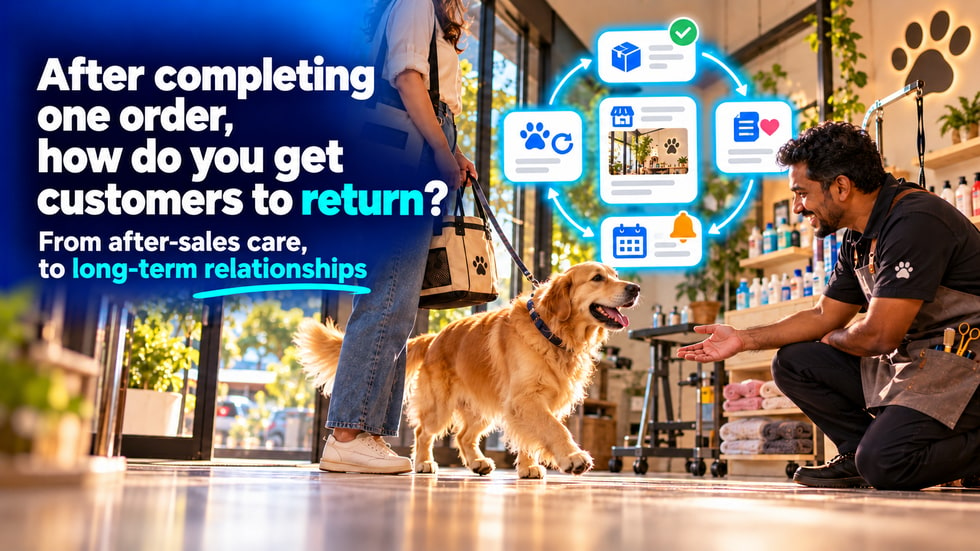
14 🔁 After completing an order, how do you get customers to come back?
🤝 From delivery confirmation and after-sales care to timely updates, build customer relationships that can be sustained over time
💡 Completing an order does not mean the customer relationship is over. Accurate delivery, proactive confirmation, usage tips, proper handling of issues, and sharing relevant updates at the right time can all improve the customer experience. This article explains how merchants can continue providing value through the WeiCity merchant channel, giving customers reasons to contact, buy from, or recommend your business again.
Many merchants spend most of their time looking for new customers and overlook customers who have already made a purchase.
Customers who have completed a transaction already have hands-on experience with the brand, products and service.
If the whole process is clear and reliable, and customers can still receive appropriate assistance after the order is completed, they are more likely to think of this merchant again when they need something.
Bringing customers back is not just about constantly sending discounts.
What matters more is doing the first transaction well, and continuing to provide useful information at appropriate times.
Whether customers are willing to come back depends first on their first experience.
Merchants should confirm whether what was promised has been delivered accurately.
• Whether the products, quantities and specifications are correct
• Whether the service content matches the confirmed plan
• Whether the completion time meets the agreed schedule
• Whether the packaging can protect the products
• Whether the delivery or self-pickup arrangements are clear
• Whether payment and receipt information is complete
• Whether customers know what they should pay attention to next
If a delay is expected, do not wait until the customer asks before explaining.
You can contact the customer in advance, explain the actual situation, and provide a new completion time.
Timely and honest communication is more likely to be understood than waiting without any explanation.
When an order is completed or a service ends, you can use a short message to confirm the result.
Reference content:
Hello, your order has been completed and delivered. It includes the specified products and quantities. If you find that anything received does not match, or if you need help understanding how to use it, please let us know within the specified contact hours, and we will help confirm.
A delivery confirmation can include:
• Completion or delivery status
• Product or service details
• How to use and store it
• After-sales contact channels
• Order records to keep
• Applicable after-sales conditions
Do not include a large amount of advertising unrelated to this order in delivery messages.
First make sure customers can receive and use the product smoothly, and then consider follow-up communication.
After a purchase, customers may still need to know how to use, store, maintain or plan the next step.
Merchants can provide suitable content based on their business type.
Food and beverage merchants can explain:
• Storage methods
• Recommended consumption time
• Reheating methods
• Allergens or information to be aware of
Retail merchants can explain:
• Instructions for use
• Cleaning and maintenance methods
• Size or installation instructions
• How to contact after-sales support
Service merchants can explain:
• Points to note after the service
• Situations to watch for
• Suggestions for the next appointment
• How to get in touch if there are questions
Education merchants can explain:
• After-class practice
• Textbooks and review methods
• What to prepare for the next lesson
• How learning progress is confirmed
This information can be organized into articles or FAQ pages on the WeiCity Merchant Channel, so relevant content can be shared directly at delivery.
This reduces repeated explanations and allows customers to review the information anytime.
The timing of after-sales follow-up should be decided by the product and service.
It is not necessary to send several messages immediately after every order is completed.
For products that are used quickly, a simple check can be made after the customer receives them.
For products that need installation, trial use or continuous use, you can wait a reasonable period before asking.
Sample reply:
Hello, we would like to confirm whether you have received your product smoothly. If you have any questions about using or storing it, you can contact us through the merchant channel.
Or:
Hello, thank you for using our service recently. We would like to check whether everything is going well. If there is anything that needs adjustment or further explanation, please let us know.
The purpose of after-sales follow-up is to provide help, not to require customers to leave a good review or make another purchase.
If a customer says everything is fine, you may politely thank them, and there is no need to keep sending multiple messages.
When customers run into problems, how a merchant handles them directly affects whether they are willing to come back.
You can handle the situation in the following order:
• Carefully read or listen to the customer's explanation
• Confirm the order and related information
• Express that you understand the problem
• Explain how much time is needed for checking
• Offer practical solutions that can actually be carried out
• Reconfirm the result after completion
Sample reply:
Hello, we understand the situation you have encountered. To confirm the cause, please provide your order information and relevant photos. We will complete the check within the specified time and explain the options available to you.
Avoid immediately blaming customers or making promises that cannot be kept before the facts have been confirmed.
If the mistake was made by the merchant, acknowledge it clearly and provide a reasonable solution.
If the problem falls outside the original scope of service, politely explain the reason and the next options available.
Do not discuss customers' private order information in public comments; guide them to an appropriate private contact channel instead.
If the channel is only used at the time of the first purchase, customers may not come back to it later.
Merchants can keep providing content relevant to customers.
• New products and new services
• Restock notices
• Usage and maintenance tips
• Holiday business hours
• Appointment availability
• Recent work
• Frequently asked customer questions
• Product bundles suitable for repurchase
• Offline events and community news
When updating content, do not only publish repetitive purchase reminders.
When customers return to the channel, they should find new and useful information.
Some businesses have natural repurchase or re-service cycles.
For example:
• Everyday products need to be replenished regularly
• Equipment needs maintenance
• Services need to be booked again
• Courses have new stages
• Seasonal products are launched at specific times
Merchants may send timely reminders when customers have agreed to receive related messages.
Reminder content should explain the reason.
Sample reply:
Hello, the products you bought previously are usually usable for a specified period of time. We have updated our restock information. If you still need them, you can visit the channel to check; if you do not need them for now, you can ignore this message.
Do not send promotional messages frequently without customers' consent.
Also do not use false stock levels, fake countdowns or exaggerated messages to create pressure.
Offers can encourage customers to buy again, but if a business relies only on price cuts over the long term, it may struggle to build stable value.
Besides discounts, you can offer other reasons to buy again.
• A more convenient repurchase process
• Clear historical product information
• Priority booking time slots
• Trial opportunities for new products
• Practical after-sales content
• Bundle plans suitable for returning customers
• A stable and familiar service experience
• Reminders provided based on actual needs
Customers may come back because the products are reliable, the service is familiar, communication is convenient, or the merchant remembers their reasonable preferences.
Price is only one factor.
Merchants can record basic information related to the service to help customers reduce repeated explanations the next time they buy.
• Products or services previously purchased
• Suitable specifications or plans
• Confirmed preferences
• Date of the last service
• After-sales service records
Only record information that is truly necessary for business operations and service.
Do not record personal information unrelated to the transaction, and do not use customer information for other purposes without consent.
If a customer asks to stop receiving messages, respect the request and stop sending them.
Satisfied customers may be willing to recommend the merchant to friends.
After an order is successfully completed, merchants can politely provide a sharing entry point.
Sample reply:
Thank you for choosing our services. If any of your friends also need related products or services, feel free to share our merchant channel with them. There is no obligation at all; your support means a lot to us.
Do not require customers to leave positive reviews, or exchange rewards for fake reviews.
Genuine recommendations should come from customers' own experiences and choices.
On the day the order is completed
• Confirm that the product or service has been completed
• Provide usage, storage, or follow-up instructions
After a reasonable period of time
• Carry out a brief after-sales check-in
• Help resolve any practical issues
Before the customer may need it again
• Provide relevant reminders with the customer's consent
• Share restocking, booking, or updated information
During regular business operations
• Keep the merchant channel updated
• Publish content that is helpful to customers
• Keep contact details and business information accurate
Timing differs for each type of business.
Merchants should decide based on the product's usage cycle and the customer's actual needs. Do not mechanically send the same message to every customer.
Merchants can observe some practical changes.
• Whether customers contact you again
• Whether repeat purchases or bookings occur
• Whether customers find it easier to make another purchase
• Whether after-sales issues are being resolved
• Whether customers voluntarily share the channel
• Which content repeat customers care about most
• Which reminders actually lead to valuable actions
Do not only count how many messages were sent.
What matters more is whether customers are being helped and whether communication is improving their experience.
• Sending consecutive advertisements right after an order is completed
• Repeating the same promotion every day
• Continuing to chase customers who have not replied
• Using fake stock levels and countdown timers
• Ignoring after-sales issues while only promoting new products
• Publicly disclosing customer information without consent
• Adding all customers to unrelated groups
• Continuing to send messages after a customer has asked you to stop
Long-term relationships must be built on respect, honesty, and choice.
Customers are willing to come back not usually because they received the most advertisements.
What they remember is whether the product met their expectations, whether the service was reliable, whether help was provided when problems arose, and whether buying again was convenient.
Get the first order right, provide appropriate care after completion, and then continue sharing useful content through the merchant channel. In this way, a single transaction can gradually grow into a long-term relationship.
👉 Review the most recent order you completed, prepare a delivery confirmation and an after-sales note, and update them on your WeiCity merchant channel.