

4 How Should Address, Map Location, and Business Hours Be Set Up? A Guide to Visit Information for Merchants
Enter addresses, navigation locations, and operating schedules accurately so customers can more easily find your premises and choose a suitable visiting time.
Before visiting, customers most want to know whether the address is accurate, whether the map can navigate them correctly, and whether the business hours are valid. This article explains how to fill in the address, map location, floor and unit information, service area, and business hours in a WeiCity merchant channel, and provides checking methods suitable for physical stores, appointment-based services, and home or on-site services.
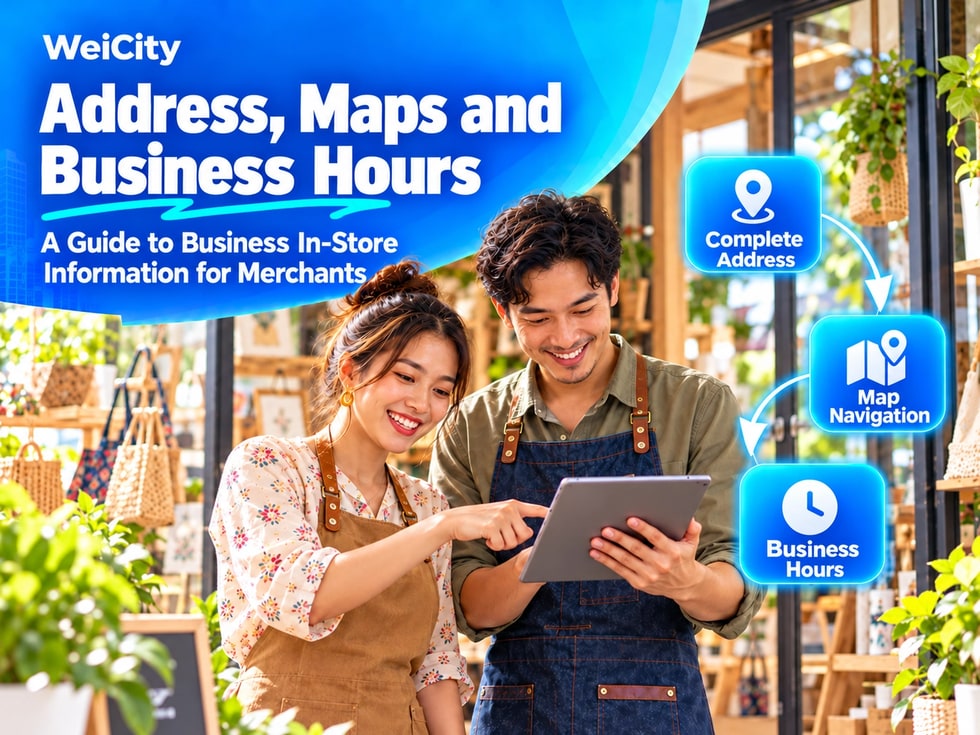
Before visiting a merchant, customers usually check three questions:
"Where is the merchant?"
"Will the map take me to the correct entrance?"
"Will the merchant be open when I get there?"
If the address is incomplete, the map pin is wrong, or the business hours are outdated, customers may go to the wrong place, make a wasted trip, or give up on contacting the merchant.
For this reason, the address, map location, and business hours are not just basic details. They are the key link between a customer browsing the channel and actually visiting in person.
💡 When setting these up, check whether customers can easily find the location and arrive at a suitable time.
The address and business hours features available may vary by account, plan, and industry. The actual fields to fill in should follow the current WeiCity page and official instructions.
Before setting up, it is recommended to confirm:
✅ Complete business address
✅ Building or mall name
✅ Floor and unit number
✅ Postcode
✅ City and state
✅ Map location
✅ Correct shop entrance
✅ Nearby landmarks
✅ Parking arrangements
✅ Public transport options
✅ Weekly opening days
✅ Daily opening hours
✅ Lunch break or service suspension times
✅ Public holiday arrangements
✅ Appointment or last order times
If the merchant has multiple branches, organize each branch's information separately to avoid mixing up addresses, phone numbers, and business hours.
Merchants with a physical shop, office, clinic, studio, or service centre should fill in the full address as far as possible.
It is recommended to follow this order:
Unit or house numberBuilding, mall, or shop nameRoad or garden namePostcodeCityStateCountry
For example:
Unit 12-3, Level 12ABC Business CentreJalan Example10450 George TownPulau Pinang, Malaysia
If the page uses a single address field, still fill it in an order that is easy for customers to read, and do not omit important information.
If the merchant is located in a mall, office building, or multi-storey building, a road address alone is usually not enough.
You should also explain:
• Mall or building name• Floor• Unit number• Which entrance is nearest• Which shop or facility is nearby• Which lift to use• Reception or security registration method• Whether an appointment is required to enter
Sample wording:
"We are located on the 2nd floor of ABC Mall, Unit L2-18, near the North Gate lift. Customers can enter from Car Park Zone B, take the lift to the 2nd floor, and turn right."
These additional notes are suitable for the merchant introduction, contact guide, or in-store visit article.
The map may only bring customers near the building and may not point out the actual entrance.
You can add:
✅ Which side of the road the shop is on
✅ Which gate to enter from
✅ Signboard colour or appearance
✅ Whether it is at the back or side
✅ Whether security registration is required
✅ Whether stairs or a lift must be used
✅ Whether there is a barrier-free entrance
✅ Whether the night-time entrance is different
These descriptions are especially important if the merchant is in a residential area, industrial area, or large commercial district.
📌 Do not simply write "call when you arrive." Provide enough information so customers can find the location on their own as far as possible.
A correct written address does not necessarily mean the map location is correct.
Common issues include:
• Pin falls on the neighbouring building• Navigation leads to the back door• Map shows the wrong road• The same building has multiple entrances• New malls or roads have not yet been updated• Old location still shown after the merchant has moved• Location mix-up between branches
After saving the map location, perform a navigation test in person.
You can start navigating from a nearby road, car park, or public transport stop to check whether the system leads to the correct place.
It is recommended to complete the following tests:
1️⃣ Tap the map or navigation option in the channel
2️⃣ Confirm it shows the correct merchant
3️⃣ Check whether the map marker is on the correct building
4️⃣ Check whether the navigation destination is close to the actual entrance
5️⃣ Test the driving route on a phone
6️⃣ Test the walking route
7️⃣ Approach from different directions on nearby roads
8️⃣ Check that the written address matches the map
9️⃣ Ask someone unfamiliar with the area to try finding it
🔟 Add entrance details based on the test results
If the location cannot be displayed accurately, use nearby landmarks, building names, and written instructions to help customers.
💡 Do not only look at the map view during testing; also check the navigation destination in practice.
Suitable landmarks help customers confirm they are heading in the right direction.
You can use:
• Malls• Schools• Hospitals• Banks• Petrol stations• Bus stops• Train stations• Major junctions• Well-known buildings• Easily recognisable public facilities
Sample wording:
"The shop is opposite ABC School, about two shop lots from the XYZ petrol station."
"Enter through the south gate of the mall, walk straight ahead, and take the lift to the 3rd floor next to the service counter."
Avoid landmarks that only local staff know and customers cannot confirm.
Unclear wording:
"Just behind the old shop."
Clearer wording:
"The shop is at the back row of ABC Commercial Centre on Jalan Example, entered from the road on the right side of the main entrance."
If customers need to visit in person, you can explain:
✅ Whether free parking is available
✅ Whether payment is required
✅ Which parking zone is recommended
✅ Whether short stops in front of the shop are allowed
✅ Whether public car parks are nearby
✅ Whether it is near a bus stop or station
✅ Whether it is convenient for e-hailing drop-off and pick-up
✅ Whether there are barrier-free parking bays
✅ Whether parking is harder during peak hours
Sample wording:
"Customers can use the mall's underground car park. Parking in Zone B is recommended, followed by the North Gate lift to the 2nd floor."
"There are only a few parking spaces in front of the shop. Saturday afternoons are busy, so allow extra time to look for parking."
Accurate and specific information reduces customers' uncertainty before visiting.
Some merchants operate as:
• Online-only businesses• Home-based studios• Home services• Mobile services• Location confirmed after booking• Event or market stalls• Delivery-based businesses
These merchants do not need to publish a private residential address in order to set up a channel.
Instead, you can explain:
• Main service areas• Delivery range• Home service coverage• Whether self-collection is available• How the self-collection location is confirmed• Whether booking is required• When the meeting address will be provided
Sample wording:
"We mainly provide home services within Penang Island. After the booking date and service details are confirmed, the merchant will confirm the actual arrangements with the customer."
"This studio operates by appointment only. The self-collection address will be provided after the order is confirmed."
📌 Do not publish a private residential address in a public channel if you do not want customers to visit it directly.
Home service merchants can organise:
✅ Main cities served
✅ Areas they can travel to
✅ Whether there is a distance limit
✅ Whether a transport fee is charged
✅ Whether remote areas require separate confirmation
✅ Service hours
✅ Address information customers need to provide
✅ Requirements for buildings, parking and site access
Sample wording:
“We mainly serve George Town and nearby areas. Other areas can be confirmed separately based on distance, time and scope of work.”
Do not simply write “Service across all of Malaysia” unless the merchant actually has the arrangements to do so.
A clear service area can reduce enquiries from customers who do not qualify.
Business hours should reflect the times when the merchant can actually receive customers or provide services.
Suggested items to organise:
• Business days each week• Daily opening time• Daily closing time• Lunch break• Regular closing days• Public holiday arrangements• Last order time• Appointment slots• Self-pickup slots• Delivery slots• Online enquiry reply times
For example:
Monday to Friday: 9:00–18:00Saturday: 9:00–14:00Sunday: Closed
If hours differ from day to day, list them separately instead of using one general time for the whole week.
If the two are different, they should be explained separately.
For example:
“The shop is open Monday to Saturday, 9:00–18:00. WhatsApp enquiries are answered during business hours and may take longer during busy periods.”
“The studio operates by appointment only and has no fixed reception hours. Please contact us first to confirm an available appointment time.”
“Online orders can be submitted at any time. Confirmation and processing take place Monday to Friday, 10:00–17:00.”
This prevents customers from assuming they will receive an immediate reply after sending a message.
Some merchants are open all day but may pause certain services in the middle of the day:
• Counter service• Kitchen order intake• Appointment services• Delivery• Customer reception• Phone replies
These should be stated clearly, for example:
“Business hours are 9:00–18:00, with a lunch break from 13:00–14:00. On-site services are paused during the lunch break.”
“Food is served from 11:00–15:00 and 17:00–21:00, with last orders taken at 20:30.”
Avoid listing only business hours without explaining the periods when services are actually unavailable.
Appointment-based merchants can explain:
✅ Dates available for booking
✅ Bookable time slots each day
✅ Whether same-day bookings are accepted
✅ How far in advance bookings must be made
✅ Whether bookings require confirmation
✅ Late arrivals or schedule changes
✅ How to cancel a booking
✅ The merchant's usual reply time
Sample wording:
“This studio operates by appointment and provides services from Tuesday to Sunday. Please contact us at least one day in advance. All time slots must be confirmed by the merchant before a booking is successful.”
📌 A customer's enquiry does not mean a booking has been made. It should be made clear that the merchant must confirm it.
In addition to business hours, food and beverage merchants can also explain:
• Breakfast, lunch and dinner serving times• Last ordering time• Takeaway order intake times• Self-pickup slots• Delivery slots• Serving times for specific menus• Days when certain dishes are not available• Special arrangements for public holidays
For example:
“The restaurant is open until 22:00, with last orders taken at 21:30.”
“The lunch menu is served from 11:30–15:00, while stocks last.”
This information is suitable for menus, articles or business notices.
Update or publish a notice promptly when any of the following happen:
• Closure on public holidays• Extended hours during festive periods• Temporary suspension of business• Shop renovation• Staff training• Special events• Equipment maintenance• Weather or traffic impacts• Suspended services during relocation
Short-term changes can be explained through posts, articles or announcements.
Long-term changes should be reflected by updating the official business hours in your channel.
📌 After a temporary notice ends, check and remove or update any outdated content.
Each branch should be organised separately:
✅ Branch name
✅ Full address
✅ Map location
✅ Contact phone number
✅ WhatsApp number
✅ Business hours
✅ Person in charge
✅ Entrance and parking instructions
✅ Products or services offered
Do not place the head office address, one branch's phone number and another branch's business hours in the same group of information.
Use clear names to tell them apart, for example:
• ABC Bakery – George Town• ABC Bakery – Bayan Lepas• ABC Bakery – Butterworth
If certain products or services are available only at specific branches, this should also be clearly stated.
The typical customer visit process is:
See the address→ Open the map→ Check business hours→ Choose a departure time→ Arrive nearby→ Look for the entrance→ Contact the merchant if necessary
Therefore, check:
• Whether the address and map match• Whether the map matches the shop entrance• Whether the business hours are still valid• Whether the phone or WhatsApp number can be used• Whether customers know how to get in once they arrive• Whether there are appropriate notes for non-business hours
If any one of these steps is wrong, the entire visit experience may be affected.
After setup, use another phone to test as an ordinary customer:
1️⃣ Open the channel
2️⃣ Find the address
3️⃣ Tap the map or navigation
4️⃣ Check the destination
5️⃣ Check the business hours
6️⃣ Read the entrance instructions
7️⃣ Check the parking information
8️⃣ Tap the phone number or WhatsApp
9️⃣ Confirm you can easily return to the channel
🔟 Determine whether a customer can complete the visit independently
It is best to have someone who is unfamiliar with the location do the test.
If that person still needs to ask “Where is it?” or “What time do you open?”, the information can still be improved.
Physical shop
“We are located at [building or mall name] [floor/unit]. The full address is [address]. Customers can enter from [entrance], and the nearby landmark is [landmark]. Business hours are [dates and times]. Before visiting, you can confirm today's arrangements via [contact method].”
Appointment-based studio
“This studio is located in [area] and operates by appointment only. Visits without confirmation are not accepted. Service hours are [dates and times]. Please contact us at least [time] in advance. Once your appointment is confirmed, we will provide complete visiting details.”
Home service
“We mainly provide home services in [area]. Service hours are [dates and times]. Other areas and special time slots can be confirmed separately. When booking, please provide your location, the service required and your preferred time.”
Online merchant
“We operate online and mainly serve [area]. Orders and enquiries can be submitted at any time, and the merchant will process them within [reply time]. Self-pickup or delivery arrangements will be explained after your order is confirmed.”
Before publishing an address, confirm that:
✅ It is a business location the merchant is willing to make public
✅ Customers can visit during the listed times
✅ The address is not a private residence published without consent
✅ Images do not show private information about residents or neighbours
✅ The map pin will not lead customers into private areas
✅ Staff members' personal contact details are not published
✅ Appointment-based locations have an appropriate confirmation process
If the merchant does not publicly accept customers, clearly state "By appointment only," "No walk-in visits," or another appropriate note.
Address Details
□ Is the merchant name consistent with the address?□ Are the house number and unit number complete?□ Are the postal code, city, and state correct?□ Is the building or mall name clear?□ Have entrance and floor details been added?
Map Location
□ Does the map marker sit on the correct building?□ Does the navigation endpoint sit near the correct entrance?□ Has it been tested on a mobile phone?□ Does the written address match the map location?□ Are nearby landmarks needed?
Visiting Arrangements
□ Is the parking method explained?□ Is the public transport method explained?□ Is advance booking required?□ Is there a security or check-in process?□ Can customers find the storefront after arriving?
Business Hours
□ Are the operating days of the week correct?□ Are the daily hours complete?□ Are lunch breaks or temporary closures explained?□ Are the last order times clear?□ Are public holiday arrangements appropriate?□ Are in-store hours and online reply hours distinguished?
Privacy and Safety
□ Has the private residential address been avoided?□ Are only contact methods the merchant is willing to use displayed?□ Have customer or staff details been kept out of view?□ Does a by-appointment location have a confirmation process?
An accurate address helps customers confirm the location, correct map positioning helps them navigate, and clear business hours help them choose a suitable time to visit or get in touch.
It does not need to be complicated, but it must:
1️⃣ Be complete on the address2️⃣ Have the map correct3️⃣ Make the entrance clear4️⃣ Show accurate times5️⃣ Keep contact valid6️⃣ Update changes promptly
After setup, personally walk through the customer journey using a mobile phone.
When customers no longer need to repeatedly ask "where are you?" and "what time do you open?", it means this information is truly working.