

7 WeiCity Message Translation: Communicating with Friends and Customers Who Speak Other Languages
Use message translation in chats to understand messages in other languages, from comprehending the content to confirming needs, so the conversation can keep going.
When you receive messages in a language you are not familiar with, you can use WeiCity message translation to help you read them. This article introduces how message translation can be used in conversations with friends, merchant inquiries, and team discussions, as well as how to reduce misunderstandings in cross-language communication through concise wording, added background, and verification of key information.
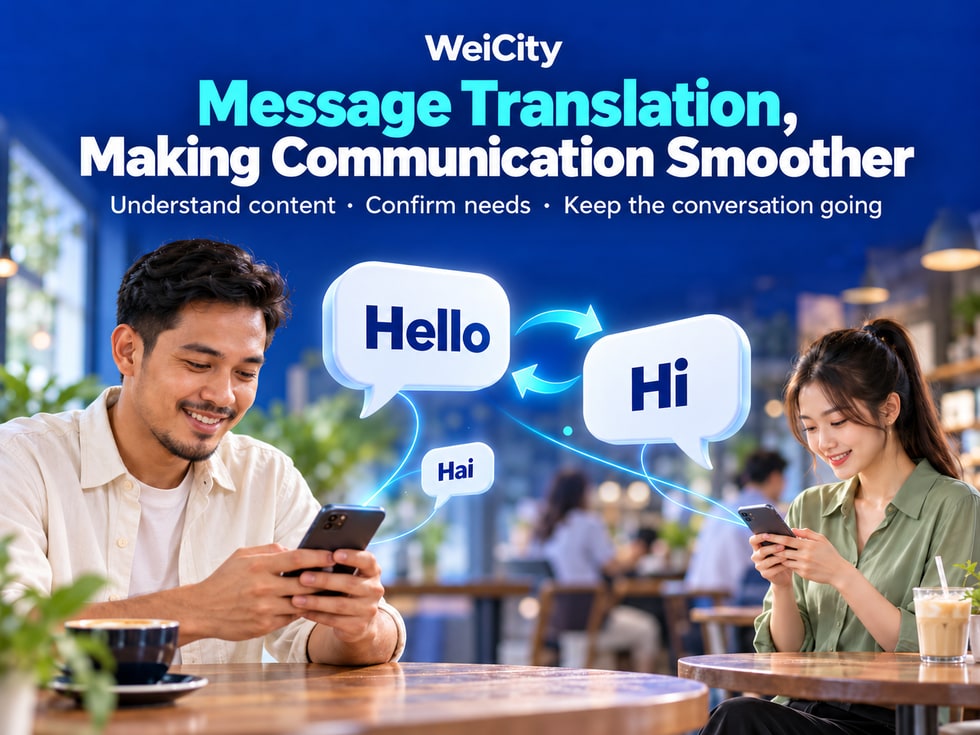
In Malaysia, we often communicate with people who use different languages.
A friend may prefer English, a customer may ask about products in Malay, and a partner may explain work needs in the language they are most comfortable with.
For example:
🇲🇾 A customer asks in Malay whether an item is in stock.
🇬🇧 A partner discusses project arrangements in English.
🇨🇳 A friend shares news about their life in Chinese.
🏪 A merchant receives product inquiries in different languages.
👥 Members of a work group communicate in different languages.
When you receive a language you are not familiar with, it can be inconvenient to copy each message and switch to another translation tool every time, which can make communication cumbersome.
The WeiCity Message Translation feature can help users understand chat content in different languages, making communication with friends, customers, and partners more convenient.
With message translation, users can first understand the main meaning of what the other person has said, and then continue to ask, confirm, or reply as needed.
💡 The value of message translation is not only converting text into another language. More importantly, it helps both sides understand each other's needs so that communication can continue.
This article introduces how to use WeiCity Message Translation, its applications for merchants, cross-language communication tips, and which important information should be confirmed again.
WeiCity Message Translation is an auxiliary tool within the chat feature.
Based on the languages and message types currently supported by the platform, users can translate chat content into another language to help them read and understand it.
💬 Everyday friend communication
Helps you understand messages your friends send in different languages.
🏪 Merchant and customer enquiries
Helps merchants quickly understand which product or service a customer is asking about.
🤝 Partner communication
Assists in understanding project descriptions and partner feedback in different languages.
👥 Group Discussions
Helps members understand discussions that concern them.
📚 Learning and event communication
Assists in reading course or event messages in different languages.
Message translation is mainly for aiding understanding. It does not mean the system will necessarily be able to:
❌ Fully understand all local dialects.
❌ Accurately explain every type of technical term.
❌ Judge the other person's true intent.
❌ Automatically confirm transaction terms.
❌ Guarantee that translations are completely error-free.
❌ Automatically complete communication or make decisions on the user's behalf.
📌 WeiCity Message Translation can help you understand messages, but for important matters, both sides still need to confirm further.
When using WeiCity Message Translation for the first time, you can start with a message in a language you are not familiar with.
The actual access points, supported languages, and translation methods may vary depending on platform version, account permissions, and message type.
Open WeiCity and log in to your account.
Find the conversation that contains the message you want to translate.
For example:
👤 Private chat with a friend.
🏪 Merchant inquiries.
💼 Work communication.
👥 Group chat.
Confirm that the message comes from the correct contact or group.
Based on the current chat interface, look for translation-related features.
Follow the on-page prompts to complete the translation.
First, understand the topic and main idea of the message.
If an expression seems unreasonable or vague, you can ask further by referring to the original text.
Reply in an appropriate language based on the actual situation.
Different languages, message types, and accounts may have different levels of support.
Specific translation entry points, available languages, and translation results should be confirmed on WeiCity's current platform interface.
📌 When using the feature for the first time, you may choose a simple message to translate first, and apply it to other chat scenarios once you are familiar with it.
Malaysia is a multilingual environment.
In daily life and business activities, people often interact with others who use different languages.
For example:
🇲🇾 Malay.
🇬🇧 English.
🇨🇳 Chinese.
As well as other languages and local languages.
Merchants may serve customers from different language backgrounds at the same time.
For example:
🛍️ Retail merchants.
🍽️ Food and beverage merchants.
🛠️ Repair services.
🎓 Educational institutions.
💇 Beauty and personal care.
Friends, neighbours, or activity members may communicate in different languages.
Team members from different backgrounds may be used to discussing work in different languages.
Parents, teachers, or study group members may use different languages to ask about general course and activity information.
It helps users understand the general meaning of a message before deciding whether further confirmation is needed.
For example, when a merchant receives a Malay inquiry, they can first use translation to understand what the customer mainly asks, and then reply based on the actual product information.
📌 In a multilingual environment, message translation can reduce barriers to understanding and make it easier for users of different languages to start communicating.
Suppose a shop in Penang displays its products through a WeiCity merchant channel.
A customer sends a Malay message:
“Ada stok untuk saiz besar?”
The general meaning of this sentence is:
“Do you have the large size in stock?”
Based on the current features, the merchant can use message translation to first understand the customer's question.
The customer mentions a large size, but may not have specified which product.
You can further confirm:
🏷️ Product name.
📏 The specific size.
🎨 Colors or styles.
Confirm whether the item is in stock based on the actual product information.
For example:
“Hello, which product are you asking about? Could you share the product name or a picture? We will help you check the stock for the large size.”
If you need to reply in Malay, also check that the translated content accurately conveys the original meaning.
For example:
📏 Dimensions.
🎨 Color.
🔢 Quantity.
💰 Prices.
📦 Collection or delivery method.
“Large size” may correspond to different specifications.
For example:
L.
XL.
60 cm.
80 cm.
Therefore, you should not determine the product the customer needs based only on the translated word "large size".
📌 Merchants can first use translation to understand the direction of the inquiry, then confirm product specifications and purchase needs through specific questions.
For repair, installation, cleaning, or other service businesses, customer inquiries may involve different situations.
For example:
🔧 What problem is the equipment having?
📍 Where is the service location?
📅 When would the customer like to schedule the service?
💰 How is the fee calculated?
The customer sends:
“Do you provide home repair services in Penang?”
The Chinese meaning is:
“Do you provide on-site repair services in Penang?”
Merchants can first use translation to understand the customer's main question.
“Hello, which equipment do you need repaired? Which area of Penang is it in? We can first confirm our service coverage and then explain the related arrangements.”
🛠️ Service items.
📍 Service area.
📅 The preferred date.
📋 The issue that needs to be addressed.
💰 Fees and related conditions.
Because customers may use incomplete sentences or omit important background.
For example:
“Can come tomorrow?”
This sentence may be asking:
📅 Can you visit on-site tomorrow?
📦 Can you deliver tomorrow?
🏪 Can you come to the store tomorrow?
Determine this based on the previous chat content.
📌 Message translation can help you understand the customer's question, but the specific service content and arrangements should still be confirmed further.
Although translated text is convenient to read, the same sentence may have different meanings in different scenarios.
For example:
“Later is fine.”
It can be understood as:
“Later is fine too.”
But what it actually means depends on the context.
It may mean:
“Meeting up a bit later is fine too.”
It may mean:
“Submitting the materials a bit later is fine too.”
It may mean:
“The event start time can be postponed.”
After reading the translated result, you can first think through:
💬 What is this sentence responding to?
👤 Who is the person the other party mentioned?
📅 Which day does the time mentioned refer to?
📁 Which file is being mentioned?
❓ Is the other party making a suggestion, or confirming a decision?
The translated result shows:
“Tomorrow is fine.”
You can follow up by asking:
“Do you mean you can provide the materials tomorrow, or that tomorrow is convenient for a meeting to discuss?”
This is clearer than assuming what the other party means.
📌 Message translation helps you understand the text, while context and follow-up questions help you understand the true purpose of the communication.
Message translation depends not only on the recipient but also on how the sender expresses themselves.
If the original text is too short, vague, or contains many abbreviations, the translation may be hard to understand.
For example:
Not clear enough:
“Two blue, Saturday works?”
Clearer:
“I would like to order two blue items. Do you have them in stock now? Can I collect them on Saturday morning?”
Do not just say:
“How much is this?”
Instead, you may write:
“How much is the A-model storage box shown in the channel?”
For example:
📦 Two items.
📏 80 cm wide.
💾 1TB capacity.
💰 RM250.
For example:
“Saturday at 10 a.m.”
Compare:
“Earlier on the weekend.”
is easier to understand.
If the communication involves arrangements across regions or countries, you may also add the date, year, and time zone.
For example:
“Is this product currently in stock?”
“What sizes are available?”
“Can delivery be arranged?”
Especially in cross-language communication, abbreviations may have different meanings.
“Hello, I would like to order two blue storage boxes.
📏 Size: Medium.
🔢 Quantity: Two.
📅 Preferred collection date: Saturday.
❓ Is it currently in stock? What is the total price?”
📌 The clearer the original message, the easier it is for the recipient to understand, which also helps reduce translation errors.
Message translation can help you understand the main idea, but some content may directly affect purchases, bookings, or work arrangements if translated incorrectly.
For example:
Customer names.
Company name.
Brand names.
Names of responsible persons.
For example:
Product codes.
Size.
Color.
Equipment models.
For example:
RM250.
RM2,500.
USD250.
These numbers and currencies must not be confused.
For example:
Friday morning.
Saturday afternoon.
15 October.
3 p.m.
For example:
George Town branch.
Bukit Mertajam branch.
Designated service location.
For example:
Two pieces.
Two sets.
Two boxes.
20 kg.
For example:
“Yes, it is possible.”
“No, it is not possible.”
“Already completed.”
“Not yet completed.”
If these expressions are misunderstood, they may directly change the meaning of the message.
“Just to confirm, the total is RM250, including the two items we discussed earlier, correct?”
Or:
“Are you confirming Saturday at 3 p.m., not Sunday at 3 p.m., correct?”
📌 Important information such as amounts, dates, quantities, models, and affirmative or negative statements is best reconfirmed through clear responses from both parties.
WeiCity chat provides auxiliary features such as voice-to-text and message translation.
The two solve different problems.
| Comparison Item | Voice-to-Text | Message Translation |
|---|---|---|
| Main Purpose | Convert voice content into text | Helps you understand messages in different languages |
| Suitable Situations | Not convenient to play audio | Unfamiliar with the language used in the message |
| Common Scenarios | Office, meetings, quiet places | Cross-language chats, merchant inquiries |
| Main result | Recognized speech text | Translated message content |
| Things to note | Speech recognition errors may occur | Translation inaccuracies may occur |
A friend sends a Chinese voice message.
You are in the office and cannot play sound.
You can use voice-to-text with the current feature and read the recognized content.
A customer sends a Malay message.
You want to understand the meaning in Chinese.
You can use message translation with the current feature to help you read it.
First check whether the platform supports converting that voice message into text.
If the converted text is still in an unfamiliar language, then check whether the related text can be translated.
Voice-to-text and message translation are not necessarily connected automatically.
Whether they can be used consecutively, which languages are supported, and which message types are covered should be based on WeiCity's actual features at the time.
📌 Voice-to-text helps with "how to read a voice message," while message translation helps with "how to understand different languages."
A multi-person group may have members with different language backgrounds at the same time.
For example:
🏪 The merchant owner uses Chinese.
🎨 The designer uses English.
📋 The project coordinator uses Malay.
👤 The customer uses the language they are familiar with.
In this case, message translation can help members understand the content related to them.
The designer sends an English message:
“Please confirm the final logo version before Friday.”
The Chinese meaning is:
"Please confirm the final logo version before Friday."
After receiving the message, the relevant members can further confirm:
📎 Which logo file?
📅 What is the specific Friday deadline?
👤 Who is responsible for confirming?
"Do you mean the second version of the logo we shared just now? We will first check the files and then reply with our final feedback."
🎯 Stay focused on a clear topic.
📎 Attach a file name or version note to files.
📅 State dates and times clearly.
👤 Use @mentions to clearly indicate who needs to respond.
📝 Restate important conclusions.
🔍 Ask promptly when a translation is unclear.
📌 Group message translation can help members with different language backgrounds take part in discussions, but final decisions still need to be clearly confirmed.
Some cross-language communication involves sharing materials, not just chat messages.
For example:
📄 Product catalogs.
🎨 Design files.
📋 Project descriptions.
📚 Course materials.
🛍️ Product specifications.
If the current feature supports it, you can share Cloud Drive files through WeiCity chat and then use message translation to help understand the related explanations.
After a merchant shares a product catalog, a customer sends an English message:
“Is the second model available in white?”
The Chinese meaning is:
"Does the second model come in white?"
Based on the translation, the merchant can first confirm which product the customer is referring to.
"Hello, do you mean Model B on page 2 of the product catalog? We will first check the supply of the white version for you."
🏷️ File name.
📄 Page number.
🛍️ Product model.
🎨 Style or color.
❓ The question that needs confirmation.
The message translation feature does not mean the system will automatically translate all content in Cloud Drive files.
Whether file content translation is supported should be based on the actual platform features.
📌 Files provide the specific materials, while message translation helps understand the communication. The two can be used together as needed.
Even with message translation, you may sometimes still encounter unclear expressions.
For example:
🔤 Specialized terms are translated inaccurately.
💬 The original text omits too much information.
📅 Time expressions are unclear.
🛍️ Product names have different translations.
❓ The same sentence may have different meanings.
In these cases, there is no need to force a guess.
You can ask a specific question directly.
"Which product do you mean? Could you provide the name or number?"
"Do you mean Friday morning or Friday afternoon?"
"Is the file you mentioned the one you shared just now?"
"Does this quantity mean two pieces or two sets?"
"Could you try a simpler way of saying it and explain again?"
"To avoid misunderstanding, could you please explain again in simple English?"
Because if you simply say:
"I don't understand."
The other person may not know which part to explain.
If you point out a specific question, the other person can more easily give a clear reply.
📌 When you have questions after translation, asking specific questions is more reliable than guessing what the other person means.
Chat messages may involve personal information, customer information, or business content.
For example:
👤 Customer names.
📞 Contact information.
📍 Address.
💰 Quotations.
📋 Internal company arrangements.
📚 Student or family information.
When using the translation feature, you should still pay attention to the scope in which information is used.
Private chat content should not be shared with unrelated people without proper authorization.
When sensitive materials are involved, confirm whether group members are appropriate to view them.
If a chat involves Cloud Drive files, check the file access settings.
When amounts, accounts, or payment methods are involved, do not make judgments based solely on translation results.
When contracts, legal terms, or formal cooperation conditions are involved, they should be checked by personnel with appropriate language and professional competence.
📌 Message translation can help with understanding, but it cannot replace necessary identity verification, privacy protection, and checking of important matters.
If you encounter problems when using message translation, you can first check the following situations.
Check whether the current message provides a translation action, and review the related feature options.
Different accounts, devices, or platform versions may have feature differences.
The supported language range may vary and should be based on the current feature description.
Check your network connection and whether the page displays an error message.
This may be related to the original wording, language characteristics, or translation quality.
You can confirm by referring to the original text, related materials, or the sender's further explanation.
You can ask the sender directly.
For example:
"I can see the translated content, but I am not sure about one point. Do you mean delivery on Friday, or starting to process on Friday?"
📌 When you encounter translation problems, first check the current platform prompts, then confirm through the original text or further questions.
If you have not used WeiCity message translation before, you can start with a simple English or Malay message.
Open the private chat or group that contains the message you need to translate.
Confirm the specific content that needs to be translated.
Follow the operations provided by the current platform.
First understand the main point of the message.
For example:
🏷️ Product name.
🔢 Quantity.
💰 Amounts.
📅 Date.
📍 Location.
If any part is unclear, you can ask the sender directly.
Reply to the other person according to the actual situation.
📌 Starting with a simple message will help you gradually become familiar with cross-language chat and message translation.
In everyday life and business communication, different languages do not necessarily mean communication cannot continue.
Through WeiCity message translation, users can, according to actual needs:
🌐 Understand different languages
Assist in reading unfamiliar messages.
🏪 Respond to merchant inquiries
First understand the customer's main needs.
🤝 Communicate about cooperation matters
Understand the questions and suggestions raised by partners.
👥 Take part in group discussions
Keep up with communication that concerns you.
📝 Clarify important details
Confirm amounts, dates, and specifications through follow-up questions.
📎 Discuss together with the materials
Discuss related content by sharing files through Cloud Drive.
🔍 Reduce misunderstandings
When an expression is unclear, confirm it against the original text and the context.
Cross-language communication can begin with three steps:
🌐 Step 1: Get the general idea first.
Use message translation to understand the main points the other person is making.
💬 Step 2: Ask questions based on the context.
Confirm what the other person really means to say.
📝 Step 3: State important matters clearly.
Check dates, amounts, quantities, locations, and next steps.
🌐 WeiCity Message Translation | Even when languages differ, you can first understand each other and make communication easier to continue.
WeiCity — Connect People. Communicate Beyond Language.
Open WeiCity and start with a message in another language to experience a more flexible way of communicating across languages.
The next article will introduce 📣 How to use WeiCity @Mentions? Remind specific members in a group so that important messages are more likely to be noticed.
Specific translation entry points, supported languages, applicable message types, translation results, and account permissions are subject to WeiCity's current platform interface and actual availability.
👉 Learn about WeiCity: https://wei.city