

64 How Exhibition and Booth Builders Can Use WeiCity: From Service Showcase to Project Quotes
Showcase booth design, construction projects, venue requirements, and project processes in one place, helping exhibitors learn more about your services and contact your team more easily.
How can exhibition construction companies, booth design teams, and event display service providers use WeiCity? Build a channel that makes it easy for customers to understand booth services, prepare their requirements, and contact you through service categories, on-site cases, project processes, and quotation checklists.
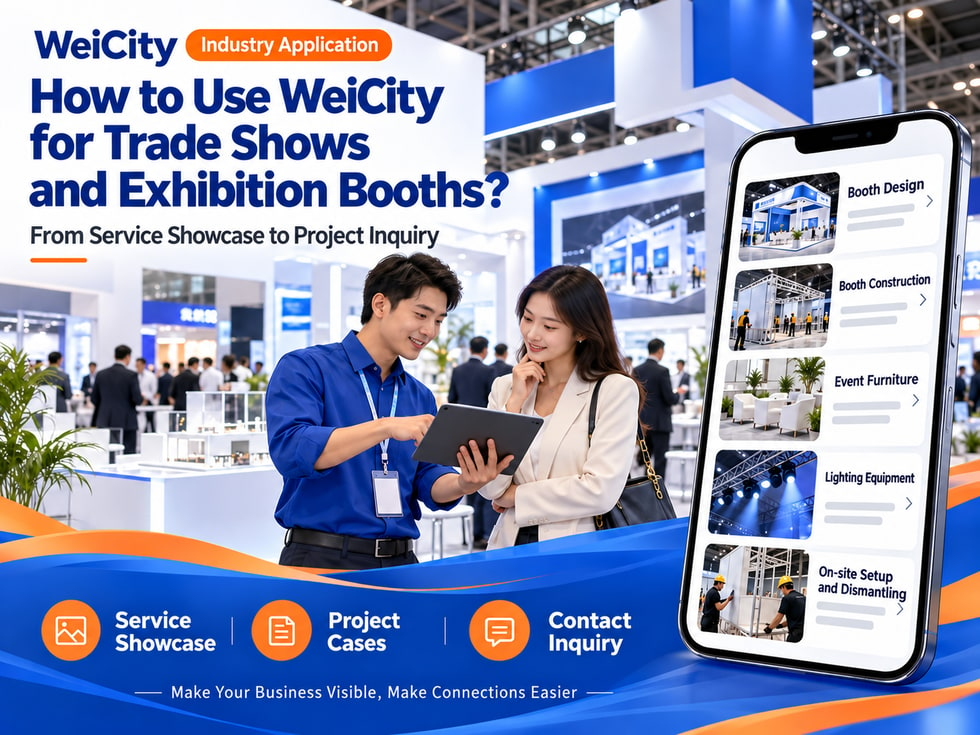
From Service Display to Project Inquiry
“Can you help design our booth?”
“What size booth can this venue accommodate?”
“How long do production and setup take?”
“Can you customize according to our brand image?”
“We already have design drawings. Can you help with production and installation?”
When exhibitors prepare for an exhibition, they usually confirm the venue dimensions, booth design, production content, move-in time, and on-site setup arrangements at the same time.
💡 With WeiCity, you can create your own exhibition service channel and organize your service scope, cases, and quotation information, so customers can first understand what you offer before contacting your team to confirm project requirements.
✅ Exhibition Setup Company
Introduce your booth design, production, and on-site setup services.
✅ Booth Design Team
Show your design style, design process, and project material requirements.
✅ Exhibition Display Producer
Explain the display panels, structures, and display materials you actually provide.
✅ Exhibition Furniture and Equipment Rental Provider
Introduce the tables, chairs, display racks, lighting, or other equipment you actually supply.
✅ Brand Display and Event Decoration Team
Showcase your corporate booth, product display area, and event space decoration services.
✅ Exhibition Logistics and On-site Support Provider
If actually provided, describe your transportation, move-in, or on-site coordination arrangements.
📌 Introduce services according to your team's actual capabilities, and clearly distinguish design, production, transportation, setup, and dismantling projects.
You can organize them according to the project process:
🔹 Booth Design
Introduce your design communication, artwork confirmation, and plan revision methods.
🔹 Booth Production
Show the structures, display panels, and display components you actually produce.
🔹 On-site Setup and Dismantling
Explain your service areas, move-in conditions, and construction arrangements.
🔹 Exhibition Furniture and Equipment
Introduce the items you can actually rent or provide.
🔹 Brand Display and Graphic Production
Explain signage, backdrops, light boxes, or other display content.
🔹 Transportation and On-site Coordination
If actually provided, introduce cargo transportation and on-site coordination.
🔹 Customized Display Projects
Show projects arranged according to customers' spaces, themes, or brand needs.
💡 Categorizing by service steps makes it easier for customers to understand which parts of a project your team can take part in.
Recommended to specify:
✅ Service Items and Included Content
✅ Applicable Exhibitions or Display Scenarios
✅ Whether Design and Production Are Quoted Separately
✅ Dimensions or Artwork Required from Customers
✅ Project Communication and Confirmation Process
✅ On-site Setup and Dismantling Arrangements
✅ Whether Transportation or Equipment Rental Is Included
✅ How Project Timelines Are Estimated
✅ Information Needed for a Quote
✅ Contact and Booking Methods
🔶 For example: Booth Setup Service Introduction
Service content: Fill in according to the design, production, and setup projects your team actually provides.
Project information: Provide the exhibition name, venue, booth size, and opening dates.
Artwork materials: If you already have design drawings, you may provide the files for the team to assess.
On-site arrangements: Confirm move-in, build-up, and move-out times.
Quotation method: Confirmed based on design scope, materials, dimensions, and on-site requirements.
Contact method: Provide a contact person and project deadline to arrange further communication.
📌 Project scope and costs should be confirmed based on booth information, venue requirements, and production content.
It is recommended to prepare:
🔹 Overall booth photos
Show the completed spatial layout and overall design.
🔹 Photos from different angles
Show the entrance, reception area, product display area, and storage space.
🔹 Comparison of design drawings and finished results
If design drawings are published, make sure they correspond to the actual case.
🔹 Photos of the production and build-up process
Introduce the team's workflow and on-site arrangements.
🔹 Cases of different scales
Show actual completed projects of different areas or types.
🔹 Detail Photos
Show how light boxes, display racks, backdrop panels, and brand logos are handled.
📌 Before publishing client names, brand logos, booth photos, or design drafts, obtain the client's authorization. Unpublished project materials should be handled with care.
1️⃣ Exhibition name and venue location
Helps in understanding the venue and on-site arrangements.
2️⃣ Booth size and floor plan
Provide materials supplied by the organizer or venue.
3️⃣ Exhibition dates and opening hours
Explain the requirements for build-up, exhibition, and move-out times.
4️⃣ Brand materials and design direction
Provide logos, colors, reference images, or existing design drafts.
5️⃣ Display content and equipment needs
Explain arrangements for products, display cabinets, screens, or other equipment.
6️⃣ Budget range and delivery deadline
Helps the team assess the project scope and production timeline.
📌 If the client has not yet obtained booth information, they can first explain what has been confirmed so far and then provide documents later.
You can prepare a communication checklist:
🔹 Venue move-in and move-out time slots
🔹 Booth floor plan and height restrictions
🔹 Power, network, or hanging point requirements
🔹 Material and construction method restrictions
🔹 Truck access and unloading rules
🔹 Worker registration or construction permit arrangements
🔹 Access routes and public area requirements around the booth
🔹 On-site manager and contact details
💡 Remind clients to verify relevant rules with the organizer or venue, and to provide formal technical materials as early as possible.
📌 Requirements may differ for each venue and exhibition. Actual design and construction arrangements should follow the information confirmed by the organizer or venue.
Recommended to specify:
✅ Scope of design, production, and build-up fees
✅ Whether materials, furniture, and equipment are included
✅ Transportation, move-in, and move-out fees
✅ Number of design revisions or confirmation process
✅ How additional items are priced
✅ Deposit and payment arrangements
✅ Project timeline and delivery milestones
✅ How temporary venue requirements are handled
🔶 For example:
“Quotations are confirmed based on booth size, design plan, materials, equipment, and on-site requirements. Please share your booth floor plan, exhibition dates, and display needs, and we will reply with the service scope and costs after assessment.”
📌 Before the plan, materials, and site conditions are confirmed, the preliminary estimate may change. The final scope and quotation should be confirmed before formal production begins.
You may confirm the following with the client in sequence:
1️⃣ Initial discussion of project needs
2️⃣ Collect booth information and venue rules
3️⃣ Confirm design direction and quotation scope
4️⃣ Check artwork, copy, and dimensions
5️⃣ Confirm production, transportation, and build-up times
6️⃣ Arrange dismantling or item recovery after the exhibition (if applicable)
💡 Explain in advance the items the client needs to confirm at each stage, so both sides can move forward on schedule.
📌 Delivery times are affected by design confirmation, material supply, venue rules, and move-in arrangements, and the timeline confirmed for the project should prevail.
🔹 About Us
Introduce the team, service areas, and project experience.
🔹 Booth Design and Construction
Explain the scope of design, production, transportation, and installation.
🔹 Case showcase
Organize works by booth type, industry, or space scale.
🔹 Exhibition Equipment and Supporting Items
Show the equipment and furniture actually provided or rented.
🔹 Project Process
Introduce the steps from requirement discussion to on-site construction.
🔹 Project Inquiry Guide
Explain the drawings, dates, and display requirements clients need to prepare.
🔹 Contact and appointments
Provide project consultation methods and team contact information.
💡 When starting out, you may first add the service scope, representative cases, and an inquiry checklist, then gradually add venue and project process explanations.
🔶 Client asks: “Can you design a booth for us?”
You can reply:
“Hello, here is an introduction to our design and construction services. Please share the exhibition location, booth size, dates, and brand materials, and we will help confirm the project process and schedule.”
🔶 Client asks: “We already have design drawings. Can you help with production?”
You can reply:
“Yes, please first provide the design drawings, dimensions, exhibition dates, and venue information. We will confirm the production scope, on-site requirements, and quotation method.”
🔶 Client asks: “How are build-up costs calculated?”
You can reply:
“Costs are confirmed based on booth size, design, materials, transportation, and on-site requirements. Please share the floor plan and requirement list, and we will reply with a quotation range after assessment.”
1️⃣ Basic team information
Name, service areas, contact details, and project experience.
2️⃣ Service categories
Organize design, production, build-up, dismantling, and equipment projects.
3️⃣ Real project cases
Prepare photos from different angles and project materials that have been authorized.
4️⃣ Project inquiry checklist
Tell clients to provide booth plans, dates, and display requirements.
5️⃣ Process and on-site explanation
Organize design confirmation, venue requirements, and construction arrangements.
✅ Are the service scope and excluded items clearly stated?
✅ Have the cases and design drafts been authorized?
✅ Have the booth size and venue conditions been verified?
✅ Does the quotation explain the scope of design, production, and transportation?
✅ Have the construction, move-in, and move-out times been confirmed?
✅ Have the materials the client needs to provide been listed?
✅ Are project materials and brand files handled properly?
✅ Are the contact details correct?
After organizing service categories, on-site cases, and inquiry guides into your channel, you can use them for daily replies, project promotion, and communication with corporate clients.
Clients can first browse the team's services and cases, then provide exhibition materials, dimensions, and design requirements. Merchants can use this to continue confirming the project scope, costs, and on-site arrangements.
Want to learn how to set up a merchant channel for exhibition and booth construction?
Feel free to contact us through the official WeiCity channel contact details, and we can work together to organize content that suits your team.
WeiCity
Make your business visible and contact easier.