

2 What Can Article Publishing Do? Organize Updates, Introduce Services, and Share Experience
Organize frequently needed information into articles so customers can read them anytime, and make daily sharing and inquiries easier.
WeiCity article publishing can be used to organize business updates, introduce service processes, answer common questions, and share practical experience. Build around topics customers care about, organize scattered explanations into clear articles with text and images, and share them through article links so readers can learn in advance and future communication has a clearer direction.
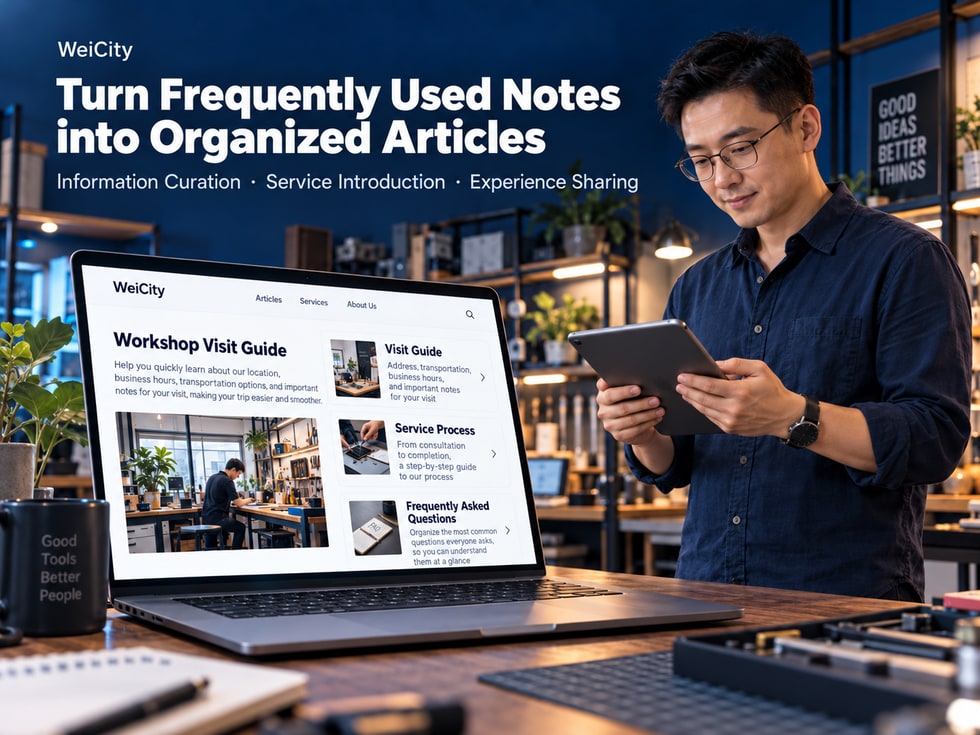
When running a business, do you often need to answer the same questions?
💬 "What services do you offer?"
📅 "Do I need to make an appointment in advance?"
💰 "How is the price calculated?"
📍 "Where is the store? Is parking convenient?"
📦 "How can I pick up my purchase after buying?"
🛠️ "What do I need to prepare before use?"
🚚 "Can you deliver to my area?"
These questions seem simple, but if different customers ask them every day, merchants have to keep repeating the same explanations.
Especially for businesses with many product specifications, complex service processes, or materials that must be prepared in advance, short messages may not be enough to explain every detail clearly.
Through the WeiCity article publishing feature, merchants can organize frequently repeated explanations into complete articles, so customers can read first and then consult further based on their actual needs.
A clear article can become an explanatory resource that is reused in everyday communication.
Customers do not need to ask from the beginning every time, and merchants can spend more time confirming specific needs, handling orders and providing services.
This article explains how to use the WeiCity article feature to organize business information, service processes, common questions and practical guides, and how to apply articles in daily consultations and promotion.
Many merchants encounter similar situations in daily operations.
In the morning, a customer asks about business hours.
In the afternoon, someone asks about the booking process.
In the evening, another customer asks about the same service items.
Although the answers are largely the same each time, time still has to be spent explaining them again.
After organizing common explanations into articles, you can share the article link at appropriate times.
For example:
Materials that need to be prepared for an appointment.
What the service includes.
Pickup time.
Additional fees.
Customers can review the information according to their own schedule, without necessarily waiting for the merchant to explain each item right away.
Articles can be organized with headings, paragraphs, images, and related links.
Different staff members can refer to the same article content, reducing inconsistent answers.
When service procedures change, you can review and update the related articles.
Suppose a photography studio receives the following questions every day:
📸 What does a photo shoot package include?
👕 What clothing should be prepared before the shoot?
💄 Is it necessary to do one's own makeup?
📍 Where is the studio located?
📅 How can I make a booking?
Merchants can organize each of these topics into a separate article.
When customers ask, share the relevant content.
📌 Articles cannot replace all communication, but they can help customers understand basic information first, so that follow-up inquiries are more specific.
If business and service information is scattered across different messages, customers may find it hard to locate complete information in one place.
For example:
The address is in one message.
Parking instructions are in another message.
Business hours still need to be asked about separately.
In this case, you can organize information on the same topic into an article.
For example:
Business hours from Monday to Friday.
Weekend schedule.
Regular closing days.
Provide the exact address.
If located in a shopping mall or commercial building, you may also include the floor and unit number.
For example:
Nearby car parks.
Parking entrance.
Parking arrangements to be aware of.
Some studios or offices may be located inside a building.
You may specify:
Which entrance to use.
How to find the lift.
Which floor it is on.
For example:
Whether an appointment is needed in advance.
What to prepare before visiting.
Explain which contact methods customers can actually use to reach you.
📍 Visiting Our Studio for the First Time? A Guide to Address, Parking, and Appointment Preparation
The article can include:
🏪 Studio address.
📷 Photo of the building exterior.
🚗 Parking location.
🏢 Floor and unit number.
📅 Appointment reminders.
For example:
Do not only write:
"Closed next Monday."
You can write:
"Temporarily closed on 2 November 2026."
This makes it easier for customers who open the article later to tell whether the information is outdated.
📌 Organizing visit information into one article lets first-time visitors learn in advance what they need to keep in mind.
A service name alone may not be enough for customers to judge whether it suits their needs.
For example:
One merchant writes:
"Professional cleaning service."
But customers may still want to know:
🏠 Which spaces are cleaned?
🧹 What items are included?
📍 Which areas do you serve?
💰 How is the cost calculated?
📅 Do I need to make a reservation in advance?
Therefore, you can provide more specific explanations through articles.
For example:
Residential customers.
Office.
Retail shops.
Clearly list the items actually provided.
For example:
Consultation.
Confirm their needs.
Schedule arrangement.
Service delivery.
For example:
Size of the space.
Address.
Photos of the site.
If a fixed price cannot be provided, explain which factors the quotation depends on.
Explain the actual booking method.
🧹 What Does the Home Cleaning Service Include? An Introduction to the Booking Process and Preparation
The main text can explain:
🏠 Suitable spaces.
🧹 Scope of service.
📋 Cleaning items.
📍 Service area.
📅 Appointment arrangements.
💰 Pricing details.
For example:
If the merchant does not provide home service around the clock, the article should not say "Home service at any time, 24 hours a day."
📌 The more specific the service introduction, the easier it is for customers to judge whether it meets their actual needs.
FAQ is short for Frequently Asked Questions.
For merchants who often answer similar questions, an FAQ article is very useful.
For example:
How far in advance should I book?
Can I change the date?
For example:
How is the fee calculated?
Is a deposit required?
For example:
What specifications are available?
How do I choose the right size?
For example:
Which areas do you deliver to?
How is the delivery fee calculated?
For example:
How long does the service take?
Do I need to prepare any materials in advance?
For example:
How should I contact you if I need to change my booking?
It is recommended to give a direct answer to each question first, then add any necessary details.
For example:
❓ Do I need to book in advance?
If your actual business requires appointments, you can write:
"Our shop operates by appointment. We recommend that customers contact us before their planned visit to confirm available dates and time slots."
If a question needs a detailed explanation, you can write it as a separate article.
For example:
FAQ:
"What do I need to prepare for a custom cake?"
Then provide a complete guide:
🎂 Custom Birthday Cake Preparation Guide: Designs, Sizes, and Pickup Dates
📌 The FAQ answers questions quickly, while detailed articles explain the steps and things to note.
Some products only need a simple introduction.
However, certain products involve size, use, installation, or maintenance, and may need more complete explanations.
For example:
🏡 Furniture.
🔌 Electronic devices.
🛠️ Hardware tools.
📷 Photography equipment.
🎨 Handcraft materials.
For example:
Size.
Capacity.
Model.
Material.
Explain which usage situations the product suits.
Introduce the basic operating steps.
Explain the actual points that need attention.
Provide suitable day-to-day care recommendations.
Explain how customers can contact the merchant if they encounter problems.
A furniture shop could publish:
🏡 How should I measure my space before buying a storage cabinet?
The article can cover:
📏 Measure the width of the intended location.
📐 Check the height and depth.
🚪 Leave room for the doors to open.
🛠️ Consider installation requirements.
📦 Check the actual product dimensions.
Because customers may not be familiar with all specifications.
By providing buying knowledge through articles, you can help them more clearly judge which products suit them.
📌 Product articles do more than introduce products; they can also help customers reduce uncertainty when shopping.
Some services require customers to prepare materials in advance.
If this is not explained beforehand, it may affect the arrangements on the day.
For example:
📸 Photography services.
🏡 Renovation Consultation.
🖨️ Printing services.
🎓 Educational courses.
🛠️ Repair services.
You can remind customers to prepare:
👕 Apparel.
💄 Makeup arrangements.
📍 Shooting location.
📅 Shooting date.
You can remind customers to prepare:
📏 Space dimensions.
📷 Site photos.
💰 Budget range.
📝 Design requirements.
You can remind customers to prepare:
📄 Print files.
📏 Dimensions.
🔢 Quantity.
📅 Delivery date.
You can remind customers to prepare:
🔧 Equipment type.
📷 Photos of the fault.
📝 Problem description.
📍 Location.
📋 What materials should I prepare before my first renovation consultation appointment?
First, explain why preparation is needed.
Then list the materials.
Finally, explain how to contact the merchant.
📌 A preparation guide helps customers understand the process before booking, and also helps the merchant confirm actual needs more quickly.
In day-to-day operations, merchants usually accumulate a good deal of experience.
This experience does not necessarily need to be written up as a complex professional article.
As long as it helps customers solve real problems, it can become useful content.
For example:
How do you choose the right product size?
For example:
How should a certain tool be properly maintained?
For example:
What details are easy to overlook before starting a renovation?
For example:
How can a small office arrange its storage space?
For example:
What printing details should you pay attention to when designing a business card?
For example:
How do you choose a bouquet for different celebration occasions?
A curtain merchant can publish:
🏡 Before ordering custom curtains, how should you measure the window?
An article can explain:
📏 Window width.
📐 Window height.
🪟 Installation position.
🎨 Fabric selection.
📝 Items to confirm with the merchant.
For example:
Do not describe one option as suitable for all customers.
Explain the conditions of applicability according to different situations.
📌 Truly helpful professional articles help customers understand the problem, rather than just emphasizing how professional the merchant is.
Some merchants want one article to introduce all of their business.
For example:
Brand history.
All products.
All services.
Promotions.
Booking process.
Contact information.
But with too much content, customers may find it hard to find the answers they need.
Ask yourself:
“What should the customer understand after reading this article?”
For example:
📍 What do first-time visitors need to know? Address, parking, and business hours
Start with a basic introduction, then gradually explain the details.
For example:
A visiting guide can include a photo of the entrance.
A product article can include a specification image.
If a topic needs more detailed explanation, you can write a separate article.
🏷️ Title.
📝 Short introduction.
📋 Main explanation.
🖼️ Related images.
❓ Frequently asked questions.
💬 Contact or next step.
Because when customers ask different questions, the merchant can share different articles.
For example:
When asked about parking, share the parking guide.
When asked about reservations, share the reservation instructions.
When asked about product specifications, share the buying guide.
📌 The clearer the topic, the easier the article is to read and the more convenient it is to use in daily customer inquiries.
Many customers open the articles shared by merchants on their phones.
Therefore, in addition to complete content, articles also need attention to layout.
Let readers know the article topic at a glance.
Avoid having the entire article as one large block of text.
Help readers quickly find the parts they need.
Make sure important content is not cropped.
A visiting guide should clearly state the address.
Check related links before publishing.
Confirm the article is easy to read on a phone.
For example:
Before setting out, a customer may only want to quickly check where to park.
If the article is too long and has no subheadings, they may have to keep searching.
📌 Clear titles, separate paragraphs, and relevant images can help customers find the key points faster on their phones.
After an article is published, it can be shared according to different communication situations.
Give a brief answer first, then share the service introduction article.
For example:
“We do offer related services. This article summarizes the service content and basic process, so you may want to take a look.”
Share the reservation preparation guide.
For example:
“This summarizes the materials to bring before your visit, so you can refer to it before your appointment date.”
Share the visiting guide.
For example:
“Here are our address, entrance, and parking instructions, so you can review them before heading out.”
Share the usage and maintenance instructions.
For example:
“This article introduces the basic use and maintenance of the product, and you can check it again whenever needed.”
Extract one key point from the article, then attach the article link.
Let staff who handle reception refer to the same service instructions.
Because customers may not know how the article relates to them.
For example:
Sending only the link.
Versus sending:
“This article summarizes the size selection and ordering process for custom cakes, so you can refer to it first.”
In comparison, the latter is easier for customers to understand.
📌 Articles can serve as communication aids, but you should still provide appropriate explanations based on the customer's specific questions.
If a merchant has several staff members serving customers, different staff may answer in different ways.
For example:
One staff member says a reservation is needed three days in advance.
Another staff member says five days.
Without unified materials, customers may become confused.
Organize the services actually being offered at present.
State how far in advance to contact, and which arrangements need separate confirmation.
Explain how fees are calculated.
Explain how pickup, delivery, or service completion works.
Let staff refer to the latest article.
If a customer's situation is special, the responsible staff should still confirm further.
A printing merchant can organize:
🖨️ Business card printing instructions.
📄 Flyer printing instructions.
📦 Packaging printing instructions.
📅 Delivery time instructions.
When staff receive an inquiry, they can share the corresponding article based on the actual question.
📌 Unified articles can reduce inconsistencies in basic information, but special needs still require individual confirmation.
Articles can be used for a long time, but a merchant's business information may change.
For example:
🕒 Changes to business hours.
📍 Store relocation.
💰 Product prices change.
🛠️ Service scope is updated.
📞 Contact information changes.
📅 The event has ended.
If an article is not updated, customers may make arrangements based on outdated information.
Confirm they are still accurate.
Especially after relocating or changing the business location.
Confirm the article does not describe services that have been discontinued.
If prices change, update the related information.
Confirm the phone number and contact channels are still valid.
Confirm the photos still reflect current products and environment.
Events that have ended should clearly indicate their status.
For information that changes often, you can label the update date as needed.
For example:
“Last updated: October 2026.”
It helps customers better understand the time context of the information.
If the WeiCity editor provides auto-save, drafts, or publishing status, confirm whether changes have taken effect based on the actual features.
📌 Regularly updating articles can reduce misunderstandings caused by outdated information.
Questions customers often ask may also be the questions they use when searching on Google.
For example:
🎂 How far in advance should I order a custom cake?
🏡 How do you measure dimensions before buying furniture?
🖨️ What files do you need to prepare for printing business cards?
📸 What do you need to prepare for a personal portrait photoshoot?
🛠️ What should be checked before air conditioner repair?
Each of these questions can become an article topic.
For example:
“How far in advance should custom cakes be ordered?”
Compare:
“Our Thoughtful Service”
Makes it easier for readers to understand the content.
If your business serves a specific area, state the actual service locations.
Avoid relying only on vague promotional phrases.
Make sure the title matches the body content.
For example:
Measurement guides can include a size diagram.
Make sure the article still matches the current business.
Whether Google crawls, indexes, or displays a page also depends on website technology, content quality, and search engine mechanisms.
📌 Turning real customer questions into articles can help readers understand the business and make the page's topic clearer.
Different merchants can choose article topics based on their actual operations.
📝 What should you know before making a reservation?
📝 How to view the online menu.
📝 What does the set meal include?
📝 How is self-pickup arranged?
📝 How do you choose product specifications?
📝 What should you confirm before buying?
📝 How are pickup and delivery arranged?
📝 Product care methods.
📝 What to prepare before repairs?
📝 How do you describe a fault or problem?
📝 What services are included?
📝 How can you understand repair costs?
📝 What should you know for your first appointment?
📝 What are the differences between care services?
📝 What should you prepare before the service?
📝 How are appointment changes arranged?
📝 Who is the course suitable for?
📝 What to prepare before class.
📝 How is the course schedule arranged?
📝 Common questions from parents.
📝 How should you prepare outfits before a shoot?
📝 What is the shoot process?
📝 How do you choose a photography package?
📝 How are photos delivered?
📝 What should you prepare before a renovation consultation?
📝 How do you measure a space?
📝 What are the steps of the project process?
📝 What should you note when choosing materials?
📌 Start by organizing the questions you answer most often every day; this is usually more practical than looking for article topics at random.
If you have not published an article before, you can start with your most recent customer inquiries.
You do not need to prepare a lot of content at once.
For example:
“What should I bring for my first visit to the studio?”
You can write:
📍 First Visit Guide to the Studio: Address, Parking, and Appointment Preparation
For example:
🏪 Studio address.
🚗 Parking location.
🏢 Building entrance.
📅 Appointment times.
📝 Materials to bring.
For example:
Studio exterior.
Entrance photo.
Parking location.
For example:
If you need to confirm an appointment, you can contact the merchant through the contact details they actually provide.
Make sure the article is easy to read.
When a customer asks the same question again, you can share the article link.
If the address, parking arrangements, or appointment process changes, update the article promptly.
The key is to:
The content is genuine.
The topic is clear.
The information is complete.
It is easy to read.
It helps solve a real problem.
📌 Starting with a question you are often asked can help you build a first merchant article that is truly useful.
You can organize common explanations into articles using the actual publishing and sharing features, then provide them to customers who need them.
It is recommended to start by organizing the questions you are asked most often every day.
Not necessarily. Related short questions can be organized into an FAQ, while more complex topics can be separate articles.
It should be long enough to clearly answer the main questions; there is no need to add length deliberately.
If the current editor supports image insertion, you can use it according to the actual features available.
You can do so using the sharing methods the article actually provides.
Not completely. Special requirements, price confirmation, and appointment arrangements may still require direct communication.
You can use related introductions and article links for promotion, depending on the actual sharing methods available.
It can serve as a unified reference, but you should ensure the content is accurate and kept up to date.
It is recommended to update them promptly to prevent customers from reading outdated information.
No specific time savings can be guaranteed; actual results depend on the article content, customer needs, and how it is used.
Not necessarily; search indexing and display are affected by many factors.
📌 The main purpose of an article is to help customers more easily access complete explanations and support merchants' daily communication.
In running a business, answering the same questions repeatedly is part of daily work.
But not every explanation needs to be entered again each time.
For example:
🕒 Opening hours.
📍 Directions to the store.
📅 Appointment preparation.
🛠️ Service process.
📦 Product Specifications.
🚚 Delivery Arrangements.
❓ Frequently asked questions.
💡 Professional knowledge.
All of this content can be organized into articles as needed.
Gather information scattered across messages in one place.
Use clear titles, separate paragraphs, and relevant images.
Provide the relevant explanation based on the questions customers raise.
Help customers contact the merchant with clearer questions.
When the business changes, check the related content promptly.
WeiCity hopes to help merchants gradually organize information they often need to explain repeatedly into content that customers can read, save links to, and revisit.
For customers, they can read the basic information first and then decide whether to make further inquiries.
For merchants, this can reduce the need to repeatedly enter basic information, allowing more communication time to focus on specific needs.
For teams, referring to the same explanation can make daily reception more consistent.
Start with one common question.
Organize it into one clear article.
Then use the article in the next customer inquiry.
📝 Let articles answer repeated questions.
💬 Focus communication on the details that really need confirmation.
🏪 Make every practical piece of content a material you can keep using in your merchant channel.
Specific article publishing, rich text editing, saving, editing, link, and sharing features depend on WeiCity's current actual pages and the features available to your account.
👉 Open WeiCity: https://wei.city/