

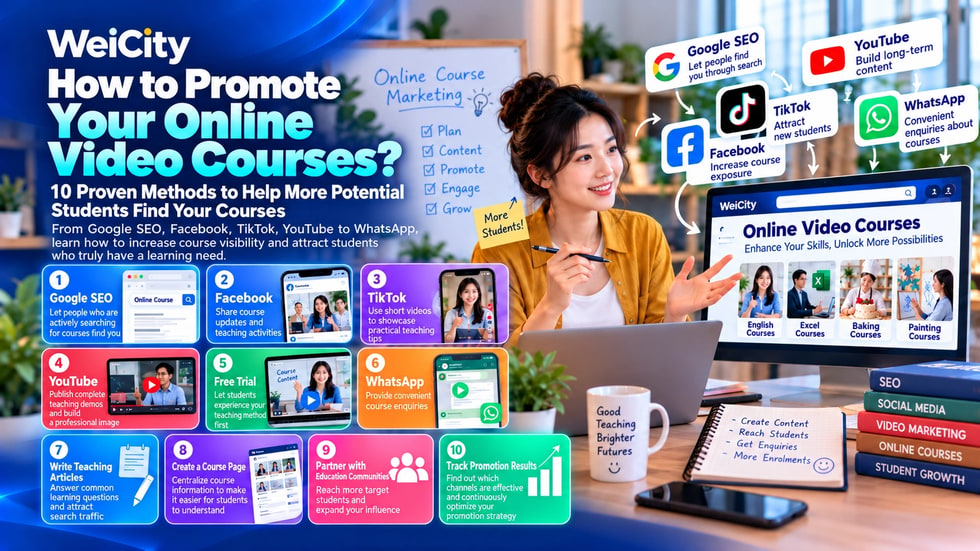
10 How to Promote Online Video Courses? 10 Ways to Help More Prospective Learners Find Your Course
From Google SEO, Facebook and TikTok to YouTube and WhatsApp course enquiries, learn how education centres, training institutions and independent instructors can increase the exposure of online courses and attract learners who genuinely need to learn.
After completing an online video course, how should you attract learners? This article summarises 10 online course promotion methods, including Google SEO, Facebook, TikTok, YouTube, WhatsApp, free trial lessons, practical teaching articles and course introduction pages. It also shares how education centres, training institutions and independent instructors can use the WeiCity merchant channel to present course materials in one place, making it easier for prospective learners to learn about, enquire about and sign up for courses.
You spent several weeks recording teaching videos, organizing course chapters, and preparing teaching materials and learning resources.
Finally, you completed a set of online video courses.
But after the course went live, you found that few people watched it and you rarely received student inquiries.
This may be a problem that many education centers, tuition providers, and independent tutors encounter.
🔸 The course content is ready, but you don't know where to promote it.
🔸 Course ads were posted on Facebook, but they didn't bring in many inquiries.
🔸 YouTube videos have views, but they haven't led to actual sign-ups.
🔸 Your course introduction can't be found when searching on Google.
🔸 Prospective students asked about the course but took no further action.
🔸 You don't know how to tell whether your promotion is working.
In fact, creating a course and promoting a course are two different tasks.
Course content determines what learners can learn, while course promotion helps people who need it discover and understand your teaching services.
Below are 10 online course promotion methods that education providers and tutors should consider.
Google Search is one of the channels worth prioritizing for online course promotion.
This is because some prospective students already have a clear learning need when they search.
For example:
🔍 Online English Course Malaysia
🔍 Beginner Excel Course Malaysia
🔍 Malaysia online English course
🔍 primary school maths online video lessons
🔍 Photoshop Course for Beginners
🔍 Online Baking Class Malaysia
🔍 Penang Computer Training
These search keywords usually reflect the course topics or learning needs users are looking for.
Therefore, merchants should prepare clear titles and written descriptions for their courses.
For example:
❌ Not recommended: English Course 01.
✅ Recommended: Beginner English speaking online course | Suitable for adult beginners.
❌ Not recommended: Computer training.
✅ Recommended: Excel basics video course | Practical lessons for office staff.
❌ Not recommended: Baking lessons.
✅ Recommended: Beginner baking online video course | Cake and bread making lessons.
Course descriptions should naturally include relevant keywords and clearly explain the actual teaching content.
However, SEO does not guarantee that a web page will rank on Google.
Whether a page is public, allowed to be indexed, website technical settings, content quality, and competition all affect actual search performance.
Facebook can be used to share course information, teaching activities, and the latest news from education centers.
It may be especially worth considering Facebook as a promotion channel for courses aimed at parents, adult learners, and local communities.
For example:
📚 Share tuition course introductions.
🗣️ Post English learning tips.
💻 Introduce computer training courses.
🎨 Showcase painting teaching works.
🏫 Share classroom activities at the education center.
Merchants can try different types of content.
✅ Teaching knowledge sharing.
✅ Course introduction images.
✅ Teachers' professional backgrounds.
✅ Real teaching activities.
✅ Free trial lesson information.
✅ Answers to common course questions.
For example, an English training center could post:
📘 Topic: Why do you still not dare to speak English after studying it for years?
The body text introduces several common learning obstacles, then explains how the course helps learners practice everyday conversations.
This kind of content first addresses the questions of prospective students and then introduces related services, which is usually more practically valuable than simply repeating "Welcome to sign up."
TikTok is suitable for sharing teaching knowledge and practical tips through short videos.
For courses that can clearly demonstrate practical operations, short videos can serve as a promotional method.
For example:
💻 A 30-second demonstration of an Excel tip.
🗣️ Introduce three English words that are easy to mispronounce.
🍰 Demonstrate simple cake decorating methods.
🎨 Show a painting technique.
📷 Share basic composition methods for mobile phone photography.
Short videos should focus as much as possible on one clear topic.
The following structure is recommended.
🎯 Opening: Raise a question that viewers are familiar with.
📚 Middle: Demonstrate a practical solution.
✅ Ending: Summarize the key points.
🔗 Follow-up: Let those who need it know how to learn the full course.
For example:
"Still using a calculator to add up Excel sheets? Try this basic formula."
Then show the steps.
Finally, you can state:
"To learn more basic Excel lessons, check out the course introduction."
The important thing is for the video itself to have real learning value, not just be a sales pitch.
YouTube can be used to publish more complete teaching demonstrations.
Compared with short videos, some complex knowledge topics may require more time to explain.
For example:
📊 Teaching common Excel formulas.
💻 Photoshop image editing steps.
📘 Methods for solving math word problems.
🗣️ English pronunciation training.
🍳 Basic baking techniques.
Merchants can select some foundational knowledge from their courses and create videos suitable for public sharing.
These contents can help viewers get to know the teacher's teaching style.
Recommended practices:
✅ Clear video titles.
✅ Clear teaching topics.
✅ Easy-to-recognize thumbnails.
✅ Video descriptions related to the teaching content.
✅ Appropriate course introduction links.
✅ Add chapter timestamps when necessary.
When viewers want to learn more, they can use the related links in the video description to learn about the full course.
However, the number of views does not equal the actual number of sign-ups.
Merchants still need to track how many viewers go on to browse course materials or make inquiries.
When meeting a teacher for the first time, some learners may not be willing to buy a full course right away.
Therefore, free trial lessons can help them first understand the teaching style.
For example:
📘 English course: Offer a basic pronunciation trial lesson.
💻 Excel course: Offer a demonstration of a commonly used formula.
🎨 Painting course: Offer a simple painting lesson.
🍰 Baking course: Show a basic operation technique.
Trial lesson content should have practical teaching value.
✅ Help learners understand the course topic.
✅ Show the instructor's teaching style.
✅ Help learners judge the difficulty level.
✅ Explain the learning direction of the full course.
✅ Provide a way to make further inquiries.
A free trial lesson may not necessarily lead to a purchase, but it can reduce prospective students' questions about the course content.
Merchants can also use trial feedback to decide whether the course introduction needs to be adjusted.
In Malaysia, WhatsApp is a commonly used tool for merchants to communicate with customers.
For education centers and training providers, prospective students may want to ask about course details before signing up.
For example:
❓ Is the course suitable for beginners?
❓ Is the course taught in Chinese or English?
❓ How much is the tuition fee?
❓ Is there a free trial lesson?
❓ Can the course be watched repeatedly?
❓ Can I study on my phone?
❓ How do I sign up?
Therefore, merchants can provide a clear WhatsApp contact in appropriate course promotional materials.
They can also prepare standard course descriptions to reduce the time spent repeatedly answering basic questions.
For example:
📚 Course name.
🎯 Suitable for.
📘 Main learning content.
💰 Course fees.
⏱️ Learning method and viewing period.
📞 How to make a sign-up inquiry.
However, merchants should respect customers' contact preferences and should not send large volumes of promotional messages without consent.
Making it easy for customers to actively make inquiries is more important than continuously sending ads to people who are not interested.
In addition to videos, written articles are also worth considering as promotional content.
This is because some prospective students will first search Google for problems they encounter.
For example:
🔍 How do you use the Excel SUM function?
🔍 How can you improve English speaking pronunciation?
🔍 How can beginners learn Photoshop?
🔍 How do you solve primary school math word problems?
🔍 What tools do beginner bakers need?
Merchants can write practical articles addressing these questions.
For example:
📘 Article title: Excel SUM Function Tutorial | How can beginners quickly add up numbers?
The body introduces basic operating methods and provides related course information.
The main purpose of an article should be to help readers solve a problem.
If readers want to study systematically, they can then learn about the full teaching service through the course introduction.
This approach helps gradually build up valuable public content.
However, articles also need to remain accurate, original, and regularly updated.
Many merchants spend a lot of time on social media promotion but overlook whether their course information is complete.
For example, after seeing a course ad, prospective students may still want to know:
📚 What does the course include?
👨🏫 Which teacher will be teaching?
🎯 What level is the course suitable for?
💰 How much does it cost to study?
🎬 How will the course be delivered?
⏱️ How long can the course be watched?
📱 How can I make further inquiries?
If there is no clear course introduction, customers may need to search for information across several platforms.
Therefore, it is recommended to consolidate key information in one place.
A course introduction can include at least:
✅ Course name.
✅ Course summary.
✅ Learning objectives.
✅ Target audience.
✅ Main teaching chapters.
✅ Instructor introduction.
✅ Teaching format.
✅ Fee and service information.
✅ Inquiry or enrollment methods.
This way, prospective learners can learn about the course first before deciding whether to take further action.
Promoting online courses does not have to rely only on advertising.
For education providers with a clear target audience, consider partnering with relevant communities or organizations.
For example:
🏫 Tutoring centers sharing learning resources with parent communities.
💻 Computer trainers sharing office skills with small businesses.
🎨 Art tutors collaborating with interest-based learning groups.
🍰 Baking instructors sharing techniques with related baking communities.
💼 Professional trainers sharing course information with industry organizations.
Forms of collaboration can include:
✅ Free knowledge sharing.
✅ Teaching demonstration events.
✅ Suitable course introductions.
✅ Online talks.
✅ Sharing of relevant educational resources.
✅ Promotional partnerships agreed upon by both parties.
The key is to choose groups that are genuinely interested in the course topic.
Merchants should also follow community rules and avoid turning teaching communities into channels for repeated advertising posts.
When promoting a course, do not focus only on how many ads were posted or how many views a video received.
For merchants who want to increase actual enrollments, it is more important to understand whether prospective learners are taking further action.
You can observe:
👀 Course exposure
How many people saw the course promotion?
🔗 Link visits
How many people clicked the course introduction link?
📚 Course views
How many people actually viewed the course materials?
💬 Course inquiries
How many people proactively contacted the merchant?
📝 Enrollment applications
How many people submitted an enrollment or clearly expressed purchase intent?
💳 Completed purchases
How many people ultimately paid to enroll?
Different platforms provide different ranges of data.
Some data may require merchants to use appropriate analytics tools, separate forms, or an order system to obtain it.
For example:
📊 A promotion received 1,000 course page views.
💬 Of these, 50 people made inquiries.
📝 In the end, 10 people enrolled.
This is only a hypothetical example to explain promotion evaluation.
Merchants can further find out:
✅ Which channel brings more valuable inquiries?
✅ Which teaching content more easily attracts interest?
✅ What questions do prospective learners ask often?
✅ Is any course material not clear enough?
✅ Which courses are worth continuing to promote?
Continuously analyzing this information can help merchants gradually improve their promotion methods.
For education providers that already share teaching content through Facebook, TikTok, or YouTube, another question worth considering is:
After viewing a promotion, where should prospective learners go next to learn about the course?
The WeiCity Merchant Channel can serve as a central entry point for introducing teaching services.
🏪 Showcase the teaching institution
Introduce the professional background of education centers, training institutions, or individual instructors.
📚 Organize course materials
Clearly explain course names, target audiences, teaching topics, and learning objectives in one place.
🎬 Share teaching-related content
Use the content formats the platform actually supports to introduce teaching features and course information.
📝 Publish knowledge articles
Respond to common questions from prospective learners through practical content.
📱 Provide contact information
Let customers know how to make further inquiries about teaching services.
🔗 Share a unified channel link
Use the Merchant Channel link across different promotion channels so customers can find relevant information more easily.
For example, an English language training institution could:
📱 Share English speaking tips on TikTok.
▶️ Publish basic pronunciation lessons on YouTube.
👥 Introduce course information on Facebook.
🔍 Seek Google search visibility through suitable public pages.
🌐 Use the WeiCity Merchant Channel to centrally present the institution and course materials.
💬 Let interested prospective learners make further inquiries through the methods the merchant provides.
The core of this promotion approach is not to require merchants to abandon their existing social media.
Rather, it is to let different channels work together.
Please note that capabilities such as course transactions, automatic enrollment, paid viewing, learning progress tracking, or marketing data tracking should be confirmed against the features WeiCity actually provides.
Merchants can organize different types of keywords based on the actual search needs of prospective learners.
📚 Course topic keywords
Online English Course
Excel Training
Baking Course
Photoshop Tutorial
🎯 Target learner keywords
English for Beginners
Excel for Office Workers
Math for Primary Students
👨🎓 Learning objective keywords
Improve English Speaking
Learn Excel Formulas
Basic Cake Decorating
📍 Location keywords
Online Courses Malaysia
English Classes Penang
Computer Training Kuala Lumpur
If the course is offered only online, do not arbitrarily claim a physical teaching location in a city just to attract search traffic.
Merchants are advised to choose keywords based on the actual course content, language, service area, and teaching format.
Do not repeatedly stuff the same words into articles.
Content suitable for Google SEO should, first and foremost, clearly answer the real questions of users.
If an education center or independent instructor is just starting to promote a course, the following simple schedule can be used as a reference.
📅 Week 1: Organize course materials
✅ Complete the course name and introduction.
✅ Clarify the target audience and teaching objectives.
✅ Prepare course images or teaching demonstrations.
✅ Check the inquiry and enrollment methods.
📅 Week 2: Publish practical teaching content
✅ Produce two to three short teaching videos.
✅ Share a solution to a common learning problem.
✅ Prepare a related teaching article.
✅ Introduce the course on suitable channels.
📅 Week 3: Increase course exposure
✅ Continue publishing teaching content.
✅ Answer common questions from prospective learners.
✅ Provide trial lesson information as needed.
✅ Test different promotional titles or images.
📅 Week 4: Review promotion results
✅ Check how course materials are being viewed.
✅ Record the main questions from prospective learners.
✅ Check inquiry and enrollment results.
✅ Identify the more valuable promotion channels.
✅ Adjust the content plan for next month.
This 30-day schedule is only a reference; the actual promotion pace should be adjusted based on team resources, course type, and budget.
Many merchants do not see good promotion results, and this is not necessarily because the course itself is poor.
It may also be because the promotional content does not clearly respond to the needs of prospective learners.
The following issues are worth checking.
❌ Only introducing the course price without explaining the learning content.
❌ Repeatedly posting the same advertisement every day.
❌ Using overly general course names.
❌ Not showing the actual teaching method.
❌ Lacking a clear inquiry entry point.
❌ Exaggerating learning outcomes or guaranteeing results that cannot be verified.
❌ Not responding to common questions from learners.
❌ Not recording which channels bring actual inquiries.
Suggested improvements:
✅ First understand the needs of target learners.
✅ Provide helpful teaching content.
✅ Clearly introduce course features.
✅ Use real instructors and actual course materials.
✅ Keep course descriptions accurate.
✅ Provide easy-to-use inquiry channels.
✅ Regularly review promotion results.
✅ Keep improving based on actual feedback.
Course promotion should not aim only to reach the most people.
More importantly, it should reach learners who are genuinely interested in the course and suitable for taking it.
Creating high-quality online video courses is an important foundation for developing an online teaching business.
However, even if the course content is complete, it is still hard to create business value if potential students never have the chance to see it.
Therefore, education providers and instructors can combine different promotion methods according to their actual resources.
🔍 Google SEO: Reach people who are searching for related courses.
📱 Facebook: Share course information and teaching activities.
🎬 TikTok: Show practical knowledge through short videos.
▶️ YouTube: Provide more complete public teaching demonstrations.
💬 WhatsApp: Make it easy for potential students to ask follow-up questions.
📝 Teaching articles: Answer common learning questions.
🌐 WeiCity Merchant Channel: Centralize information about your teaching services, course materials and contact details.
📊 Performance review: Keep track of which promotion methods are most helpful.
You do not need to operate all channels at the very beginning.
You can first choose platforms that suit your target students, create truly valuable content, and then gradually expand your promotion.
🌐 WeiCity | Make your professional courses easier to discover, and make it more convenient for prospective students to learn about your teaching services.
🎓 From sharing knowledge, to understanding courses, to actively making inquiries, online course promotion gets a clearer direction.