

56 How Auto Repair and Maintenance Merchants Can Use WeiCity: From Service Showcase to Vehicle Owner Bookings
Showcase repair services, service scope, booking materials, and shop information in one place, helping vehicle owners learn more about your services and contact you more easily.
How can auto repair shops, car maintenance centers, and professional repair service providers use WeiCity? Build a channel that makes it easy for vehicle owners to understand services, describe problems, and contact you through service categories, shop and equipment photos, booking guidance, and vehicle drop-off instructions.
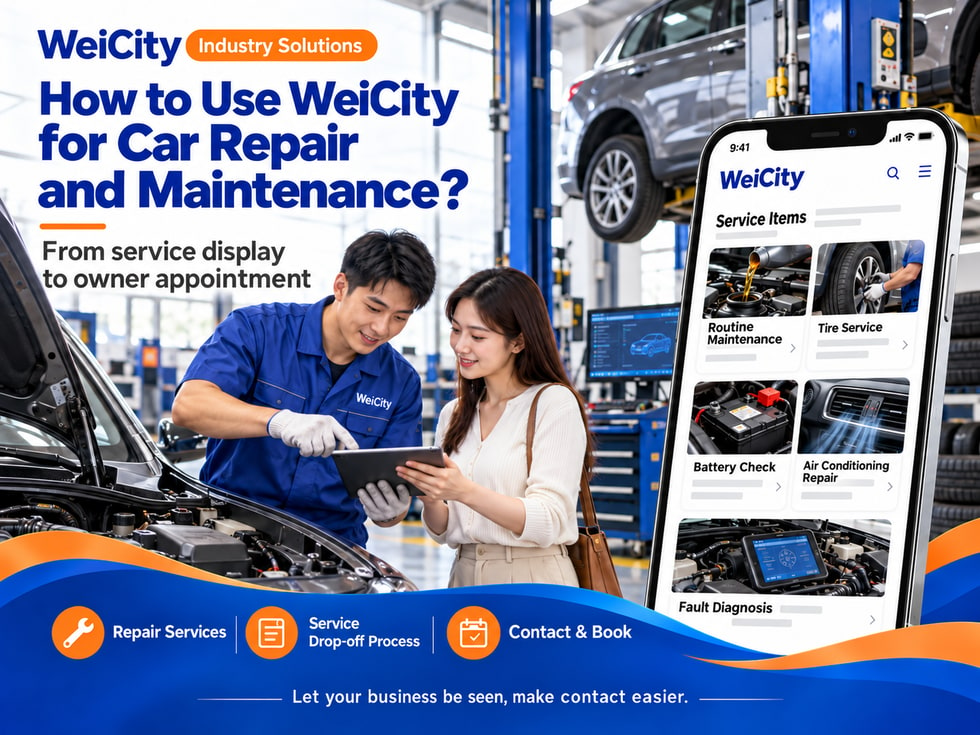
From showcasing services to vehicle owner appointments
"Do you offer regular maintenance?"
"There is an abnormal noise when the car starts. Can you check it?"
"Do I need an appointment to replace parts?"
"About how long does a repair take?"
"Can I first find out the inspection and quotation process?"
When looking for repair and maintenance services, vehicle owners usually first want to know what a workshop can handle, what vehicle information they need to provide, and how inspection, quotation, and repair are arranged.
💡 With WeiCity, you can set up your own repair service channel and organize your service items, vehicle drop-off process, and appointment methods, so vehicle owners can learn about your services first and then contact you to confirm a suitable arrangement.
✅ General auto repair workshop
Introduce the inspection, repair, and maintenance items you actually provide.
✅ Regular auto maintenance center
Explain common maintenance items, appointment methods, and service scope.
✅ Tyre and wheel service provider
Showcase actual services such as tyre inspection, replacement, balancing, or alignment.
✅ Battery and automotive electrical service provider
Introduce battery testing, replacement, and electrical system inspection services.
✅ Car air-conditioning repair service provider
Explain the scope of car air-conditioning inspection, repair, and maintenance.
✅ Repairer for specific brands or models
Introduce the brands, models, and service conditions you are actually familiar with.
📌 Introduce items based on your workshop's equipment, staff experience, and actual service scope, so vehicle owners do not mistakenly assume that every model and fault can be handled.
You can organize them by service type:
🔹 Regular maintenance
Introduce the inspection and maintenance items actually provided.
🔹 Engine and mechanical repair
Explain the service scope your workshop can handle and the appointment process.
🔹 Brake and suspension inspection
Introduce the vehicle information owners can prepare when making an inquiry.
🔹 Tyre and wheel services
Organize products, specification inquiries, and related services.
🔹 Battery and electrical inspection
Explain how inspection and replacement services are arranged.
🔹 Car air-conditioning services
Introduce inspection, repair, and appointment methods.
🔹 Vehicle diagnostics and fault inspection
Explain the symptoms, warning lights, or diagnostic information the vehicle owner should provide.
💡 Make service names as specific as possible, and explain which items require inspecting the vehicle before they can be confirmed.
Recommended to specify:
✅ Service item name
✅ Vehicle types or brand range that can be handled
✅ Inspections or operations included in the service
✅ Whether an appointment is required
✅ How the estimated time is confirmed
✅ Whether the fee is fixed, charged per item, or quoted after inspection
✅ Whether parts need to be reserved
✅ What vehicle owners need to prepare before bringing their vehicle in
✅ How to inquire about warranty or after-sales service
✅ Shop address and contact information
🔶 Example: Introduction to regular maintenance service
Service scope: List items based on what the shop actually provides.
Applicable vehicles: Explain the target services or any restrictions.
Appointment information: Provide the vehicle brand, model, year, and mileage.
Fee confirmation: If quotes depend on the vehicle model and actual condition, explain this in advance.
Scheduling: Contact the shop to confirm available time slots and the time required.
📌 Maintenance items, parts, and labor hours may vary by vehicle model and should be confirmed based on vehicle information and actual inspection results.
1️⃣ Vehicle brand and model
Helps the shop preliminarily confirm vehicle information.
2️⃣ Year of manufacture and mileage
Helps understand how the vehicle has been used.
3️⃣ Problems to be checked
Describe unusual noises, warning lights, or other observable symptoms.
4️⃣ When and under what circumstances the problem occurs
For example, during a cold start, while driving, or when using a specific function.
5️⃣ Photo of dashboard warning lights
If there are warning lights, a photo helps the shop understand the situation preliminarily.
6️⃣ Preferred drop-off date
Makes it easier to check the shop's schedule.
📌 Symptoms described by vehicle owners can help with preliminary communication, but cannot replace on-site inspection or fault diagnosis.
It is recommended to prepare:
🔹 Shop exterior and entrance
Helps vehicle owners find the repair location.
🔹 Repair bays and equipment
Shows the actual service environment and equipment.
🔹 Technicians at work
If people appear in the photo, obtain their consent first.
🔹 Service item details
Show actual operations for tire, battery, or other repair items.
🔹 Before and after maintenance records
If used to showcase cases, make sure the information is accurate and obtain the vehicle owner's permission.
🔹 Drop-off or pickup location
Helps new customers understand how vehicles enter the shop.
📌 Before publishing license plates, registration documents, repair orders, or vehicle owner information, cover identifiable personal information and obtain necessary authorization.
You can introduce it step by step:
1️⃣ Vehicle owner describes the vehicle situation
Provide vehicle information, the symptoms, and contact details.
2️⃣ Shop confirms the appointment
Arrange a drop-off time or preliminary consultation.
3️⃣ Inspect the vehicle
Confirm which items need to be handled based on the actual condition.
4️⃣ Explain repair content and fees
Review the quote, parts, and estimated time with the vehicle owner.
5️⃣ Arrange repairs after the vehicle owner confirms
Proceed only with the items the owner clearly agrees to have repaired.
6️⃣ Contact the owner for pickup after completion
Explain payment, vehicle handover, and how to follow up.
💡 Explain "initial inquiry," "inspection and quote," and "repair confirmation" separately so vehicle owners understand each step.
📌 Vehicle conditions should be judged after inspection by repair staff. Online photos or descriptions cannot guarantee an accurate diagnosis or quote.
Recommended to specify:
✅ Whether the inspection fee is charged separately
✅ Repair items covered by the quote
✅ Parts are OEM, aftermarket, or other types (explain according to actual situation)
✅ Whether pre-ordering is required
✅ How labor and material costs are calculated
✅ How additional problems found during service are communicated
✅ Whether after-sales arrangements are provided for repair items
✅ Payment methods and pickup process
🔶 For example:
"The final fee will be calculated based on the vehicle inspection results, required parts, and the repair items confirmed. Before repairs begin, we will confirm the quote and scope of work with you."
📌 Parts inventory, prices, and repair times may change and should be confirmed again before repairs are scheduled.
You can organize the following in the channel:
🔹 Contact the shop before booking
🔹 Bring vehicle keys and relevant documents
🔹 Explain recent repairs or parts replacements
🔹 Remove valuables and personal items
🔹 Tell the shop whether a spare key is available or if there are special handling requirements
🔹 If the vehicle cannot be driven, contact the shop first to confirm towing arrangements
🔹 After repairs are completed, pick up the vehicle as instructed by the shop
📌 If the vehicle has a condition that affects safe driving, stop in a safe place first and contact appropriate roadside assistance or professionals.
Suggested content:
✅ How repair records are provided or can be looked up
✅ Which services have after-sales arrangements
✅ Related conditions and scope of applicability
✅ Which receipts or repair documents should be kept
✅ How to contact the shop if related problems occur with the vehicle
✅ Whether a re-inspection appointment is required
💡 Explain in-shop services separately from warranties provided by parts manufacturers to avoid customer confusion.
📌 After-sales scope and time limits should follow the merchant's actual policies and the relevant product terms.
🔹 About Us
Introduce the repair shop, service areas, and business hours.
🔹 Regular maintenance
Organize common maintenance items and appointment information.
🔹 Repair services
Categorize by mechanical, electrical, air conditioning, tires, and other items.
🔹 Vehicle drop-off process
Explain the steps for booking, inspection, quoting, and repair confirmation.
🔹 Shop and equipment
Show the service environment, drop-off location, and actual equipment.
🔹 FAQ
Organize questions vehicle owners often ask before bringing their vehicle in.
🔹 Contact and appointments
Provide contact details, business hours, and vehicle drop-off instructions.
💡 To start, you can first add shop information, main services, an appointment information checklist, and the drop-off process, then gradually add repair cases.
🔶 Vehicle owner asks: "Do you offer regular maintenance?"
You can reply:
"Hello, here is our maintenance service information. Please tell us your vehicle brand, model, year, and current mileage, and we will help confirm the items and appointment time."
🔶 Vehicle owner asks: "There is a noise when driving. Can you tell what is broken?"
You can reply:
"We cannot confirm the specific cause from an online description. Please tell us when the noise occurs and your vehicle information. We will arrange an inspection first and then explain the handling options based on the actual results."
🔶 Vehicle owner asks: "How much will the repair cost?"
You can reply:
"The fee needs to be confirmed based on the vehicle model, the problem, and the inspection results. Please share your vehicle information and symptoms, and we will explain how to book an inspection and quote next."
1️⃣ Basic store information
Name, address, business hours, and contact information.
2️⃣ Main service categories
Start by organizing the items customers ask about most often.
3️⃣ Vehicle information checklist
Tell customers what information to provide when booking.
4️⃣ Inspection and quoting process
Explain the steps for inspection, quoting, and confirming repairs.
5️⃣ Shop photos and drop-off guide
Help new customers understand the service environment and how vehicles enter the shop.
✅ Are the service scope and applicable vehicles explained?
✅ Are inspection fees, quotes, and the repair confirmation process clear?
✅ Are customers reminded that online descriptions cannot replace inspection?
✅ How are parts and inventory confirmed?
✅ Do service photos cover vehicle owners' personal information?
✅ Do after-sales arrangements match actual policies?
✅ Are the shop address and booking method correct?
After organizing repair items, appointment information, and the drop-off process in the channel, you can use it for daily replies, shop promotion, and vehicle owner inquiries.
Vehicle owners can first learn the service scope, then provide vehicle information and symptoms. Merchants can also use this to continue confirming appointments, inspections, and quotes.
Want to learn how to create an auto repair and maintenance merchant channel?
Feel free to contact us through WeiCity's official channel contact information, and we can organize display content suited to your repair shop or team.
WeiCityMake your business visible and your contact easier.