

3 What Is a Delivery Minimum Order? How Can Merchants Set a Minimum Online Order Amount?
Clearly state the minimum amount and delivery conditions for delivery orders so customers understand the requirements before ordering.
For restaurants offering delivery, how can you explain the minimum order amount, delivery area, and related fees? This article explains what a delivery minimum order means, how to present it on your menu page, and how merchants can organize ordering terms based on their actual delivery arrangements. It helps customers decide whether their order meets the requirements and reduces back-and-forth confirmation before and after ordering.
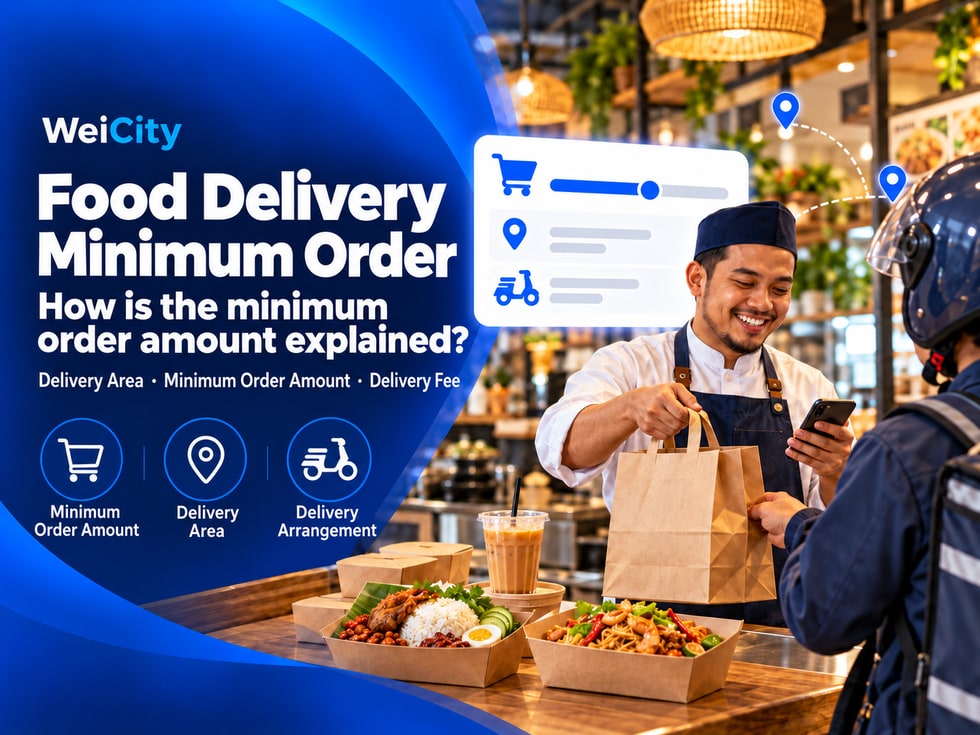
When customersplan to order delivery, they often check a few questions first:
🔸 Can this restaurant deliver to my area?
🔸 What is the minimum amount I need to order?
🔸 How much is the delivery fee?
🔸 Can I still place an order if I don't reach the minimum amount?
🔸 Does the delivery minimum order amount include the delivery fee?
🔸 Can I add more items or extras to reach the minimum order amount?
If these conditions are not clearly explained, customers may find after choosing their food that their order does not meet the requirements, which may require them to reselect items or cancel the order.
📋 The WeiCity Online Ordering feature supports setting a minimum order amount for orders. Merchants can use menus and delivery notes together to clearly state delivery requirements in advance, so customers understand the order conditions before they place an order.
The delivery minimum order amount (Minimum Order Amount) is the minimum food amount that a customer's selected items must reach, as set by the merchant, for the order to meet the corresponding delivery conditions.
For example:
🍱 Merchant-set delivery minimum order amount: RM20.
🍜 Customer's selected items: RM15.
❌ The food amount does not reach the RM20 minimum order requirement.
If the customer adds another item priced at RM6:
🍜 Original items: RM15.
🥚 Added item: RM6.
💰 Food amount: RM21.
✅ Meets the RM20 delivery minimum order requirement.
The above is only a calculation example. Whether an order can be submitted, and which items count toward the minimum order amount, should be determined according to the platform's order calculation rules and the merchant's settings.
Note that the minimum order amount and the delivery fee are different items.
🔸 Minimum order amount
The minimum food order amount that must be reached.
🔸 Delivery fee
The delivery charge that the merchant or delivery arrangement may collect.
🔸 Food price
The amount for the dishes and add-ons the customer selects.
Merchants should explain these charges separately to avoid customers mistaking the minimum order amount for the delivery fee or the total order amount.
The minimum order amount should be set according to the merchant's actual operations and delivery arrangements.
It does not necessarily need to copy the amounts of other food platforms or nearby restaurants.
Consider the following factors first.
✅ Delivery area
Distances and delivery arrangements may differ across areas.
✅ Food prices
Review the typical amounts for common single-person or multi-person orders.
✅ Food preparation capacity
Estimate the order volume the store can prepare and dispatch consistently.
✅ Delivery arrangements
Understand whether delivery is handled by the merchant itself, a third-party provider, or another method.
✅ Customer needs
Consider the dishes and portion sizes nearby customers usually buy.
✅ Delivery costs
Estimate rider, transport, packaging, and other related costs.
For example, a restaurant mainly sells single-person sets priced between RM10 and RM15.
If the minimum order amount is set too high, single-person customers may need to buy extra items they do not need in order to meet the delivery requirement.
Conversely, if the merchant's delivery costs are high, a minimum order amount that is too low may make it difficult for some orders to maintain reasonable profit.
A suitable minimum order amount needs to consider the merchant's costs, actual delivery capacity, and customer purchasing habits at the same time.
Customers are best able to see key delivery requirements before choosing their food.
Merchants can organize delivery information into short, specific content.
🛵 Delivery area
State the areas or range where delivery is available.
💰 Minimum order amount
Clearly indicate the minimum amount required for delivery orders.
🚚 Delivery fee
Explain whether the fee is charged separately and how customers can confirm the fee.
⏰ Delivery time
List the time periods when orders are accepted or the expected arrangements.
📱 Contact details
Provide contact methods customers can use if they have questions about their orders.
For example:
📍 Delivery area: Designated areas in George Town.
💰 Minimum order amount: RM20.
🚚 Delivery fee: Explained separately based on delivery location.
⏰ Order acceptance hours: Daily from 12:00 p.m. to 8:00 p.m.
📱 Contact: Reach out via the phone number or WhatsApp provided by the merchant.
If the minimum order amount or delivery fee differs between areas, list the applicable areas and conditions separately.
Also, confirm whether WeiCity's current minimum order amount settings support configuring different amounts by delivery area. If they do not yet, clearly explain the actual rules so customers are not misled.
The following is only an example to illustrate the format. Merchants should replace it with their own actual arrangements.
🏪 Restaurant name
Example: George Town Family Restaurant.
🛵 Delivery range
Designated delivery areas in George Town.
💰 Delivery minimum order amount
RM20.
🚚 Delivery fee
Explained separately based on delivery location.
⏰ Order acceptance hours
Daily from 12:00 p.m. to 8:00 p.m.
📱 Order confirmation
After submitting an order, please watch for the merchant's confirmation message.
Suppose the customer selects:
🍗 Chicken chop rice: RM12.90.
🥤 Drink: RM4.00.
💰 Food amount: RM16.90.
Since the food amount is below RM20, it does not yet meet the minimum order requirement in this example.
If the customer adds:
🍟 Snack: RM5.00.
💰 Updated food amount: RM21.90.
✅ Meets the RM20 delivery minimum order requirement.
If the delivery fee is calculated separately, it should be explained to the customer at an appropriate stage.
After reviewing this information, customers can first judge whether their order meets the delivery conditions.
After receiving an order, merchants can check the following items according to their in-store process.
✅ Food amount
Whether the food amount the customer selected reaches the minimum order amount.
✅ Delivery address
Whether it is within the service area provided by the merchant.
✅ Dishes and add-ons
Confirm that the dish names, quantities, and related options are correct.
✅ Delivery fee
Whether the related fees have been explained to the customer.
✅ Delivery arrangement
Whether the expected delivery arrangement matches the current order volume.
✅ Special requests
Whether the customer's special requests can be accommodated.
If an order does not meet the delivery conditions, contact the customer as early as possible to explain the reason and inform them of available options.
For example:
🔸 Add other items.
🔸 Adjust the quantity ordered.
🔸 Where applicable, switch to in-store pickup.
🔸 Handle order cancellation according to the merchant's actual policy.
Merchants should avoid adding a minimum spending requirement at the last minute, after a customer has already submitted an order, when it was not explained in advance.
Business hours, delivery areas, and food prices may change.
For example:
📍 The restaurant changes its delivery area.
💰 The merchant adjusts the minimum order amount.
🚚 The delivery fee changes.
⏰ Order acceptance hours change during holidays.
🍱 Some food prices are adjusted.
After changing conditions, merchants should update the related information on the online ordering page at the same time.
📌 After adjusting the minimum order amount, check whether the menu page shows the latest amount.
📌 When delivery to certain areas is paused, update the delivery area information promptly.
📌 When delivery arrangements change for holidays or special time periods, publish a notice in advance.
📌 After updating food prices, check that order amounts and minimum order conditions are consistent.
📌 If different areas have different delivery requirements, make sure customers can easily find the correct information.
Keeping menus and delivery information consistent can reduce cases where customers place orders based on outdated information.
For food merchants, customers need more than photos of dishes before placing an order.
They also want to know prices, delivery areas, minimum order amounts, and contact methods.
Through the WeiCity merchant channel and Online Ordering feature, merchants can present this information in one place.
🍽️ Display an online menu
Let customers see dish names, images, prices, and descriptions.
🥚 Explain menu options
Based on the actual features and merchant settings, display flavors, add-ons, and any additional fees.
💰 Set a Minimum Online Ordering Amount
Configure the applicable minimum order amount according to the features currently offered by the platform.
🛵 Describe Delivery Arrangements
Explain the delivery areas, fees, and service conditions the merchant actually offers.
📱 Provide contact information
Let customers contact the merchant for further information if they have questions.
🔗 Share Your Merchant Channel
Share your restaurant introduction and ordering entry on Facebook, WhatsApp, or other suitable channels.
For example, a restaurant in Penang can focus on introducing:
🍗 Signature chicken chop rice.
🍜 Noodle set meals.
🥤 Drinks and snacks.
💰 Minimum delivery order amount.
🛵 Delivery area.
📱 Ordering contact details.
In this way, after seeing the dishes, customers can learn more about the relevant ordering requirements without repeatedly asking for basic information.
Please note that how the minimum amount is calculated, whether submission is restricted when the threshold is not met, and how delivery fees are calculated should follow the rules that WeiCity currently officially has in effect.
Some customers and food business operators search Google for questions related to delivery fees.
For example:
🔍 Minimum Order Amount for Delivery.
🔍 Food Delivery Minimum Order Malaysia.
🔍 Restaurant Delivery Charges Malaysia.
🔍 Restaurant delivery minimum order.
🔍 Minimum takeaway order amount.
🔍 Malaysia restaurant delivery.
🔍 Online Food Ordering Malaysia.
Therefore, merchants can clearly state the actual conditions in their ordering introduction.
For example:
❌ Delivery service, order now.
✅ George Town restaurant delivery | Minimum order RM20 and delivery area details.
❌ Online ordering.
✅ Restaurant online ordering | View menu, minimum order amount, and delivery fees.
Suggested page contents:
✅ A clear restaurant name.
✅ The actual service area.
✅ Menu and dish prices.
✅ Minimum order amount.
✅ Explanation of delivery fees.
✅ Order acceptance and delivery times.
✅ Contact and ordering methods.
This information helps potential customers understand the merchant's service and helps search engines determine the topic of the page.
However, whether Google indexes and displays the relevant page also depends on how open the web page is, technical settings, content quality, and actual search competition.
If you run a restaurant, café, snack shop, or other food business, you can prepare by following these steps.
✅ Step 1: Organize the dishes and prices you currently offer.
✅ Step 2: Understand the typical customer order amounts.
✅ Step 3: Confirm your actual delivery area.
✅ Step 4: Estimate delivery and packaging costs.
✅ Step 5: Choose a suitable minimum order amount.
✅ Step 6: Clearly state whether delivery fees are charged separately.
✅ Step 7: Check WeiCity's current minimum order setting rules.
✅ Step 8: Prepare a clear explanation of delivery conditions.
✅ Step 9: Test orders below the minimum amount.
✅ Step 10: Test orders that meet the minimum amount.
✅ Step 11: Confirm that customers can understand the relevant restrictions.
✅ Step 12: Regularly review the minimum order amount and your actual delivery arrangements.
For example, a merchant can first select several common set meals and test how many dishes customers need to buy to reach the minimum order amount.
If the minimum amount does not match the spending habits of your main customer group, you can reassess it based on actual costs and order conditions.
For food merchants that offer delivery services, the minimum order amount is an important operating condition.
However, a higher minimum order amount is not always better, and a lower one does not necessarily attract more customers.
What matters more is that it matches the merchant's actual delivery costs and customer needs.
Merchants should make sure customers clearly understand the following before placing an order:
💰 The minimum amount that must be ordered.
🛵 Which areas can be delivered to.
🚚 Whether delivery fees are calculated separately.
🍱 How dishes and add-ons are priced.
⏰ When orders are accepted.
📱 How to contact the merchant if they have questions.
With WeiCity online ordering, merchants can display their menu and set a minimum online ordering amount. Combined with clear delivery instructions, customers can understand delivery arrangements, and merchants can process orders more easily.
🌐 WeiCity | Help customers understand menus and delivery conditions, making online ordering clearer and more convenient.
🛵 Start by organizing your delivery area and minimum order conditions so customers know what requirements to meet before placing an order.